


The Tech World Pavilion, originally built by Taiwan for last year’s World Expo in Osaka, Japan, is to be recreated and displayed at the Taiwan Lantern Festival in Chiayi County next month, the Executive Yuan said yesterday.
The pavilion is being brought back to Taiwan to give local audiences access to an exhibition linking technology, nature and culture, with Chiayi selected because the pavilion’s “Nature Theater” was inspired by Yushan (Jade Mountain, 玉山), Premier Cho Jung-tai (卓榮泰) told a news conference.
The pavilion, which attracted 1.16 million visitors during last year’s expo, features three immersive zones: the Life Theater, which highlights Taiwan’s ecological resilience through kinetic LED installations; the Nature Theater, which uses 3D technology to recreate landscapes such as Jiaming Lake (嘉明湖); and the Future Theater, which showcases Taiwan’s role in the global semiconductor supply chain using high-resolution Mini LED displays, the Ministry of Economic Affairs said.
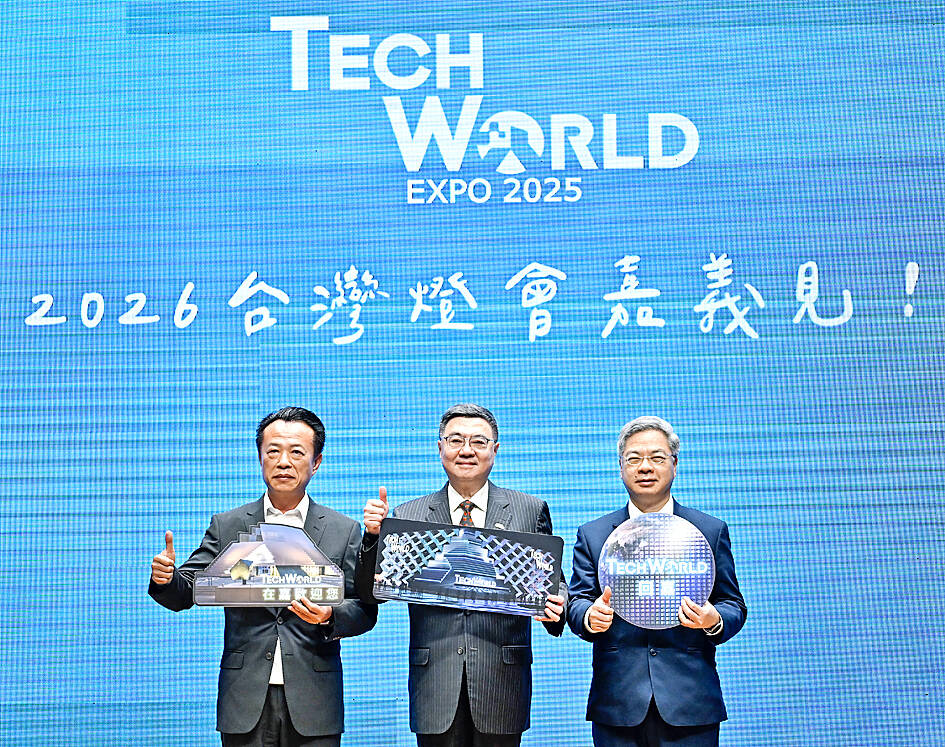
Photo: Chen Chih-chu, Taipei Times
The decision to display the pavilion at the Taiwan Lantern Festival in Chiayi County was made after scouting 30 sites in northern, central and southern Taiwan, and taking into account festivities and other factors, International Trade Administration Director-General William Liu (劉威廉) said.
The pavilion is to open to visitors on March 1, two days ahead of the opening of the Taiwan Lantern Festival, to accommodate more visitors, Taiwan External Trade Development Council chairman James Huang (黃志芳) said.
Both the festival and exhibition at the pavilion are to end on March 15, he added.
“The pavilion’s exterior might not be exactly the same as that at the World Expo, but it would nevertheless capture the look and feel of the original design. The exhibits at the three theaters will be presented as faithfully as possible,” Huang said.
International Trade Administration Deputy Director Susan Hu (胡啟娟) said that all pavilions at the Osaka expo had to be fully dismantled after the exhibition ended, and the construction materials recycled.
However, the pavilion’s exhibition would be recreated using advanced technology, she said, adding that starting today, people can start making online reservations to visit the pavilion.
Funding for the reconstruction of the pavilion, estimated at NT$80 million to NT$90 million (US$2.5 million to US$2.9 million), would come from the remaining funds from building the original pavilion and financial support from the Executive Yuan, Hu said.
This year’s Taiwan Lantern Festival is to feature “Light of Alishan — A World of Illumination,” as its main lantern, performances by domestic and international groups, such as Aomori Nebuta Festival, Irish step-dancing, Paper Windmill Theater and Ming Hwa Yuan, as well as fireworks and drone shows.

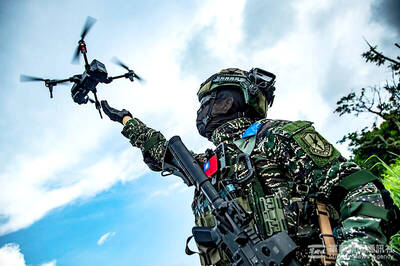
RESILIENCE: Taiwan plays a key role in semiconductors, energy, information infrastructure and advanced manufacturing, AIT Director Raymond Greene said Taiwan’s continued investment in deterrence and resilience remains vital, especially in uncrewed systems and other emerging technologies, American Institute in Taiwan (AIT) Director Raymond Greene said yesterday. Greene made the remarks at the annual National Strategic Summit on Supply Chain Resilience held by the Research Institute for Democracy, Society and Emerging Technology (DSET), a government-backed think tank. As Taiwan last year became the US’ fourth-largest trading partner and supply chain security is becoming more important, cooperation in emerging technologies continues to deepen between the two countries, he said. The US is committed to accelerating innovation, building key infrastructure, strengthening cooperation

The National Chungshan Institute of Science and Technology yesterday showcased its locally developed variants of the Vision 60 robotic patrol dog, which it plans to deploy on the nation’s outlying territories in the South China Sea. The variants were produced under the Joint Lab project — created by the institute and domestic companies — and assembled with domestically produced motors, lenses and artificial intelligence (AI) systems alongside licensed tech from the US, Missile and Rocket Systems Research Division deputy director Jen Kuo-kang (任國光) told the media event at a military base in Taipei’s Dazhi (大直) area. Taiwan has built up its strengths

RIGHT DIRECTION: Taiwan’s efforts to prevent forced labor include a proposal to ‘fully prohibit’ employers from withholding workers’ documents, an official said Taiwan is to establish a mechanism to restrict imports of goods linked to forced labor, the Executive Yuan said yesterday, after the US proposed imposing additional tariffs on Taiwanese goods over labor concerns. “The Ministry of Labor and the Ministry of Economic Affairs are to establish an interministerial review procedure,” Executive Yuan spokesperson Michelle Lee (李慧芝) said at a news briefing in Taipei. “The government is to use the Foreign Trade Act [貿易法] as the legal basis to restrict imports of goods produced with forced labor” and bring its supply chain governance more in line with international standards on human rights, resilience

NOT IMMEDIATE: Taiwan has a chance to appeal the proposed 10 percent tariff before it starts, while other countries face a 12.5 percent tariff from the trade office Taiwan is among 60 economies determined by the US to have failed to impose or enforce a ban on the importation of goods produced with forced labor, according to a notice released on Tuesday by the Office of the US Trade Representative (USTR), which proposed imposing an additional 10 percent or more tariff on them. The USTR in a statement said that following an investigation, it had determined under Section 301 of the Trade Act of 1974 that the failure of the 60 economies to impose and effectively enforce a prohibition on the importation of goods produced with forced labor is


 RSS
RSS