


Taiwan must look to fellow democracies, not China, for trade and economic cooperation, President William Lai (賴清德) said yesterday, as his government mapped out how the nation plans to work with the US in areas such as artificial intelligence (AI) and critical minerals.
Senior Taiwanese and US officials last week discussed cooperation in AI, technology and drones at a high-level forum launched during the first administration of US President Donald Trump, with the US Department of State praising Taiwan as a “vital partner.”
The two sides signed statements on cooperation on economic security and on the Pax Silica Declaration — a US-led initiative aimed at securing AI and semiconductor supply chains amid intense competition from Beijing, Washington’s main strategic rival.
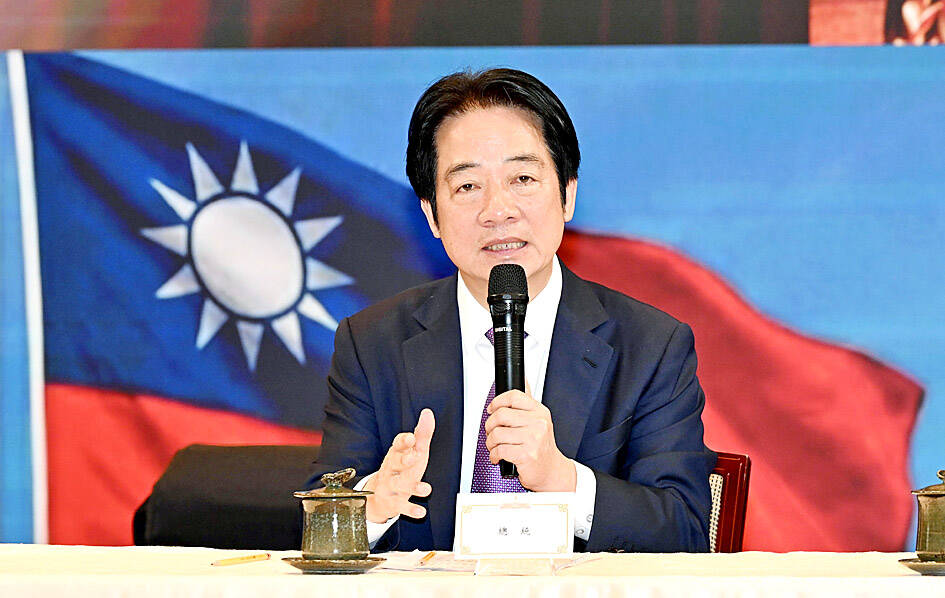
Photo: Luo Pei-de, Taipei Times
Speaking at a news conference at the Presidential Office in Taipei about the US-Taiwan Economic Prosperity Partnership Dialogue, Lai lauded the outcome of those talks.
“Taiwan is on the right economic path and is striding confidently onto the world stage. Taiwan has both the capability and the confidence to work with its democratic partners to lead the next generation of prosperity,” Lai said.
Lai was speaking Chinese Nationalist Party (KMT) Deputy Chairman Hsiao Hsu-tsen (蕭旭岑) was in Beijing for a think tank exchange with the Chinese Communist Party (CCP) on ostensibly nonpolitical issues such as AI and tourism.
Lai said Taiwan’s opposition “had their own positions,” and pointed to the differences of Taiwan’s slower economic growth under the previous KMT government, which signed a landmark trade deal with China, and much faster growth since the Democratic Progressive Party took office in 2016.
“Do we want to continue collaborating with the US, Japan, Europe and other allied nations, or again lock ourselves into China?” he asked.
In response to media queries about KMT-CCP exchanges, Lai said that the news conference was not specifically aimed at the KMT’s cross-strait initiatives, but it does provide a contrast for the public to clearly distinguish between the economic strategies.
“Is the Democratic Progressive Party government’s current approach — working closely with the US and allied nations to engage internationally — more beneficial to Taiwan’s economy? Or is the opposition’s push for a ‘second go west [of Taiwan to China]’ better for Taiwan’s economic development?” Lai asked.
Lai said that this comparison allows the public to assess the economic growth rates from the past year, as well as the eight years under his predecessor, former president Tsai Ing-wen (蔡英文), compared with the eight years under former president Ma Ying-jeou (馬英九) of the KMT, to determine which approach has been more effective.
The DPP government not only values its international relations with the US and other nations, but also places great importance on cross-strait relations, he said.
Lai said that after assuming the presidency, he had spoken of his desire to promote cooperation through exchanges and dialogue, with the goal of achieving peaceful coexistence and mutual prosperity.
Taiwan is eager to engage in exchanges and cooperation with China on the basis of equality and dignity, he said, adding that this has been cross-strait policy for nearly a decade from Tsai’s administration to his government, with a continued commitment to goodwill.
Additional reporting by Chen Yun
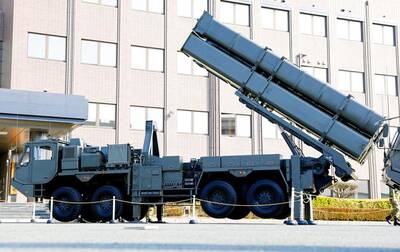
Japan has deployed long-range missiles in a southwestern region near China, the Japanese defense minister said yesterday, at a time when ties with Beijing are at their lowest in recent years. The missiles were installed in Kumamoto in the southern region of Kyushu, as Japan is attempting to shore up its military capacity as China steps up naval activity in the East China Sea. “Standoff defense capabilities enable us to counter the threat of enemy forces attempting to invade our country ... while ensuring the safety of our personnel,” Japanese Minister of Defense Shinjiro Koizumi said. “This is an extremely important initiative for
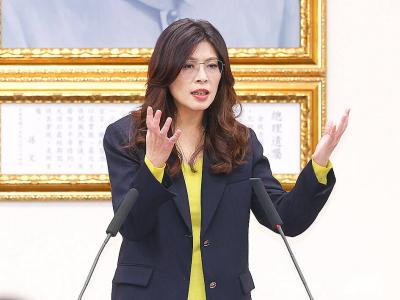
Chinese Nationalist Party (KMT) Chairwoman Cheng Li-wun (鄭麗文) today accepted an invitation from Chinese President Xi Jinping (習近平) to lead a delegation to China next month, saying she hopes to promote the peaceful development of cross-strait relations and bring stability to the Taiwan Strait. “I am grateful and happy to accept this invitation,” Cheng said in a statement from the KMT chairperson’s office. Cheng said she hopes both sides can work together to promote the peaceful development of cross-strait relations, enhance exchange and cooperation, bring stability to the Taiwan Strait and improve people’s livelihoods. At today's news conference, Cheng said any efforts to
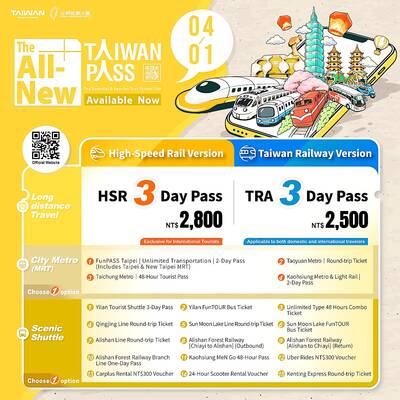
MORE POPULAR: Taiwan Pass sales increased by 59 percent during the first quarter compared with the same period last year, the Tourism Administration said The Tourism Administration yesterday said that it has streamlined the Taiwan Pass, with two versions available for purchase beginning today. The tourism agency has made the pass available to international tourists since 2024, allowing them to access the high-speed rail, Taiwan Railway Corp services, four MRT systems and four Taiwan Tourist Shuttles. Previously, five types of Taiwan Pass were available, but some tourists have said that the offerings were too complicated. The agency said only two types of Taiwan Pass would be available, starting from a three-day pass with the high-speed rail and a three-day pass with Taiwan Railway Corp. The former costs NT$2,800

The nation’s fastest supercomputer, Nano 4 (晶創26), is scheduled to be launched in the third quarter, and would be used to train large language models in finance and national defense sectors, the National Center for High-Performance Computing (NCHC) said. The supercomputer, which would operate at about 86.05 petaflops, is being tested at a new cloud computing center in the Southern Taiwan Science Park in Tainan. The exterior of the server cabinet features chip circuitry patterns overlaid with a map of Taiwan, highlighting the nation’s central position in the semiconductor industry. The center also houses Taiwania 2, Taiwania 3, Forerunner 1 and


 RSS
RSS