


Japanese Prime Minister Sanae Takaichi’s party is likely to score a landslide victory in next week’s lower house election, a survey by the Asahi newspaper showed, heightening the chance that the country would continue to pursue big spending and tax cuts.
A strong showing in Sunday’s election would solidify Takaichi’s grip on her party and give a mandate for her expansionary fiscal policy, which could heighten concerns about Japan’s finances and push bond yields higher.
“Implementing expansionary fiscal policy at a time the economy is at near full employment would heighten inflationary pressure” and weaken the yen, BNP Paribas chief Japan economist Ryutaro Kono said.
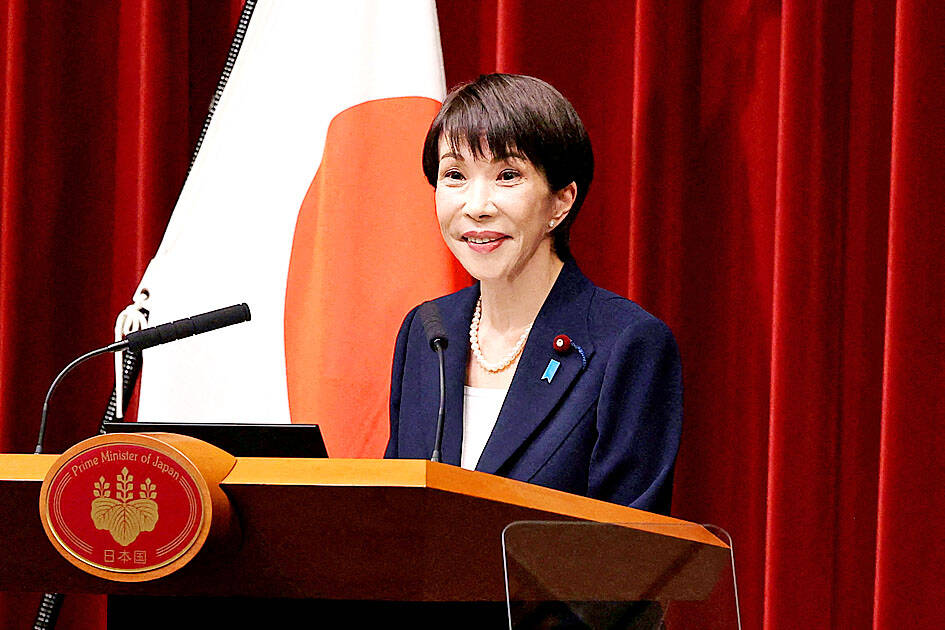
Photo: Reuters
“The Bank of Japan may be forced to accelerate the pace of interest rate hikes to combat the weak yen and inflationary pressures from expansionary fiscal policy,” he said.
Takaichi’s Liberal Democratic Party (LDP) is likely to well exceed a majority of 233 seats out of 465 seats up for grabs in the lower house, according to the poll released on Sunday. That would be an increase from 198 seats now.
Together with the LDP’s coalition partner, the Japan Innovation Party, the ruling alliance would likely reach 300 seats, the poll showed.
The largest opposition party, the Centrist Reform Alliance, is struggling and could lose half its 167 seats, the poll showed.
Super-long Japanese government bond yields, which are sensitive to fiscal risks, rose yesterday as investors priced in the chance that Takaichi would push through her “proactive” fiscal policy focused on bigger spending and tax cuts.
The yen wobbled after Takaichi’s weekend comments, in which she talked up the benefits of a weaker currency.
“People say the weak yen is bad right now, but for export industries, it’s a major opportunity,” Takaichi said on Saturday, adding that the currency’s decline would boost the value of Japan’s huge foreign reserves.
A government spokesperson yesterday said that Takaichi was not highlighting the benefits of a weak yen, and instead stressing the need to create an economic structure resilient to currency fluctuations.
A weak yen has been a source of headache for Japanese policymakers as it pushes up import costs and broader inflation.
Japan suffered a broad market rout last month after Takaichi pledged to suspend an 8 percent levy on food sales for two years, reviving investor concerns about fiscal discipline in a nation with public debt more than twice the size of its economy.
Most parties have also called for a suspension or a cut to the consumption tax to cushion the blow to households from rising living costs.
Some analysts say a strong LDP win could actually prevent Japan from resorting to extreme tax cuts or spending plans proposed by some opposition parties.
In its campaign pledge, the LDP clearly commits to reducing Japan’s debt-to-GDP ratio, and pursuing expenditure and revenue reforms, Morgan Stanley MUFG Securities chief Japan economist Takeshi Yamaguchi said.
“Our view that excessive concern over Japan’s fiscal position is unnecessary remains unchanged,” he said.

A signaling system malfunction disrupted high-speed rail (HSR) services beginning at 8am today, with trains temporarily reduced to three northbound and three southbound trains per hour as authorities conduct inspections. The malfunction occurred on a section of track in Miaoli County during pre-operation checks early this morning, forcing northbound and southbound trains to use a single track, the HSR operator said. The regular schedule has been replaced with three hourly trains offering only nonreserved seating in each direction, stopping at every station, it said, adding that business class cars would still have reserved seating. Departures from terminal stations are scheduled at the top

Taiwan is still in the process of assessing the possibility of recruiting workers from Eswatini, the Ministry of Foreign Affairs said yesterday, adding that its goal is to help Eswatini upgrade its vocational training centers. If there are plans to recruit workers from Eswatini, safeguarding national security, protecting public health and ensuring the employment rights of Taiwanese would be prerequisites, Department of West Asian and African Affairs Director-General Yen Chia-liang (顏嘉良) told a news conference. Key considerations would also include filling labor shortages in specific industries, and fostering bilateral professional and technical exchanges, he said. Yen was asked about the progress of labor

VERBOSE VESSELS: A CGA cutter and a China Coast Guard exchanged verbal barbs for more than a day in Taiwanese-controlled waters before the Chinese vessel left The Taiwanese and Chinese coast guards had a standoff near the strategically located Pratas Islands (Dongsha Islands, 東沙群島) in the north of the South China Sea, the Coast Guard Administration (CGA) said yesterday. The two sides engaged in intense radio exchanges over sovereignty claims during the 33-hour standoff. China Coast Guard vessel 3501 eventually left the restricted waters, 26.6 nautical miles (49.2km) west of the Pratas Islands, at 5pm yesterday, the CGA said. Lying approximately between southern Taiwan and Hong Kong, the Taiwan-controlled Pratas are seen by some security experts as vulnerable to Chinese attack due to their distance — more than

A US uncrewed surface vessel (USV) encountered multiple Chinese warships during an autonomous transit of the Taiwan Strait, US defense company Seasats said in a statement on Wednesday. Seasats announced that a Lightfish USV had completed the first autonomous transit of the Taiwan Strait. Over five days, the USV traversed the entire length of the Strait while constantly monitoring surface vessel traffic, the company said. The Lightfish encountered multiple Chinese warships, one of which was a Chinese People’s Liberation Army Navy (PLAN) Type 056 corvette, it said. The Chinese vessels were operating “well within Taiwan’s exclusive economic zone without transmitting their identity via the


 RSS
RSS