


The Centers for Disease Control (CDC) yesterday warned of a higher risk of hantavirus infection this spring, after Taiwan’s first hantavirus-related death in 26 years was confirmed in Taipei.
The person who died was a man in his 70s, a resident of Daan District (大安), the CDC said.
The man was hospitalized after showing symptoms including fever, gastrointestinal discomfort and shortness of breath, it said, adding that he passed away on Jan. 13, eight days after he became ill, from sepsis complicated by multiple organ failure and pneumonia.
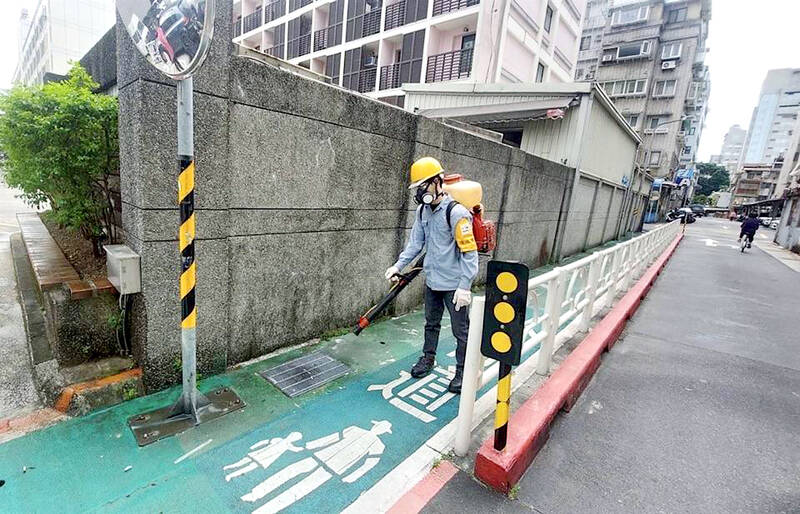
Photo courtesy of the Taipei Department of Health
Agency data showed that as of yesterday, there had been 44 hantavirus cases since 2017, CDC Deputy Director-General Lin Min-cheng (林明誠) said.
The disease is primarily spread by rodents.
Cases were most prevalent in January in each of those years — eight in the month since 2017 — Lin said, adding that figures for March to May were also above average.
Of the 44 cases, 29 were men and 15 were women, while 32 were aged 30 to 59, or nearly 75 percent, he said.
Mice reproduce throughout the year, but populations tend to be larger in spring, he said.
Hantavirus infection is highly correlated to exposure at workplaces, Lin said.
For example, many of the people diagnosed with the disease worked at traditional markets or in related businesses, which increases the chances of being exposed to rodents, Lin said.
Moreover, mice are a key vector of hantaviruses and have become highly adapted to densely populated urban environments, he said.
Vector control measures and personal protection are important to prevent hantavirus infection, he said.
People must wear a mask when they engage in spring cleaning — indoors and outdoors — which is a typical activity around the Lunar New Year holiday, to protect themselves from inhaling air carrying the pathogen, he said.
If rodent droppings or urine are found, bleach should be applied to the area before they are removed, Lin said, adding that people should wait 30 minutes after applying the bleach before cleaning to give the disinfectant enough time to take full effect.
Cleaning tools, such as rags, mops, brooms and brushes, must be disinfected before being used again after they are exposed to rodent droppings, he said.
People should follow the “three noes” principle of “no food, no habitat, no entry” for rodents in homes, Lin said.
Sewer rats, roof rats and house mice are the most common rat and mouse species in Taiwan, National Taiwan University Department of Entomology professor emeritus Hsu Err-lieh (徐爾烈) said.
Despite their poor vision, rodents have extremely sensitive senses of smell, hearing and touch, and are excellent learners and burrowers, Hsu said.
Rats can use holes with a diameter of 2cm — about the size of a NT$10 coin — while house mice can use even smaller holes, he said.
Holes, cracks and ventilation ducts must be sealed or blocked if they are wider than 2cm to ensure there is no entry point for rodents, he said, adding that food should be kept in sealed glass or metal containers.
Storage spaces should be kept clean and uncluttered to help avoid rat infestations, he added.
Physical controls are preferred to chemical controls when dealing with rodents at home, Hsu said.
Chemical measures should be the last resort and must be kept out of reach of pets and children, he said.
Dead rodents should be wrapped in two trash bags and clearly labeled so trash collection personnel can identify the contents, the Ministry of the Environment said.
Additional reporting by CNA

A signaling system malfunction disrupted high-speed rail (HSR) services beginning at 8am today, with trains temporarily reduced to three northbound and three southbound trains per hour as authorities conduct inspections. The malfunction occurred on a section of track in Miaoli County during pre-operation checks early this morning, forcing northbound and southbound trains to use a single track, the HSR operator said. The regular schedule has been replaced with three hourly trains offering only nonreserved seating in each direction, stopping at every station, it said, adding that business class cars would still have reserved seating. Departures from terminal stations are scheduled at the top

DRONE CENTRAL: Taiwan aims to become Asia’s democratic hub for drones, with most exports focused on high-quality military-grade models, an official said Taiwan’s drone industry is expected to expand significantly by 2030, producing 100,000 units per month and exporting half of them, the Ministry of Economic Affairs said yesterday. Current drone production capacity is about 15,000 units per month, but the industry can quickly scale up as demand increases, Industrial Development Administration Director-General Chiou Chyou-huey (邱求慧) told a news conference in Taipei. Taiwan’s drone output grew 2.5-fold last year to NT$12.9 billion (US$408.3 million) under a government program to develop the uncrewed vehicle sector, he said. The Executive Yuan in October last year approved plans to invest NT$44.2 billion into domestic production of uncrewed aerial

VERBOSE VESSELS: A CGA cutter and a China Coast Guard exchanged verbal barbs for more than a day in Taiwanese-controlled waters before the Chinese vessel left The Taiwanese and Chinese coast guards had a standoff near the strategically located Pratas Islands (Dongsha Islands, 東沙群島) in the north of the South China Sea, the Coast Guard Administration (CGA) said yesterday. The two sides engaged in intense radio exchanges over sovereignty claims during the 33-hour standoff. China Coast Guard vessel 3501 eventually left the restricted waters, 26.6 nautical miles (49.2km) west of the Pratas Islands, at 5pm yesterday, the CGA said. Lying approximately between southern Taiwan and Hong Kong, the Taiwan-controlled Pratas are seen by some security experts as vulnerable to Chinese attack due to their distance — more than
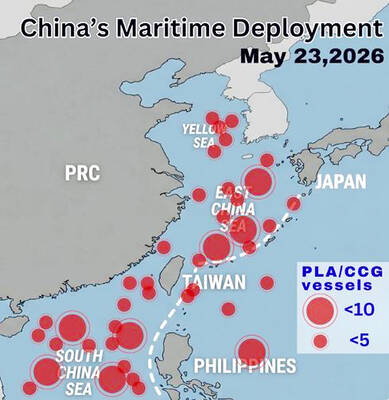
WARNING: China should stop engaging in actions that undermine regional peace and stability, as it would only build resentment among people across the Strait, the CGA said China has deployed more than 100 navy, coast guard and other vessels in waters from the Yellow Sea to the South China Sea and the western Pacific since US President Donald Trump and Chinese President Xi Jinping (習近平) met in Beijing, National Security Council Secretary-General Joseph Wu (吳釗燮) said yesterday. “In this part of the world, #China is the one & only PROBLEM wrecking the #StatusQuo & threatening regional peace & stability,” Wu wrote on X. In a separate post, he said Beijing was coercing Taiwan’s maritime domain, calling it illegal and provocative, after the Coast Guard Administration (CGA) expelled a


 RSS
RSS