


The Legislative Yuan sent the Taiwan People’s Party’s (TPP) defense bill to committee for review today, after continuing to block the Executive Yuan’s NT$1.25 trillion (US$39.52 billion) special defense budget.
The opposition again blocked the Executive Yuan’s eight-year special defense budget during the Procedure Committee’s meeting on Tuesday, preventing it from being added to the Legislative Yuan’s agenda for today’s meeting.
The Legislative Yuan was set to review amendments to the Housing Act (住宅法), Satellite Broadcasting Act (衛星廣播電視法) and the Act Governing the Settlement of Ill-gotten Properties by Political Parties and Their Affiliate Organizations (政黨及其附隨組織不當取得財產處理條例) when it convened this afternoon.
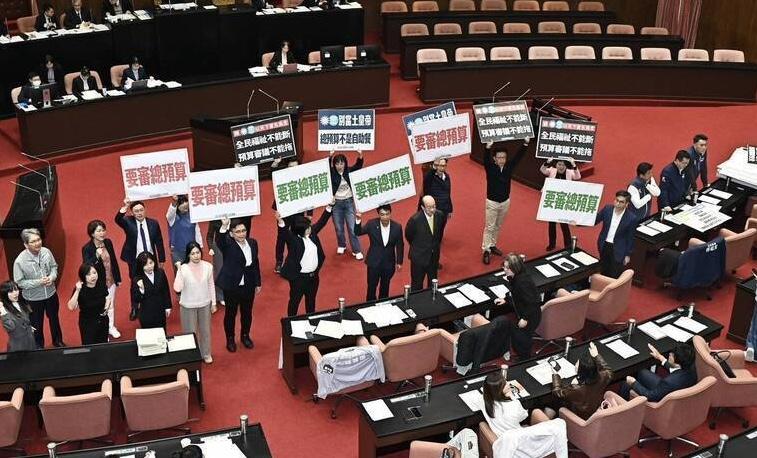
Photo: Tu Chien-jung, Taipei Times
The Democratic Progressive Party caucus proposed adding a review of the Executive Yuan’s special defense budget, but the opposition parties blocked it with their majority.
Under the opposition’s majority, the legislature then voted to send the TPP’s proposed “national security and asymmetric warfare procurement bill” to committee review.
The TPP’s proposal lists five items, including the High Mobility Artillery Rocket System (HIMARS), with total spending of NT$400 billion to be budgeted on an annual basis.
It allocates NT$126.7 billion for 60 M109A7 self-propelled howitzers along with 4,080 rounds of precision munitions, and NT$127.6 billion for 82 HIMARS multiple rocket missile systems.
It also covers anti-armor loitering munition systems, capped at NT$34.7 billion, 70 Javelin anti-armor missile launchers and 1,050 missiles, capped at NT$11.8 billion, and 24 TOW 2B anti-armor missile launchers and 1,545 missiles, capped at NT$11.1 billion.
Several preapproved US weapons sales present in the Cabinet's special budget are omitted, including US$1.01 billion for tactical mission network software, US$96 million for AH-1W helicopter parts and US$91.4 million for Harpoon missile support.
Funding for partnerships with the local arms industry, procurement of 200,000 drones, and the T-Dome multilayered air defense system are also absent.
The Executive Yuan’s version allocates NT$1.25 trillion to strengthen asymmetric warfare capabilities over eight years.
Repeatedly blocking the Executive Yuan’s special defense budget ignores the nation’s true needs, delaying national defense development and hindering joint operations, Executive Yuan spokesperson Michelle Lee (李慧芝) said.
The TPP’s proposed budget merely copies information made public by the Ministry of National Defense (MND) and cuts up the Executive Yuan’s version, Lee said.
It lacks strategic vision, military development planning, contradicts military procurement procedures and overlooks self-defense, she said.
It also threatens to obstruct arms purchases from the US and impact Taiwan’s sustainable combat capabilities, she added.
The MND previously said that the TPP’s proposal would only procure part of the necessary equipment and lacks supporting measures, which would make it hard to implement and may have serious long-term repercussions.
The Executive Yuan’s proposed budget was made through close communication with the US, Lee said, adding that it includes a comprehensive strategy and military development plan, aligns with procurement procedures and would enhance Taiwan’s self-defense capabilities.
As the TPP’s proposal lacks these elements, the Executive Yuan’s budget must be sent to committee review to truly build Taiwan’s national defense, she said.
The legislature has repeatedly blocked a review of the Cabinet's special defense budget since President William Lai (賴清德) announced it in November last year, with the opposition demanding that Lai first brief lawmakers and take questions on the proposal — a request Lai has rejected.

‘NO SECURITY RISK’: The Railway Bureau reassured the public that the technicians’ activities were limited to technical guidance and did not involve sensitive systems The Railway Bureau yesterday said it had invited eight Chinese technicians to assist with an airport MRT construction project. The bureau issued the confirmation after an Internet user said Chinese nationals had entered the construction zone of Taiwan Taoyuan International Airport’s Terminal 3 project. They asked why “individuals from an enemy state” were allowed access to such a major national infrastructure project, which raised serious concerns over Taiwan’s industrial safety, sensitive systems and information security. The bureau’s Northern Region Engineering Branch Office said subcontractor Taiwan Handle Industrial Co (台灣手把工業) of the Taoyuan airport MRT’s “Contract No. CU05 Project A14 Station Civil, MEP &

A US uncrewed surface vessel (USV) encountered multiple Chinese warships during an autonomous transit of the Taiwan Strait, US defense company Seasats said in a statement on Wednesday. Seasats announced that a Lightfish USV had completed the first autonomous transit of the Taiwan Strait. Over five days, the USV traversed the entire length of the Strait while constantly monitoring surface vessel traffic, the company said. The Lightfish encountered multiple Chinese warships, one of which was a Chinese People’s Liberation Army Navy (PLAN) Type 056 corvette, it said. The Chinese vessels were operating “well within Taiwan’s exclusive economic zone without transmitting their identity via the
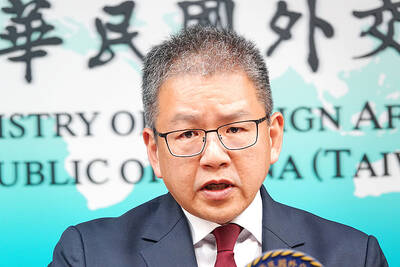
Taiwan is still in the process of assessing the possibility of recruiting workers from Eswatini, the Ministry of Foreign Affairs said yesterday, adding that its goal is to help Eswatini upgrade its vocational training centers. If there are plans to recruit workers from Eswatini, safeguarding national security, protecting public health and ensuring the employment rights of Taiwanese would be prerequisites, Department of West Asian and African Affairs Director-General Yen Chia-liang (顏嘉良) told a news conference. Key considerations would also include filling labor shortages in specific industries, and fostering bilateral professional and technical exchanges, he said. Yen was asked about the progress of labor
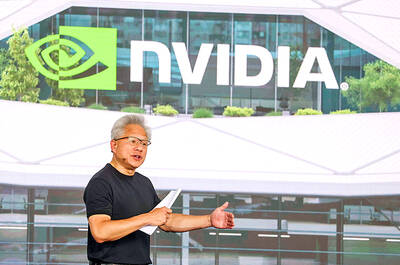
‘BOOMING’: ’ The number of partners we have here is incredible. You can see from their stock prices. They’re doing so well, they’re so happy,’ Jensen Huang said Nvidia Corp’s spending in Taiwan has ballooned to about US$150 billion a year, 10 times the US$10 billion to US$15 billion the company spent five years ago, Nvidia chief executive officer Jensen Huang (黃仁勳) said yesterday, suggesting Taiwan’s strategic importance in the global artificial intelligence (AI) supply chain. “Taiwan is the epicenter of the AI revolution. This is where the chips come, packaging comes. This is where the systems are made. This is where AI supercomputers were created,” Huang said at a meeting for the company’s employees in Beitou-Shilin Technology Park (北投士林科技園區) in Taipei, the planned site of Nvidia’s Taipei headquarters. “Taiwan


 RSS
RSS