


Academia Sinica yesterday unveiled its 20-quantum-bit (qubit) superconducting quantum computer, a milestone in the nation’s quantum research since introducing its 5-qubit computer in 2023.
“With the development of the 20-qubit superconducting quantum computer, Taiwan is officially at the starting point of the large-scale quantum chip fabrication process,” Academia Sinica president James Liao (廖俊智) said in a statement.
While information in traditional computers is represented as either a 1 or a 0, qubits can be processed as both 1 and 0, using quantum superposition, enabling the computation of calculations that would take traditional computers years to complete.
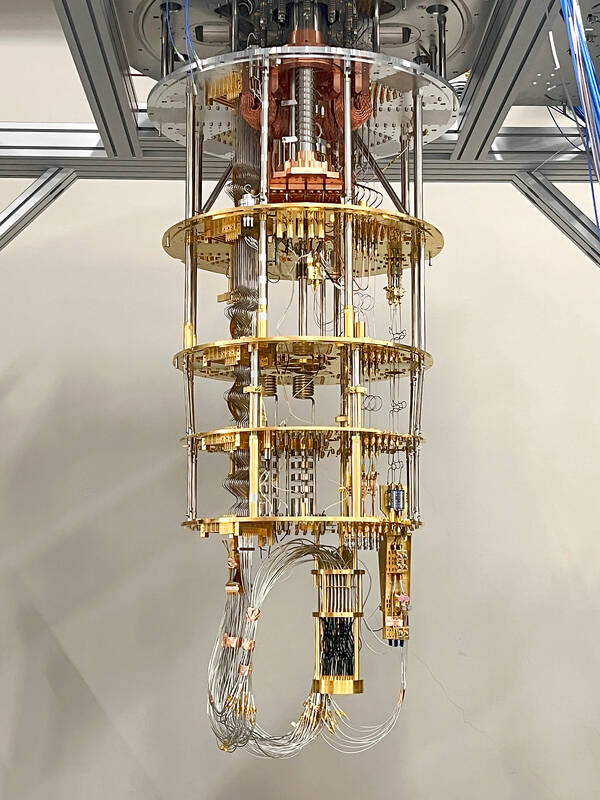
Photo courtesy of Academia Sinica
Quantum computing, which is being pursued with substantial investments by numerous nations, is widely recognized as a key enabler for integrating high-performance computing and artificial intelligence, the institute said.
The 20-qubit quantum computer project was started last year by first creating high-quality superconducting qubits using an 8-inch wafer fabrication platform, it said.
The production process helped create the nation’s first quantum semiconductor fabrication research and development platform, as well as the first quantum computing testing platform, it said.
The researchers also applied semiconductor industry methods to control the quality of large-diameter wafers during manufacturing, ensuring stricter standards of quality and uniformity as the number of qubits increased, the institute said.
Chen Chii-tung (陳啟東), executive director of Academia Sinica’s Thematic Center for Quantum Computer, said that a practical quantum computer requires high-quality, large-scale qubits to realize its full functionality.
“The 20-qubit quantum computing system not only accommodates a larger computational variable space, but also symbolizes Academia Sinica’s mastery of reliably fabricating multiple qubits and coupling them, as well as the successful development of key technologies, such as laser-based fine-tuning of qubit frequencies,” he said.
The research team continues to refine chip stacking techniques to reduce crosstalk between qubits, while simultaneously improving qubit control and readout efficiency, he added.
The team also extended qubit coherence times from 15 to 30 microseconds in the 5-qubit era to 530 microseconds, significantly improving the stability of quantum states and enabling longer computation durations, the institute said.
Ke Chung-ting (柯忠廷), assistant research fellow at Academia Sinica’s Research Center for Critical Issues, said that superconducting qubits are extremely sensitive to electromagnetic interference.
Beyond the control microwave signals, any stray signals penetrating the packaging system can adversely affect qubit performance, he said.
Academia Sinica plans to host the International Superconducting Quantum Computing Workshop at the Research Center for Key Issues at its southern campus from Wednesday to Friday next week, when academicians and industry professionals would have the opportunity to test the 20-qubit superconducting quantum computing system firsthand.

A signaling system malfunction disrupted high-speed rail (HSR) services beginning at 8am today, with trains temporarily reduced to three northbound and three southbound trains per hour as authorities conduct inspections. The malfunction occurred on a section of track in Miaoli County during pre-operation checks early this morning, forcing northbound and southbound trains to use a single track, the HSR operator said. The regular schedule has been replaced with three hourly trains offering only nonreserved seating in each direction, stopping at every station, it said, adding that business class cars would still have reserved seating. Departures from terminal stations are scheduled at the top
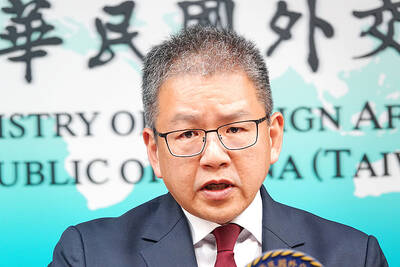
Taiwan is still in the process of assessing the possibility of recruiting workers from Eswatini, the Ministry of Foreign Affairs said yesterday, adding that its goal is to help Eswatini upgrade its vocational training centers. If there are plans to recruit workers from Eswatini, safeguarding national security, protecting public health and ensuring the employment rights of Taiwanese would be prerequisites, Department of West Asian and African Affairs Director-General Yen Chia-liang (顏嘉良) told a news conference. Key considerations would also include filling labor shortages in specific industries, and fostering bilateral professional and technical exchanges, he said. Yen was asked about the progress of labor

VERBOSE VESSELS: A CGA cutter and a China Coast Guard exchanged verbal barbs for more than a day in Taiwanese-controlled waters before the Chinese vessel left The Taiwanese and Chinese coast guards had a standoff near the strategically located Pratas Islands (Dongsha Islands, 東沙群島) in the north of the South China Sea, the Coast Guard Administration (CGA) said yesterday. The two sides engaged in intense radio exchanges over sovereignty claims during the 33-hour standoff. China Coast Guard vessel 3501 eventually left the restricted waters, 26.6 nautical miles (49.2km) west of the Pratas Islands, at 5pm yesterday, the CGA said. Lying approximately between southern Taiwan and Hong Kong, the Taiwan-controlled Pratas are seen by some security experts as vulnerable to Chinese attack due to their distance — more than

A US uncrewed surface vessel (USV) encountered multiple Chinese warships during an autonomous transit of the Taiwan Strait, US defense company Seasats said in a statement on Wednesday. Seasats announced that a Lightfish USV had completed the first autonomous transit of the Taiwan Strait. Over five days, the USV traversed the entire length of the Strait while constantly monitoring surface vessel traffic, the company said. The Lightfish encountered multiple Chinese warships, one of which was a Chinese People’s Liberation Army Navy (PLAN) Type 056 corvette, it said. The Chinese vessels were operating “well within Taiwan’s exclusive economic zone without transmitting their identity via the


 RSS
RSS