


British Prime Minister Keir Starmer yesterday arrived in Beijing to meet with Chinese President Xi Jinping (習近平), hoping to restore long fraught relations.
It is the first visit to China by a British prime minister since 2018 and follows a string of Western leaders courting Beijing in the past few weeks, pivoting from a mercurial US.
Starmer, who is also expected to visit Shanghai tomorrow, would later make a brief stop in Japan to meet with Japanese Prime Minister Sanae Takaichi.
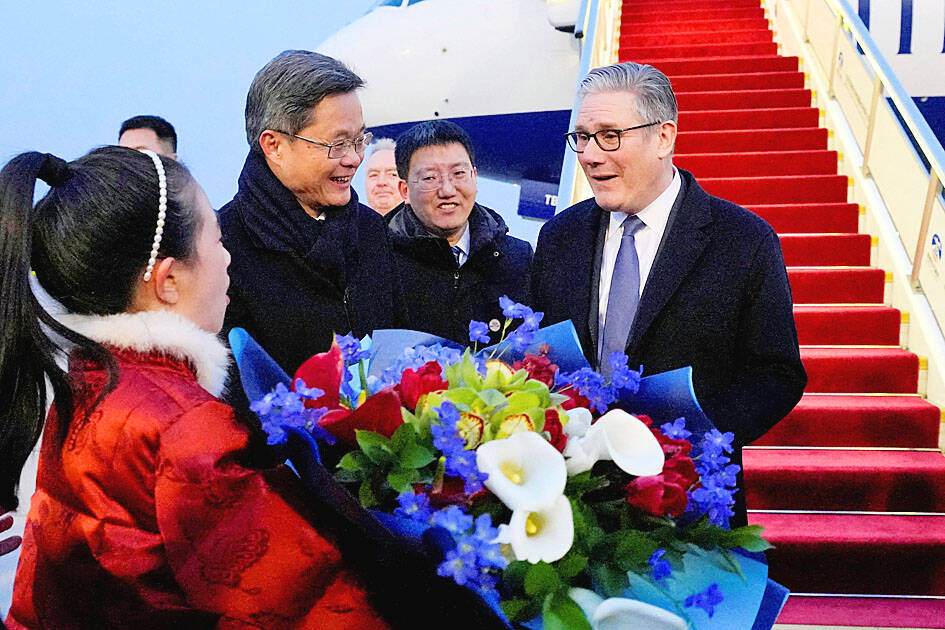
Photo: Reuters
For Xi, the trip is an opportunity to show Beijing can be a reliable partner at a time when US President Donald Trump’s policies have rattled historic ties between Washington and its Western allies.
Starmer is battling record-low popularity polls and hopes the visit can boost the UK’s beleaguered economy.
The trip has been lauded by Downing Street as a chance to boost trade and investment ties while raising thorny issues such as national security and human rights.
Starmer is today to meet with Xi for lunch, followed by a meeting with Chinese Premier Li Qiang (李強).
The British leader said the visit to China was “going to be a really important trip for us,” vowing to make “some real progress.”
There are “opportunities” to deepen bilateral relations, Starmer told reporters traveling with him on the plane to China.
“It doesn’t make sense to stick our head in the ground and bury in the sand when it comes to China; it’s in our interests to engage and not compromise on national security,” he added.
China, for its part, “is willing to take this visit as an opportunity to enhance political mutual trust,” Chinese Ministry of Foreign Affairs spokesman Guo Jiakun (郭嘉昆) told a news conference.
Starmer is the latest Western leader to be hosted by Beijing in the past few months, following visits by Canadian Prime Minister Mark Carney and French President Emmanuel Macron.
Faced with Trump’s threats to impose tariffs on Canada for signing a trade agreement with China, and the US president’s attempts to create a new international institution with his “Board of Peace,” Beijing has been affirming its support for the UN to visiting leaders.
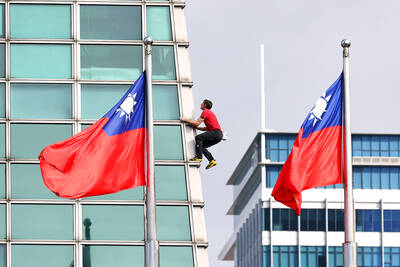
DAREDEVIL: Honnold said it had always been a dream of his to climb Taipei 101, while a Netflix producer said the skyscraper was ‘a real icon of this country’ US climber Alex Honnold yesterday took on Taiwan’s tallest building, becoming the first person to scale Taipei 101 without a rope, harness or safety net. Hundreds of spectators gathered at the base of the 101-story skyscraper to watch Honnold, 40, embark on his daredevil feat, which was also broadcast live on Netflix. Dressed in a red T-shirt and yellow custom-made climbing shoes, Honnold swiftly moved up the southeast face of the glass and steel building. At one point, he stepped onto a platform midway up to wave down at fans and onlookers who were taking photos. People watching from inside
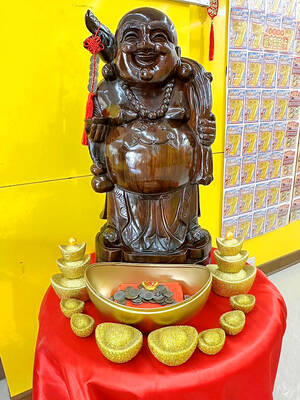
A Vietnamese migrant worker yesterday won NT$12 million (US$379,627) on a Lunar New Year scratch card in Kaohsiung as part of Taiwan Lottery Co’s (台灣彩券) “NT$12 Million Grand Fortune” (1200萬大吉利) game. The man was the first top-prize winner of the new game launched on Jan. 6 to mark the Lunar New Year. Three Vietnamese migrant workers visited a Taiwan Lottery shop on Xinyue Street in Kaohsiung’s Gangshan District (崗山), a store representative said. The player bought multiple tickets and, after winning nothing, held the final lottery ticket in one hand and rubbed the store’s statue of the Maitreya Buddha’s belly with the other,

‘COMMITTED TO DETERRENCE’: Washington would stand by its allies, but it can only help as much as countries help themselves, Raymond Greene said The US is committed to deterrence in the first island chain, but it should not bear the burden alone, as “freedom is not free,” American Institute in Taiwan Director Raymond Greene said in a speech at the Institute for National Defense and Security Research’s “Strengthening Resilience: Defense as the Engine of Development” seminar in Taipei yesterday. In the speech, titled “Investing Together and a Secure and Prosperous Future,” Greene highlighted the contributions of US President Donald Trump’s administration to Taiwan’s defense efforts, including the establishment of supply chains for drones and autonomous systems, offers of security assistance and the expansion of
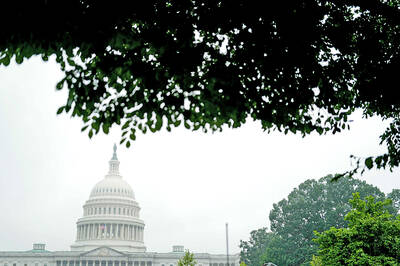
STREAMLINED: The dedicated funding would allow the US to transfer equipment to Taiwan when needed and order upgraded replacements for stockpiles, a source said The US House of Representatives on Thursday passed a defense appropriations bill totaling US$838.7 billion, of which US$1 billion is to be allocated to reinforcing security cooperation with Taiwan and US$150 million to replace defense articles provided to the nation. These are part of the Consolidated Appropriation Act, which the US House yesterday passed with 341 votes in favor and 88 against. The act must be passed by the US Senate before Friday next week to avoid another government shutdown. The US House Committee on Appropriations on Monday unveiled the act, saying that it allocates US$1 billion for the Taiwan Security Cooperation Initiative


 RSS
RSS