


The Chinese Nationalist Party’s (KMT) and the Chinese Communist Party’s (CCP) cross-strait exchange forum would severely harm national dignity and security, the Democratic Progressive Party (DPP) said yesterday.
The KMT has said that party Chairwoman Cheng Li-wun (鄭麗文) is sending a delegation to represent it at the Cross-Strait Cooperation Vision Forum in Beijing from Monday to Wednesday next week.
Beijing appears to have dominated everything about the event from its naming and agenda to the timing of its news conference, DPP spokeswoman Han Ying (韓瑩) said in a statement.
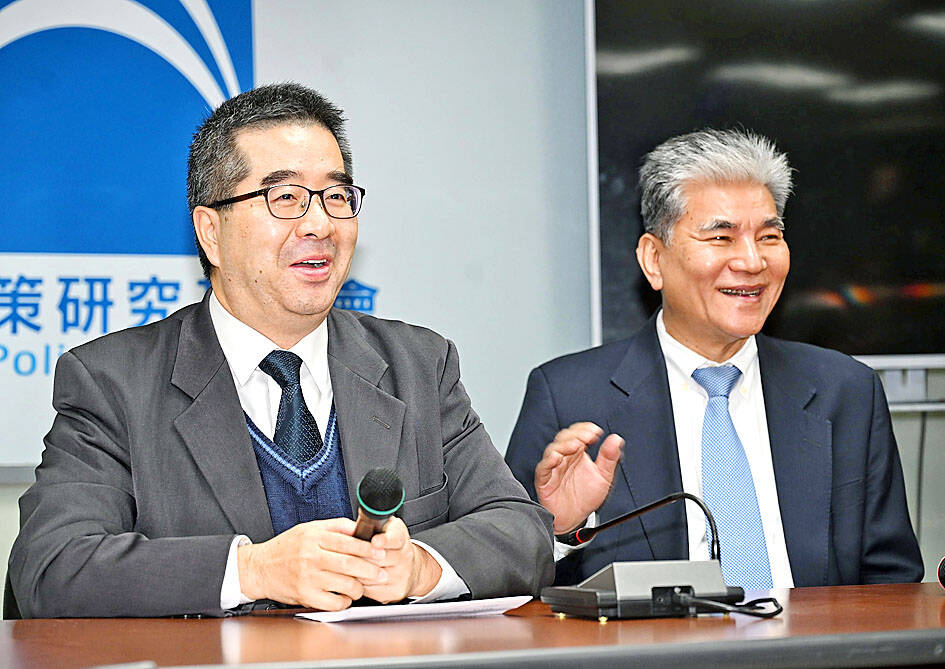
Photo: Chang Chia-ming, Taipei Times
“The uncanny coordination calls into question whether the KMT answers to Taiwan or China,” she said.
The KMT’s meek acceptance of Beijing’s arrangements for the meeting surrenders the nation’s agency to Chinese whims, which harms national dignity and creates a national security risk, she said.
Beijing allegedly delayed the forum multiple times to signal its displeasure over the KMT’s performance in countering the policies of the DPP-led Executive Yuan, Han said, citing media reports about the forum.
The KMT’s subsequent obstruction — achieved in collaboration with the Taiwan People’s Party — of US arms sales and Taiwan’s effort to build supply chains could be seen as an attempt to curry favor with China, she said.
The DPP must question whether the KMT has relegated itself to acting as a tool of Beijing to meddle in Taiwanese politics, she added.
Members of the KMT delegation should be careful when visiting China, as internal turmoil in the country could endanger their personal safety, Han said.
“Do not get embroiled in China’s internal conflicts just to play along with ‘united front’ efforts,” she said.
KMT Vice Chairman Hsiao Hsu-tsen (蕭旭岑) said he and Lee Hong-yuan (李鴻源), who heads the KMT-run National Policy Foundation, are expected to lead a delegation of 40 academics to a forum held by a CCP-run think tank in Beijing.
The panel would discuss tourism, air travel, healthcare, the precision machining sector, artificial intelligence, disaster relief, emergent energy sources and measures to curb carbon emissions.
By insisting on adhering to the so-called “1992 consensus” and rejecting Taiwanese independence, former president Ma Ying-jeou’s (馬英九) administration secured economic cooperation with China that subsequent DPP governments inherited and continue to enjoy, he said.
The “1992 consensus,” a term former Mainland Affairs Council chairman Su Chi (蘇起) in 2006 admitted making up in 2000, refers to a tacit understanding between the KMT and the CCP that both sides of the Strait acknowledge there is “one China,” with each side having its own interpretation of what “China” means.
Ma’s policies proved that cooperation and cross-strait exchanges are good for the people on both sides, Hsiao said.
There can be no doubt that the KMT stands with ordinary Taiwanese who support the speedy restoration of cross-strait exchanges, he said.
A poll from last year showed that 80 percent of Taiwanese want to maintain regular bilateral channels of communications, Hsiao added.
The forum is an opening to broadening exchanges between Taiwan and China that would contribute to peace, stability and prosperity, he said.
Several academics have withdrawn from the delegation under pressure from government agencies following news reports about the forum, Hsiao said, calling on the Executive Yuan to refrain from ideological interference with cross-strait economic exchanges.
Cheng’s visit to China is an important part of the party’s vision for cross-strait interactions, but details are still in flux at the moment, he said.
The Mainland Affairs Council said that the KMT’s attempt to label the forum as nonpolitical is a tacit acknowledgement of the event’s deep unpopularity.
The party’s frequent trips to China amid Beijing’s relentless campaign of diplomatic and military intimidation does not escape the notice of Taiwanese, the council said.
China’s goal to annihilate the Republic of China would not change regardless of who has visited Beijing, it said, adding that unauthorized political dialogue with China is illegal.
Without government authorization, organizations are prohibited from engaging in political agreements with China or involving matters related to government authority, the council said.

SILENCING CRITICS: In addition to blocking Taiwan, China aimed to prevent rights activists from speaking out against authoritarian states, a Cabinet department said The Ministry of Foreign Affairs (MOFA) yesterday condemned transnational repression by Beijing after RightsCon, a major digital human rights conference scheduled to be held in Zambia this week, was abruptly canceled due to Chinese pressure over Taiwanese participation. This year’s RightsCon, the world’s largest conference discussing issues “at the intersection of human rights and technology,” was scheduled to take place from tomorrow to Friday in Lusaka, and expected to draw 2,600 in-person attendees from 150 countries, along with 1,100 online participants. However, organizers were forced to cancel the event due to behind-the-scenes pressure from China, the ministry said, expressing its “strongest condemnation”
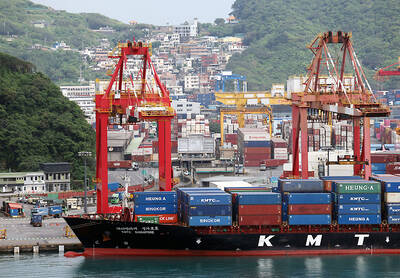
Taiwan’s economy grew far faster than expected in the first quarter, as booming demand for artificial intelligence (AI) applications drove a surge in exports, spilling over into investment and consumption, the Directorate-General of Budget, Accounting and Statistics (DGBAS) said yesterday. GDP growth was 13.69 percent year-on-year during the January-to-March period, beating the DGBAS’ February forecast by 2.23 percentage points and marking the most robust growth in nearly four decades, DGBAS senior official Chiang Hsin-yi (江心怡) told a news conference in Taipei. The result was powered by exports, which remain the backbone of Taiwan’s economy, Chiang said. Outbound shipments jumped 51.12 percent year-on-year to
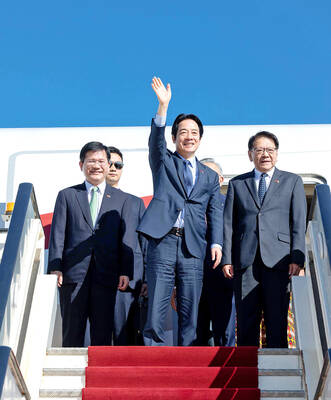
DELAYED BUT DETERMINED: The president’s visit highlights Taiwan’s right to international engagement amid regional pressure from China President Willaim Lai (賴清德) yesterday arrived in Eswatini, more than a week after his planned visit to Taiwan’s sole African ally was suspended because of revoked overflight permits. “The visit, originally scheduled for April 22, was postponed due to unforeseen external factors,” Lai wrote on social media. “After several days of careful arrangements by our diplomatic and national security teams, we successfully arrived today.” Lai said he looked forward to further deepening Taiwan-Eswatini relations through closer cooperation in the economy, agriculture, culture and education, as well as advancing the nation’s international partnerships. The president was initially scheduled to arrive in time to celebrate
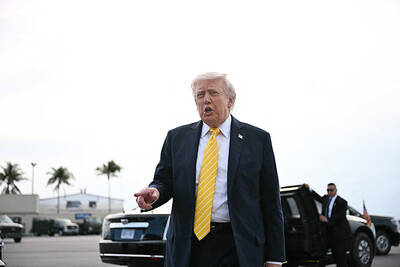
Iran’s Islamic Revolutionary Guard Corp (IRGC) yesterday said the US faced a choice between an “impossible” military operation or a “bad deal” with Tehran, after US President Donald Trump disparaged Iran’s latest peace proposal. Negotiations between the two countries have been deadlocked since a ceasefire came into effect on April 8, with only one round of direct peace talks held so far. Iran’s Tasnim and Fars news agencies reported that Tehran had submitted a 14-point proposal to mediator Pakistan, but Trump was quick to cast doubt on it. “I will soon be reviewing the plan that Iran has just sent to us, but


 RSS
RSS