


Officials from Taiwan and the US held a sixth round of talks under the Economic Prosperity Partnership Dialogue (EPPD) in Washington yesterday and signed a pact agreeing to the principles of "Pax Silica."
The meeting was led on the US side by US Undersecretary of State for Economic Affairs Jacob Helberg, while Taiwan was represented by Minister of Economic Affairs Kung Ming-hsin (龔明鑫), the US Department of State said in a statement.
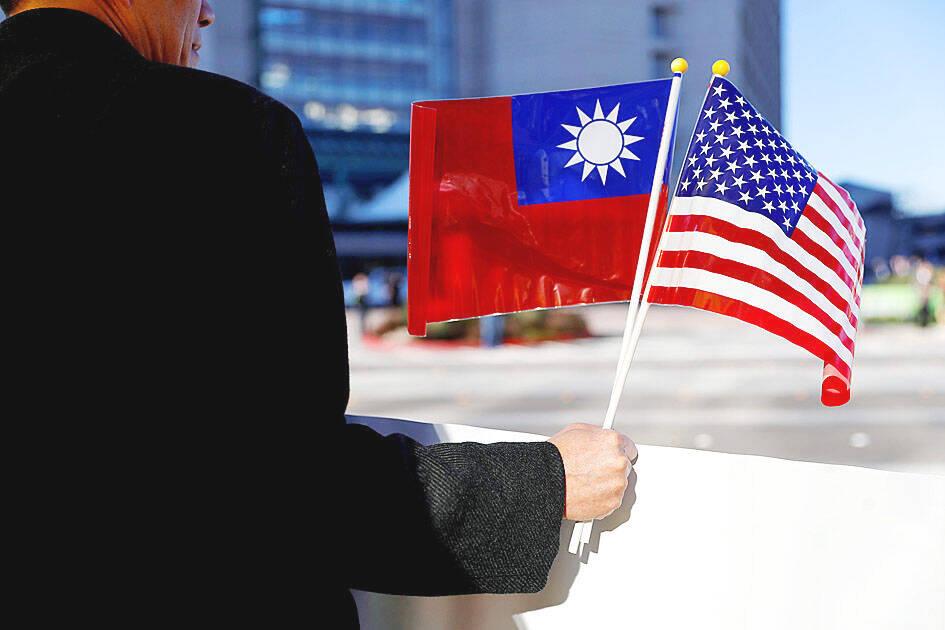
Photo: Reuters
The talks covered topics that included supply chain security, particularly in the field of artificial intelligence, as well as cooperation on uncrewed aircraft system component certification, support for trusted digital infrastructure and cooperation on critical minerals, the statement said.
Discussions also focused on "highlighting progress in responding to economic coercion, pursuing mutual cooperation in third countries and addressing tax-related barriers to increase investment between the United States and Taiwan," the department said.
Taiwan and US representatives also signed a joint statement endorsing the principles of the Pax Silica Declaration, the statement said.
"Pax Silica" is a US-led initiative focused on coordinating trusted supply chains for advanced technologies, whose initial eight signatories (now 11) did not include Taiwan, the world's leading producer of advanced semiconductors.
Upon its launch last month, Helberg said Taiwan had been involved and made contributions to the initiative, and that planners expected to roll out "several new members" in the first quarter of this year.
"Give us a little bit of room to let sensitive conversations unfold on a bilateral basis," Helberg told a Taiwan-based reporter at the time, who asked if there was a pathway for Taiwan to be brought in as a full participant.
Asked yesterday for an update on Taiwan's potential membership, Helberg said the signing of a joint statement was a "major milestone," but did not provide a timeframe for entry.
The EPPD framework was launched in November 2020 near the end of US President Donald Trump's first term, and continued during the administration of former US president Joe Biden.
Yesterday marked the sixth set of meetings under the EPPD framework, and the first since Trump returned to office in January last year.

A signaling system malfunction disrupted high-speed rail (HSR) services beginning at 8am today, with trains temporarily reduced to three northbound and three southbound trains per hour as authorities conduct inspections. The malfunction occurred on a section of track in Miaoli County during pre-operation checks early this morning, forcing northbound and southbound trains to use a single track, the HSR operator said. The regular schedule has been replaced with three hourly trains offering only nonreserved seating in each direction, stopping at every station, it said, adding that business class cars would still have reserved seating. Departures from terminal stations are scheduled at the top

Taiwan is still in the process of assessing the possibility of recruiting workers from Eswatini, the Ministry of Foreign Affairs said yesterday, adding that its goal is to help Eswatini upgrade its vocational training centers. If there are plans to recruit workers from Eswatini, safeguarding national security, protecting public health and ensuring the employment rights of Taiwanese would be prerequisites, Department of West Asian and African Affairs Director-General Yen Chia-liang (顏嘉良) told a news conference. Key considerations would also include filling labor shortages in specific industries, and fostering bilateral professional and technical exchanges, he said. Yen was asked about the progress of labor

VERBOSE VESSELS: A CGA cutter and a China Coast Guard exchanged verbal barbs for more than a day in Taiwanese-controlled waters before the Chinese vessel left The Taiwanese and Chinese coast guards had a standoff near the strategically located Pratas Islands (Dongsha Islands, 東沙群島) in the north of the South China Sea, the Coast Guard Administration (CGA) said yesterday. The two sides engaged in intense radio exchanges over sovereignty claims during the 33-hour standoff. China Coast Guard vessel 3501 eventually left the restricted waters, 26.6 nautical miles (49.2km) west of the Pratas Islands, at 5pm yesterday, the CGA said. Lying approximately between southern Taiwan and Hong Kong, the Taiwan-controlled Pratas are seen by some security experts as vulnerable to Chinese attack due to their distance — more than

A US uncrewed surface vessel (USV) encountered multiple Chinese warships during an autonomous transit of the Taiwan Strait, US defense company Seasats said in a statement on Wednesday. Seasats announced that a Lightfish USV had completed the first autonomous transit of the Taiwan Strait. Over five days, the USV traversed the entire length of the Strait while constantly monitoring surface vessel traffic, the company said. The Lightfish encountered multiple Chinese warships, one of which was a Chinese People’s Liberation Army Navy (PLAN) Type 056 corvette, it said. The Chinese vessels were operating “well within Taiwan’s exclusive economic zone without transmitting their identity via the


 RSS
RSS