


About 92 percent of foreign companies said they plan to maintain or increase investment in Taiwan this year, with the majority saying they remain confident about the local market despite ongoing geopolitical uncertainties and tariff-related risks, the American Chamber of Commerce (AmCham) in Taiwan said in a survey released yesterday.
About 82 percent said they are optimistic about Taiwan’s economic outlook over the next 12 months, citing last year’s strong growth driven by artificial intelligence (AI) demand, which boosted investment in servers and advanced chip production, AmCham Taiwan’s Business Climate Survey said.
However, as a growing share of Taiwan’s exports is driven by AI-related hardware, the gains have remained uneven, with traditional industries exposed to US tariffs and China’s oversupply continuing to struggle, the chamber said.
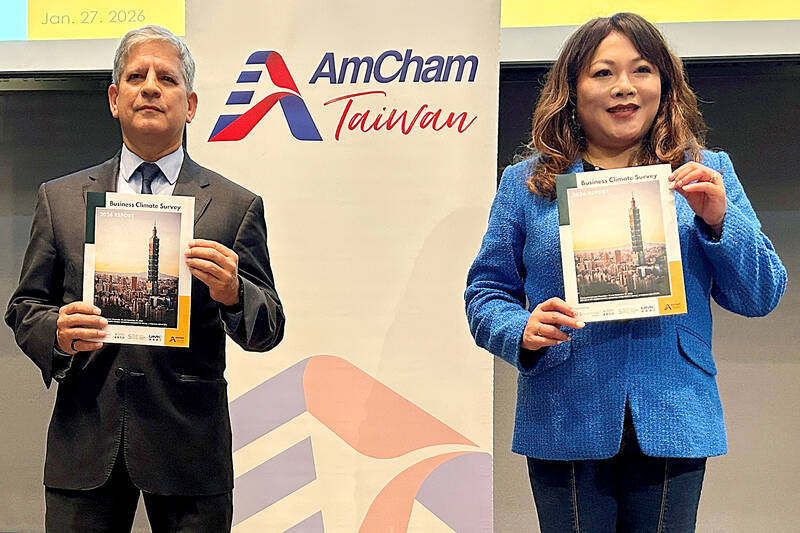
Photo: Ben Blanchard, Reuters
More foreign firms in Taiwan are preparing emergency plans as security concerns rise, but actual disruption from tensions with China is very low, the survey showed.
About 46 percent of respondents said they were revising business continuity plans to “bolster resilience,” compared with 40 percent last year, it said.
This year, national security topped the list of foreign companies’ perceived risk to business operations, although only 7 percent reported significant disruptions last year from tensions in the Taiwan Strait, it said.
Personal anxiety about increased military activities remained unchanged at three, on a scale of up to five.
“Companies choose to stay in Taiwan despite these geopolitical concerns and it’s not because things are easy, it’s because companies are getting better at managing these risks with resilience planning and business operation planning,” AmCham Taiwan chairperson Anita Chen (陳幼臻) told reporters in Taipei.
AmCham Taiwan said that 206 of its 411 eligible members responded to the survey conducted shortly before China’s most recent war games. The group serves as an important conduit between the foreign, especially US, business community in Taiwan and policymakers in Taipei and Washington.
Taiwan has repeatedly called for the swift passage of an agreement to avoid double taxation, currently stalled in the US Senate, saying it would encourage more bilateral investment.
AmCham Taiwan president Carl Wegner said that from speaking to people in Washington, this year looked like a “good year with positive potential” for that deal to be approved.
“We speak about it with all the delegations that come here, they bring that message back” to Washington, he added.
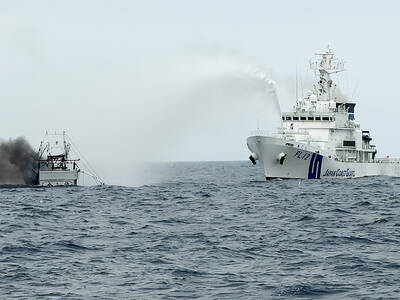
CREDIT-GRABBER: China said its coast guard rescued the crew of a fishing vessel that caught fire, who were actually rescued by a nearby Taiwanese boat and the CGA Maritime search and rescue operations do not have borders, and China should not use a shipwreck to infringe upon Taiwanese sovereignty, the Coast Guard Administration (CGA) said yesterday. The coast guard made the statement in response to the China Coast Guard (CCG) saying it saved a Taiwanese fishing boat. The Chuan Yu No. 6 (全漁6號), a fishing vessel registered in Keelung, on Thursday caught fire and sank in waters northeast of Diaoyutai Islands (釣魚台). The vessel left Keelung’s Badouzih Fishing Harbor (八斗子漁港) at 3:35pm on Sunday last week, with seven people on board — a 62-year-old Taiwanese captain surnamed Chang (張) and six
LEVERAGE: China did not ‘need to fire a shot’ to deny Taiwan airspace over Africa when it owns ‘half the continent’s debt,’ a US official said, calling it economic warfare The EU has raised concerns about overflight rights following the delay of President William Lai’s (賴清德) planned state visit to the Kingdom of Eswatini after three African nations denied overflight clearance for his charter at the last minute. Taiwanese allies Paraguay and Saint Kitts and Nevis, as well as several US lawmakers and the Inter-Parliamentary Alliance on China (IPAC) condemned China for allegedly pressuring the countries. Lai was scheduled to fly directly to Taiwan’s only African ally from yesterday to Sunday to celebrate the 40th anniversary of King Mswati III’s accession and his 58th birthday, but Seychelles, Mauritius and Madagascar suddenly revoked
RISKY BUSINESS: The ‘incentives’ include initiatives that get suspended for no reason, creating uncertainty and resulting in considerable losses for Taiwanese, the MAC said China’s “incentives” failed to sway sentiment in Taiwan, as willingness to work in China hit a record low of 1.6 percent, a Ministry of Labor survey showed. The Directorate-General of Budget, Accounting and Statistics (DGBAS) also reported that the number of Taiwanese workers in China has nearly halved from a peak of 430,000 in 2012 to an estimated 231,000 in 2024. That marked a new low in the proportion of Taiwanese going abroad to work. The ministry’s annual survey on “Labor Life and Employment Status” includes questions respondents’ willingness to seek employment overseas. Willingness to work in China has steadily declined from
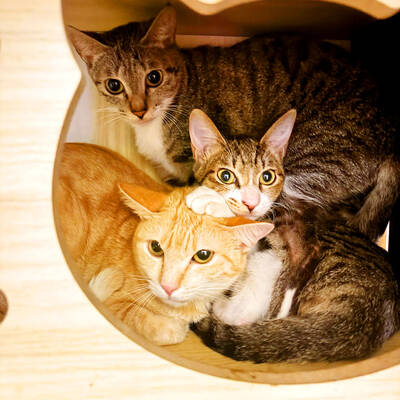
The number of pet cats in Taiwan surpassed that of pet dogs for the first time last year, reaching 1,742,033, a 32.8 percent increase from 2023, the Ministry of Agriculture said yesterday, citing a survey. By contrast, the number of pet dogs declined slightly by 1.2 percent over the same period to 1,462,528, the ministry said. Despite the shift, households with dogs still slightly outnumber those with cats by 1.2 percent. However, while the number of households with multiple dogs has remained relatively stable, households keeping more than two cats have increased, contributing to the overall rise in the feline population. The trend


 RSS
RSS