


The impact of the US’ “reciprocal” tariffs on Taiwan’s exports, industrial output and employment has largely eased after the levy was lowered from 20 percent to 15 percent, giving Taiwanese manufacturers a competitive advantage, Deputy Minister of Economic Affairs Ho Chin-tsang (何晉滄) said yesterday.
The lower tariffs, not stacked on existing duties, would lift Taiwanese exports to the US by 0.04 to 0.08 percent, reversing an earlier projected decline of 5.75 to 7.5 percent, according to an analysis conducted a government-affiliated think tank, Ho said at a meeting of the legislature’s Economics Committee.
The adjustment is expected to reverse the impact on industrial output, turning an estimated annual decline of 1.3 to 1.4 percent into a modest increase of between 0.01 and 0.02 percent, he said.
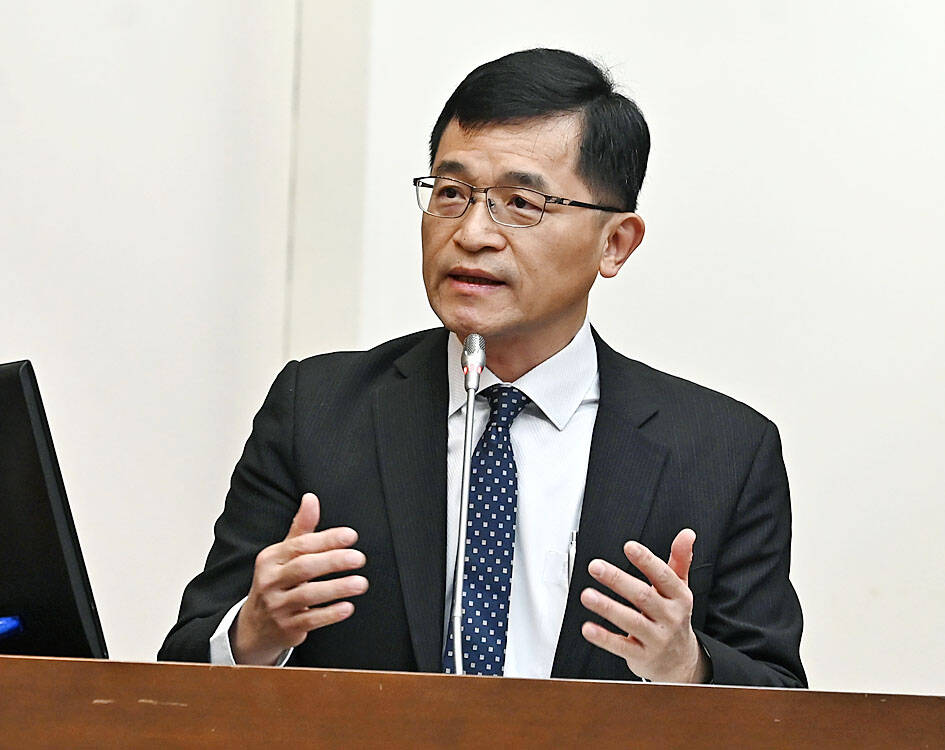
Photo: Wang Yi-sung, Taipei Times
In terms of overall economic growth, the effect on Taiwan’s GDP is projected to shift from a contraction of between 0.3 and 0.78 percent to a slight increase of about 0.01 percent, Ho said.
The new rate is expected to reverse the impact on industrial employment, turning an estimated loss of 36,000 jobs into a net increase of 206 to 329 positions, he said.
Under the new tariff framework, Taiwan is equal with Japan and South Korea, representing a relative gain for Taiwanese manufacturers, as it reduces the burden of having higher tariffs than the two countries, Ho said.
The lower tariff rate is expected to enhance the competitiveness of local manufacturers relative to peers in countries that still face higher US tariffs, such as Mexico, Vietnam and China, he said.
Automotive components are included in the latest tariff negotiations, with the rate dropping from 26.25 percent to 15 percent, a move that has already begun to help manufacturers regain orders, Ho said, citing an auto parts maker who immediately traveled to the US to secure orders after learning of the new rate.
In the high-tech sector, Taiwan has become the first country to secure most-favored-nation tariff treatment for semiconductors and related products, he said.
Based on the agreement, Taiwanese businesses are to invest up to US$250 billion in the US and the government would provide credit guarantees of up to US$250 billion to support the investments.
State-run CPC Corp, Taiwan (台灣中油) has signed a memorandum of understanding with an Alaska-based liquefied natural gas developer to secure a stable supply of natural gas, with the deal still under evaluation, Ho said.
If the investment is finalized, Taipei would ask Washington to count it as part of the US$250 billion investments under the tariff negotiation framework, he said.
The planned US$250 billion investment would not crowd out domestic investment, as the funds would be deployed gradually based on client demand rather than all at once, he said.
Major high-tech firms such as Taiwan Semiconductor Manufacturing Co (台積電) are continuing to expand their investments in Taiwan, underscoring that overseas spending would not hinder local development, he added.

A signaling system malfunction disrupted high-speed rail (HSR) services beginning at 8am today, with trains temporarily reduced to three northbound and three southbound trains per hour as authorities conduct inspections. The malfunction occurred on a section of track in Miaoli County during pre-operation checks early this morning, forcing northbound and southbound trains to use a single track, the HSR operator said. The regular schedule has been replaced with three hourly trains offering only nonreserved seating in each direction, stopping at every station, it said, adding that business class cars would still have reserved seating. Departures from terminal stations are scheduled at the top

Taiwan is still in the process of assessing the possibility of recruiting workers from Eswatini, the Ministry of Foreign Affairs said yesterday, adding that its goal is to help Eswatini upgrade its vocational training centers. If there are plans to recruit workers from Eswatini, safeguarding national security, protecting public health and ensuring the employment rights of Taiwanese would be prerequisites, Department of West Asian and African Affairs Director-General Yen Chia-liang (顏嘉良) told a news conference. Key considerations would also include filling labor shortages in specific industries, and fostering bilateral professional and technical exchanges, he said. Yen was asked about the progress of labor

A US uncrewed surface vessel (USV) encountered multiple Chinese warships during an autonomous transit of the Taiwan Strait, US defense company Seasats said in a statement on Wednesday. Seasats announced that a Lightfish USV had completed the first autonomous transit of the Taiwan Strait. Over five days, the USV traversed the entire length of the Strait while constantly monitoring surface vessel traffic, the company said. The Lightfish encountered multiple Chinese warships, one of which was a Chinese People’s Liberation Army Navy (PLAN) Type 056 corvette, it said. The Chinese vessels were operating “well within Taiwan’s exclusive economic zone without transmitting their identity via the

VERBOSE VESSELS: A CGA cutter and a China Coast Guard exchanged verbal barbs for more than a day in Taiwanese-controlled waters before the Chinese vessel left The Taiwanese and Chinese coast guards had a standoff near the strategically located Pratas Islands (Dongsha Islands, 東沙群島) in the north of the South China Sea, the Coast Guard Administration (CGA) said yesterday. The two sides engaged in intense radio exchanges over sovereignty claims during the 33-hour standoff. China Coast Guard vessel 3501 eventually left the restricted waters, 26.6 nautical miles (49.2km) west of the Pratas Islands, at 5pm yesterday, the CGA said. Lying approximately between southern Taiwan and Hong Kong, the Taiwan-controlled Pratas are seen by some security experts as vulnerable to Chinese attack due to their distance — more than


 RSS
RSS