


Two days of talks between US, Russian and Ukrainian negotiators aimed at finding a path to end the four-year war yesterday wrapped up in Abu Dhabi as Kyiv came under a massive Russian air attack.
Yesterday’s discussions ran for about three hours. The Ukrainian delegation is expected to brief Ukrainian President Volodymyr Zelenskiy, who is likely to then issue comments.
Another round of trilateral talks are to be held next week, Axios reported.
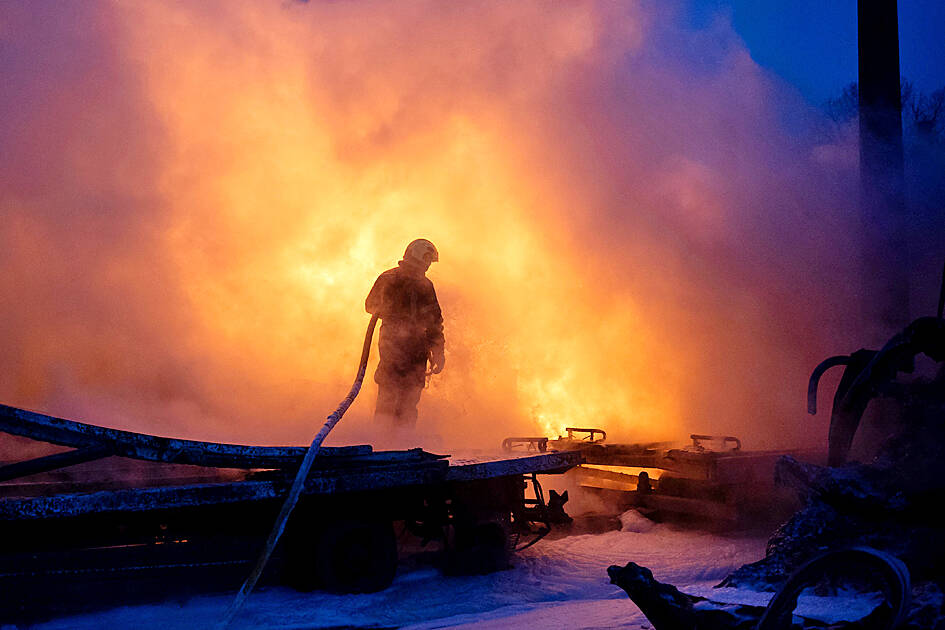
Photo: AFP
Kremlin forces overnight launched more than 370 drones and 21 missiles, Zelenskiy said earlier on X.
Kyiv and the surrounding region, as well as parts of the Sumy, Kharkiv and Chernihiv regions in Ukraine’s north came under fire, he said.
Power cuts were widespread.
Ukrainian Minister of Foreign Affairs Andrii Sybiha denounced the strikes as a “cynical” move by Russian President Vladimir Putin.
“His missiles hit not only our people, but also the negotiation table,” Sybiha said on X.
At least one person was killed in Kyiv and four injured, while falling debris sparked fires across multiple districts and disrupted water and heating supplies, Kyiv Mayor Vitali Klitschko said in Telegram posts.
About 6,000 buildings in the capital were left without heating amid temperatures around minus-8°C. The strikes damaged critical infrastructure, much of which had only recently been reconnected following strikes earlier in the month, Klitschko said.
More than 800,000 consumers in Kyiv were without electricity, Ukrainian Deputy Prime Minister Oleksiy Kuleba said.
In Kharkiv, a maternity hospital, a dormitory for displaced people, a medical college and residential buildings were among the buildings damaged, with dozens injured, Zelenskiy said.
At least 31 people were wounded, local authorities said.
Almost the entire city of Chernihiv in northern Ukraine, with a population of about 300,000, was left without electricity, and authorities called on residents to store water.
Emergency power outages were imposed in the Odesa, Dnipropetrovsk and Chernivtsi regions, according to statements from local utilities.
Kuleba separately said that the EU would give Ukraine 447 generators to help with power for schools, hospitals and shelters.
“Every such Russian strike on our energy infrastructure proves that there must be no delays in supplying air defenses,” Zelenskiy said. “No blind eye can be turned to these strikes; they must be met with a strong response. We are counting on the reaction and assistance of all our partners.”
Earlier in the week, Zelenskiy discussed strengthening Ukraine’s air defenses with US President Donald Trump during their meeting at the Davos forum in Switzerland, and made a blistering attack on European allies for not standing up to Putin.
The Russian Ministry of Defense said its overnight strikes targeted a plant producing long-range drones and energy facilities linked to Ukraine’s military-industrial complex. The drones hit a Roshen Confectionery chocolate and cake factory in Kyiv owned by Ukraine’s former president Petro Poroshenko, killing an employee.
Separately, Russia reported that 75 Ukrainian drones targeted various regions overnight, with no information on damage. Most of the drones were intercepted over the Rostov and Belgorod regions.
Thousands of buildings in Kyiv and across Ukraine have been left without heating and basic amenities by frequent Russian airstrikes. The latest barrage coincided with the trilateral talks in Abu Dhabi.
The latest discussions followed months of US-led negotiations in pursuit of peace talks between two sides. US and Ukrainian officials earlier said they have made significant progress on a 20-point plan to end the conflict that has lasted almost four years, and spiraled into Europe’s biggest since World War II.
After Trump met Zelenskiy at Davos this week, US representatives Steve Witkoff and Jared Kushner, Trump’s son in law, traveled to Moscow to meet Putin before heading to Abu Dhabi.
The pair were yesterday set to meet in Israel with Israeli Prime Minister Benjamin Netanyahu.

A signaling system malfunction disrupted high-speed rail (HSR) services beginning at 8am today, with trains temporarily reduced to three northbound and three southbound trains per hour as authorities conduct inspections. The malfunction occurred on a section of track in Miaoli County during pre-operation checks early this morning, forcing northbound and southbound trains to use a single track, the HSR operator said. The regular schedule has been replaced with three hourly trains offering only nonreserved seating in each direction, stopping at every station, it said, adding that business class cars would still have reserved seating. Departures from terminal stations are scheduled at the top

Taiwan is still in the process of assessing the possibility of recruiting workers from Eswatini, the Ministry of Foreign Affairs said yesterday, adding that its goal is to help Eswatini upgrade its vocational training centers. If there are plans to recruit workers from Eswatini, safeguarding national security, protecting public health and ensuring the employment rights of Taiwanese would be prerequisites, Department of West Asian and African Affairs Director-General Yen Chia-liang (顏嘉良) told a news conference. Key considerations would also include filling labor shortages in specific industries, and fostering bilateral professional and technical exchanges, he said. Yen was asked about the progress of labor

VERBOSE VESSELS: A CGA cutter and a China Coast Guard exchanged verbal barbs for more than a day in Taiwanese-controlled waters before the Chinese vessel left The Taiwanese and Chinese coast guards had a standoff near the strategically located Pratas Islands (Dongsha Islands, 東沙群島) in the north of the South China Sea, the Coast Guard Administration (CGA) said yesterday. The two sides engaged in intense radio exchanges over sovereignty claims during the 33-hour standoff. China Coast Guard vessel 3501 eventually left the restricted waters, 26.6 nautical miles (49.2km) west of the Pratas Islands, at 5pm yesterday, the CGA said. Lying approximately between southern Taiwan and Hong Kong, the Taiwan-controlled Pratas are seen by some security experts as vulnerable to Chinese attack due to their distance — more than

A US uncrewed surface vessel (USV) encountered multiple Chinese warships during an autonomous transit of the Taiwan Strait, US defense company Seasats said in a statement on Wednesday. Seasats announced that a Lightfish USV had completed the first autonomous transit of the Taiwan Strait. Over five days, the USV traversed the entire length of the Strait while constantly monitoring surface vessel traffic, the company said. The Lightfish encountered multiple Chinese warships, one of which was a Chinese People’s Liberation Army Navy (PLAN) Type 056 corvette, it said. The Chinese vessels were operating “well within Taiwan’s exclusive economic zone without transmitting their identity via the


 RSS
RSS