


The US military would prioritize protecting its homeland and deterring China while providing “more limited” support to allies in Europe and elsewhere, a Pentagon strategy document released on Friday said. The document did not mention Taiwan.
The 2026 National Defense Strategy (NDS) marks a significant departure from past Pentagon policy in its emphasis on allies taking on increased burdens with less backing from Washington and its softer tone on traditional foes China and Russia.
“As US forces focus on homeland defense and the Indo-Pacific, our allies and partners elsewhere will take primary responsibility for their own defense with critical but more limited support from American forces,” the document said.
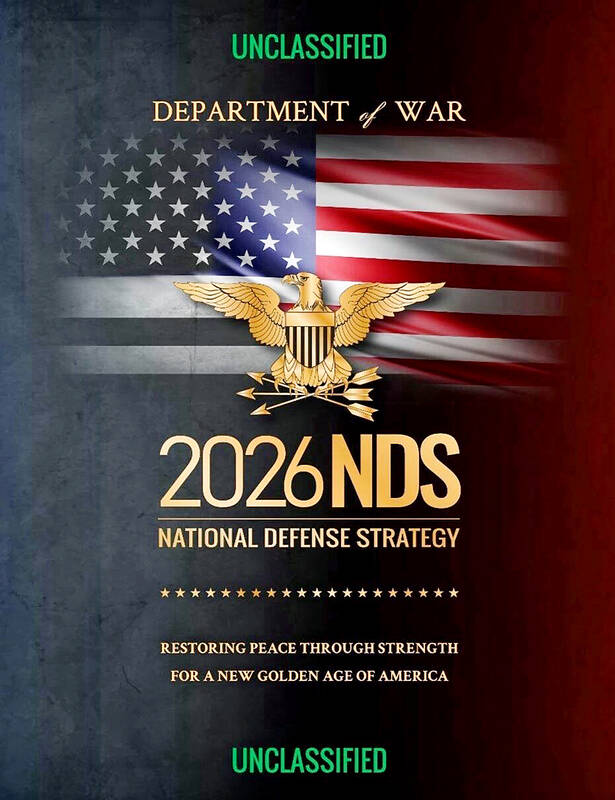
Photo: National Security Council Secretary-General Joseph Wu’s X account
The previous NDS — released during then-US president Joe Biden’s tenure — described China as Washington’s most consequential challenge and said that Russia posed an “acute threat.”
The new document urges “respectful relations” with Beijing — while making no mention of Taiwan — and describing the threat from Russia as a “persistent but manageable” one affecting NATO’s eastern members.
Both the Biden and Trump strategies say homeland defense is important, but their descriptions of the threats facing the US differ significantly.
US President Donald Trump’s administration’s NDS takes aim at the past administration for neglecting border security, saying this led to a “flood of illegal aliens” and widespread narcotics trafficking.
“Border security is national security,” and the Pentagon “will therefore prioritize efforts to seal our borders, repel forms of invasion, and deport illegal aliens,” it said.
Meanwhile, Biden focused on China and Russia, saying they posed “more dangerous challenges to security and safety at home” than even the threat of terrorism.
The 2026 NDS also includes no mention of the dangers of climate change — which the Biden administration had identified as an “emerging threat.”
Like Trump’s national security strategy, which was released last month, the NDS elevates Latin America to the top of the US agenda.
The Pentagon “will restore American military dominance in the Western Hemisphere. We will use it to protect our Homeland and our access to key terrain throughout the region,” the NDS said.
The document called that the “Trump Corollary to the Monroe Doctrine,” a reference to the declaration two centuries ago by the then-young US that Latin America was off limits to rival powers.
Since returning to office last year, Trump has repeatedly employed the US military in Latin America, ordering a shocking raid that abducted Venezuelan leader Nicolas Maduro and his wife, as well as strikes on more than 30 alleged drug-smuggling boats that have killed more than 100 people.
The Trump administration has provided no definitive evidence that the sunken vessels were involved in drug trafficking, and international law experts and rights groups say the strikes likely amount to extrajudicial killings, as they have apparently targeted civilians who do not pose an immediate threat to the US.

A signaling system malfunction disrupted high-speed rail (HSR) services beginning at 8am today, with trains temporarily reduced to three northbound and three southbound trains per hour as authorities conduct inspections. The malfunction occurred on a section of track in Miaoli County during pre-operation checks early this morning, forcing northbound and southbound trains to use a single track, the HSR operator said. The regular schedule has been replaced with three hourly trains offering only nonreserved seating in each direction, stopping at every station, it said, adding that business class cars would still have reserved seating. Departures from terminal stations are scheduled at the top

Taiwan is still in the process of assessing the possibility of recruiting workers from Eswatini, the Ministry of Foreign Affairs said yesterday, adding that its goal is to help Eswatini upgrade its vocational training centers. If there are plans to recruit workers from Eswatini, safeguarding national security, protecting public health and ensuring the employment rights of Taiwanese would be prerequisites, Department of West Asian and African Affairs Director-General Yen Chia-liang (顏嘉良) told a news conference. Key considerations would also include filling labor shortages in specific industries, and fostering bilateral professional and technical exchanges, he said. Yen was asked about the progress of labor

VERBOSE VESSELS: A CGA cutter and a China Coast Guard exchanged verbal barbs for more than a day in Taiwanese-controlled waters before the Chinese vessel left The Taiwanese and Chinese coast guards had a standoff near the strategically located Pratas Islands (Dongsha Islands, 東沙群島) in the north of the South China Sea, the Coast Guard Administration (CGA) said yesterday. The two sides engaged in intense radio exchanges over sovereignty claims during the 33-hour standoff. China Coast Guard vessel 3501 eventually left the restricted waters, 26.6 nautical miles (49.2km) west of the Pratas Islands, at 5pm yesterday, the CGA said. Lying approximately between southern Taiwan and Hong Kong, the Taiwan-controlled Pratas are seen by some security experts as vulnerable to Chinese attack due to their distance — more than

A US uncrewed surface vessel (USV) encountered multiple Chinese warships during an autonomous transit of the Taiwan Strait, US defense company Seasats said in a statement on Wednesday. Seasats announced that a Lightfish USV had completed the first autonomous transit of the Taiwan Strait. Over five days, the USV traversed the entire length of the Strait while constantly monitoring surface vessel traffic, the company said. The Lightfish encountered multiple Chinese warships, one of which was a Chinese People’s Liberation Army Navy (PLAN) Type 056 corvette, it said. The Chinese vessels were operating “well within Taiwan’s exclusive economic zone without transmitting their identity via the


 RSS
RSS