


Civil servants would face problems administering the 38 projects fast-tracked in a motion by opposition parties, who have now stalled the general budget for 147 days, Cabinet officials said yesterday.
Meanwhile, the Democratic Progressive Party (DPP) urged opposition parties to review and deliberate the entire NT$3.35 trillion (US$105.98 billion) budget instead of fast-tracking a small group of 38 programs, equaling only 2.4 percent of the full budget.
On Friday last week, lawmakers of the Chinese Nationalist Party (KMT) and the Taiwan People’s Party (TPP) forwarded a bill to fund the select programs directly to a second reading.
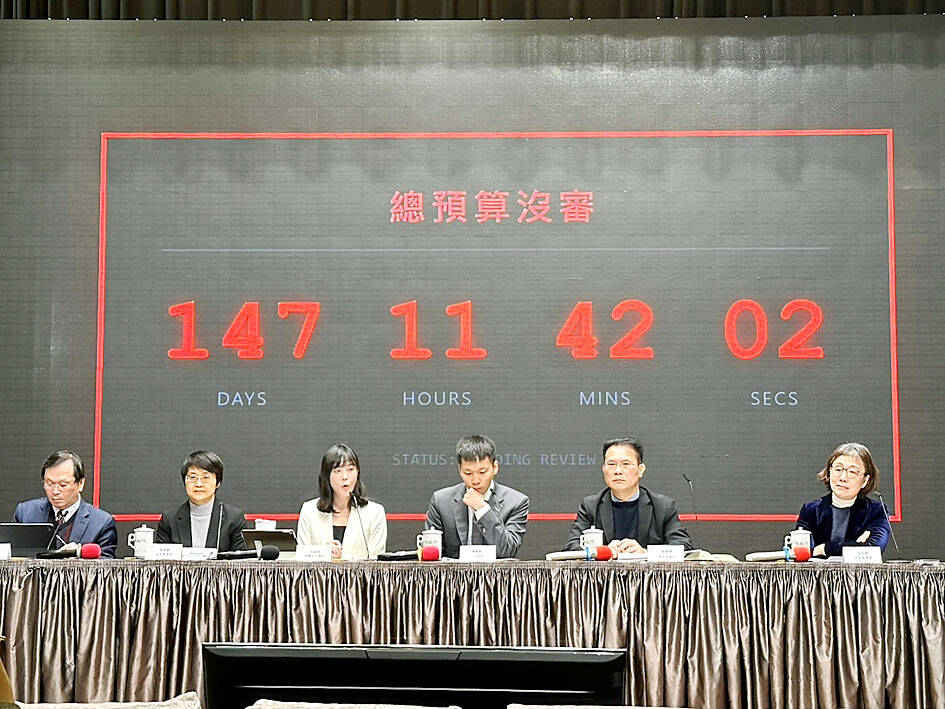
Photo: Chung Li-hua, Taipei Times
The legislature yesterday convened cross-party negotiations to discuss the 38 programs, but proceedings halted when DPP lawmakers left the room after speaking and ministry representatives expressed objections to discussing the bill rather than the entire budget.
Cabinet spokeswoman Michelle Lee (李慧芝) told a news conference after the weekly Cabinet meeting that the opposition parties believed they could push for review and approval this legislative session to disburse funding for the programs they prioritized, but the motion passed last week was only a “resolution,” which lacks legal authority to force civil servants to implement them.
“It was voted on as a resolution by opposition legislators. It was not a budget bill that passed a third reading, so civil servants would face issues when asked to implement the programs,” Lee said.
“Every budget item and its funding is important, so programs should not be prioritized,” she added.
“We do not understand why the opposition parties do not follow the legislative process for the budget,” she said.
When the proper legislative process is followed and a third reading is completed, the funds can be allocated, allowing Taiwan to make progress on new construction projects and economic developments, Lee said.
The prioritized items include a TPass public transportation program, subsidy programs for young families, housing assistance for young couples, flood control construction projects and others favored by the opposition, the DPP said.
“The 38 programs are in the general budget, which the Cabinet submitted to the legislature on Aug. 29 last year,” it said.
TPP deputy caucus whip Chang Chi-kai (張?楷) said that the DPP once emphasized the importance of budgets for the TPass system and flood control programs, but now that the opposition has offered solutions, it has done an about-face.
KMT deputy secretary-general Lin Pei-hsiang (林沛祥) said that the government failed in its duty to compile a budget according to the law, making its proposed budget illegal.
The smaller budget to fund the 38 programs was compiled according to Article 54 of the Budget Act (預算法), Lin said, adding that the government should quickly compile a new budget for the legislature to deliberate.
Additional reporting by Chen Cheng-yu and CNA

A signaling system malfunction disrupted high-speed rail (HSR) services beginning at 8am today, with trains temporarily reduced to three northbound and three southbound trains per hour as authorities conduct inspections. The malfunction occurred on a section of track in Miaoli County during pre-operation checks early this morning, forcing northbound and southbound trains to use a single track, the HSR operator said. The regular schedule has been replaced with three hourly trains offering only nonreserved seating in each direction, stopping at every station, it said, adding that business class cars would still have reserved seating. Departures from terminal stations are scheduled at the top

Taiwan is still in the process of assessing the possibility of recruiting workers from Eswatini, the Ministry of Foreign Affairs said yesterday, adding that its goal is to help Eswatini upgrade its vocational training centers. If there are plans to recruit workers from Eswatini, safeguarding national security, protecting public health and ensuring the employment rights of Taiwanese would be prerequisites, Department of West Asian and African Affairs Director-General Yen Chia-liang (顏嘉良) told a news conference. Key considerations would also include filling labor shortages in specific industries, and fostering bilateral professional and technical exchanges, he said. Yen was asked about the progress of labor

VERBOSE VESSELS: A CGA cutter and a China Coast Guard exchanged verbal barbs for more than a day in Taiwanese-controlled waters before the Chinese vessel left The Taiwanese and Chinese coast guards had a standoff near the strategically located Pratas Islands (Dongsha Islands, 東沙群島) in the north of the South China Sea, the Coast Guard Administration (CGA) said yesterday. The two sides engaged in intense radio exchanges over sovereignty claims during the 33-hour standoff. China Coast Guard vessel 3501 eventually left the restricted waters, 26.6 nautical miles (49.2km) west of the Pratas Islands, at 5pm yesterday, the CGA said. Lying approximately between southern Taiwan and Hong Kong, the Taiwan-controlled Pratas are seen by some security experts as vulnerable to Chinese attack due to their distance — more than

A US uncrewed surface vessel (USV) encountered multiple Chinese warships during an autonomous transit of the Taiwan Strait, US defense company Seasats said in a statement on Wednesday. Seasats announced that a Lightfish USV had completed the first autonomous transit of the Taiwan Strait. Over five days, the USV traversed the entire length of the Strait while constantly monitoring surface vessel traffic, the company said. The Lightfish encountered multiple Chinese warships, one of which was a Chinese People’s Liberation Army Navy (PLAN) Type 056 corvette, it said. The Chinese vessels were operating “well within Taiwan’s exclusive economic zone without transmitting their identity via the


 RSS
RSS