


Taipei aims to become a close strategic partner of Washington in artificial intelligence (AI) after striking a deal to cut tariffs and boost investment in the US, Vice Premier Cheng Li-chiun (鄭麗君) said yesterday.
The administration of US President Donald Trump has pushed Taiwan, a major producer of semiconductors, to invest more in the US, specifically in chips that power AI.
“In this negotiation, we promoted two-way Taiwan-US high-tech investment, hoping that in the future we can become close AI strategic partners,” said Cheng, who led the talks that clinched Thursday’s trade deal, which cuts tariffs on many of Taiwan’s exports and directs new investments in the US’ technology industry.
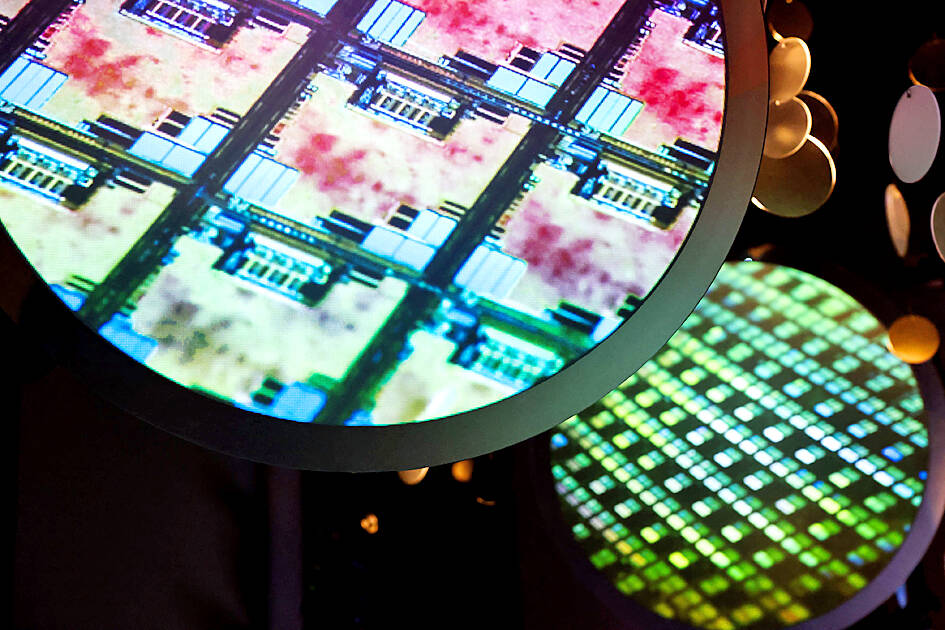
Photo: Cheng I-hwa, AFP
US Secretary of Commerce Howard Lutnick said Taiwanese companies would invest US$250 billion to boost the production of semiconductors, energy and AI in the US.
The figure includes US$100 billion already committed by chipmaker Taiwan Semiconductor Manufacturing Co (TSMC, 台積電) last year, with more to come, he added.
Cheng called the deal “win-win,” saying that it would also encourage US investment in Taiwan.
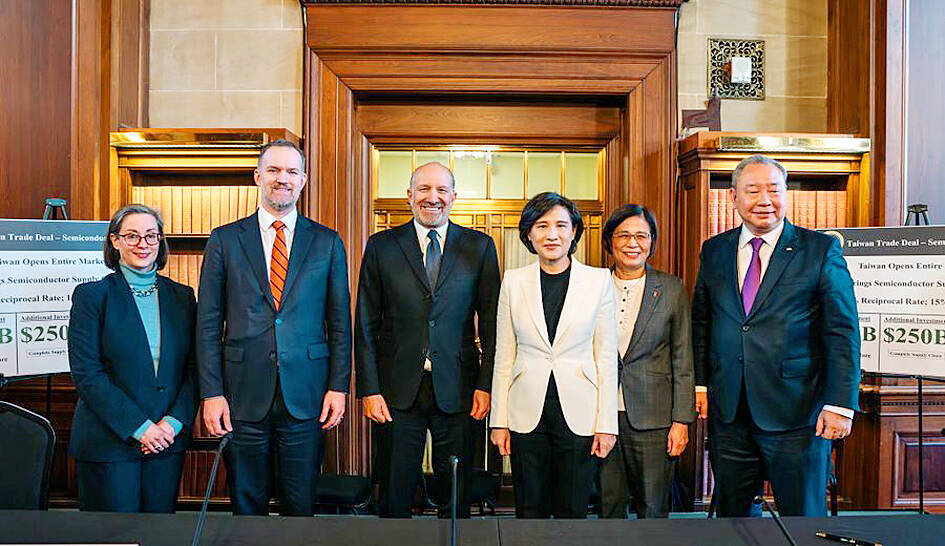
Photo: screen grab from Lutnick’s X account
The investment plan is up to the company, rather than driven by the government, and Taiwanese companies would continue to invest at home, she added.
“We believe [the goal of] this supply-chain cooperation is not ‘move,’ but ‘build.’ We expand our footprint in the US and support it in building local supply chains, but even more so, it is an extension and expansion of Taiwan’s technology industry,” Cheng said.
A memorandum of understanding (MOU) was signed on the investment commitments and a more formal trade pact would be signed in the coming weeks, she added.
The MOU did not provide a timeline on when the US$250 billion investment pledge would have to be fulfilled.
The US said Taiwan would also guarantee an additional US$250 billion in credit to facilitate further investment.
There have been concerns that Taiwanese semiconductor companies investing heavily in the US would hollow out the nation’s domestic industry and weaken the “silicon shield” that protects it from a Chinese attack.
Cheng did not say whether the deal would reduce US dependence on Taiwan, but said she did not believe the increased investment would hurt the Taiwanese semiconductor industry.
“While every country pursues its own national security goals, Taiwan’s priority is to support the international expansion and extension of its high-tech industries,” she said. “This is not an industrial relocation, but an extension and expansion of Taiwan’s technology sector.”
The sector’s output has grown at home while semiconductor companies have expanded their overseas investment footprint, Cheng said.
TSMC in a statement said it welcomed the prospect of “robust” trade pacts between Taiwan and the US, adding that all its investment decisions were based on market conditions and customer demand.
“The market demand for our advanced technology is very strong,” it said. “We continue to invest in Taiwan and expand overseas.”
Lutnick said the objective was to bring 40 percent of Taiwan’s chip supply chain and production to the US.
If they were not built in the US, the tariff would likely be 100 percent.
Additional reporting by CNA

The Legislative Yuan’s Finance Committee yesterday approved proposed amendments to the Amusement Tax Act (娛樂稅法) that would abolish taxes on films, cultural activities and competitive sporting events, retaining the fee only for dance halls and golf courses. The proposed changes would set the maximum tax rate for dance halls and golf courses at 50 and 20 percent respectively, with local governments authorized to suspend the levies. Article 2 of the act says that “amusement tax shall be levied on tickets sold or fees charged by amusement places, facilities or activities” in six categories: “Cinema; professional singing, story-telling, dancing, circus, magic show, acrobatics

Tainan, Taipei and New Taipei City recorded the highest fines nationwide for illegal accommodations in the first quarter of this year, with fines issued in the three cities each exceeding NT$7 million (US$220,639), Tourism Administration data showed. Among them, Taipei had the highest number of illegal short-term rental units, with 410. There were 3,280 legally registered hotels nationwide in the first quarter, down by 14 properties, or 0.43 percent, from a year earlier, likely indicating operators exiting the market, the agency said. However, the number of unregistered properties rose to 1,174, including 314 illegal hotels and 860 illegal short-term rental
INFLATION UP? The IMF said CPI would increase to 1.5 percent this year, while the DGBAS projected it would rise to 1.68 percent, with GDP per capita of US$44,181 The IMF projected Taiwan’s real GDP would grow 5.2 percent this year, up from its 2.1 percent outlook in January, despite fears of global economic disruptions sparked by the US-Iran conflict. Taiwan’s consumer price index (CPI) is projected to increase to 1.5 percent, while unemployment would be 3.4 percent, roughly in line with estimates for Asia as a whole, the international body wrote in its Global Economic Outlook Report published in the US on Monday. The figures are comparatively better than the IMF outlook for the rest of the world, which pegged real GDP growth at 3.1 percent, down from 3.3 percent
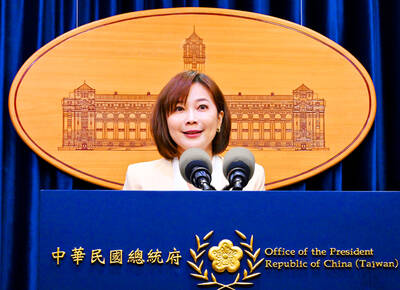
ECONOMIC COERCION: Such actions are often inconsistently applied, sometimes resumed, and sometimes just halted, the Presidential Office spokeswoman said The government backs healthy and orderly cross-strait exchanges, but such arrangements should not be made with political conditions attached and never be used as leverage for political maneuvering or partisan agendas, Presidential Office spokeswoman Karen Kuo (郭雅慧) said yesterday. Kuo made the remarks after China earlier in the day announced 10 new “incentive measures” for Taiwan, following a landmark meeting between Chinese President Xi Jinping (習近平) and Chinese Nationalist Party (KMT) Chairwoman Cheng Li-wun (鄭麗文) in Beijing on Friday. The measures, unveiled by China’s Xinhua news agency, include plans to resume individual travel by residents of Shanghai and China’s Fujian


 RSS
RSS