


The US has agreed to lower tariffs on Taiwanese goods from 20 percent to 15 percent, without stacking them on existing most-favored-nation (MFN) rates, the Executive Yuan said yesterday, adding that Taiwan has also become the first country to secure the most-favorable treatment for its semiconductor and related product suppliers under Section 232 of the US Trade Expansion Act.
The trade negotiations, which concluded on Thursday, included commitments to expand supply chain investment cooperation and deepen Taiwan-US collaboration on artificial intelligence (AI), the Cabinet said.
The new tariff rate matches US rates on goods from major trade partners such as Japan, South Korea and the EU.

Photo: CNA
Taiwanese semiconductor, electronics manufacturing services, AI and energy companies would invest US$250 billion in the US, it added, but did not give a timeframe.
The government has also agreed to provide financial institutions up to US$250 billion in credit guarantees to support semiconductor, and information and communications technology investments, the Executive Yuan said.
Taiwan is the first country to secure the most-favorable treatment for its semiconductor and related product suppliers, which should significantly ease uncertainties in the local semiconductor industry, the Cabinet said.
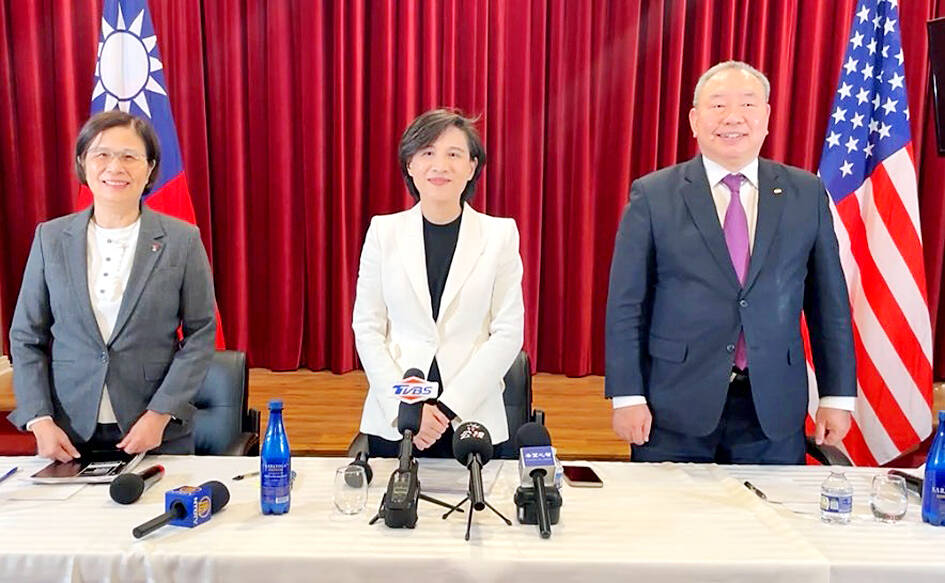
Photo: screen grab from the Executive Yuan’s livestream
Taiwanese semiconductor firms would be granted most-favorable status when they import raw materials, equipment and electronic components for their US operations, it said.
Washington has recognized and accepted a “Taiwan model,” which allows Taiwanese companies to follow their own plans for investing in the US and moving closer to US clients, the Cabinet said, adding that it should encourage local companies to enter the US’ supply chain and build industrial capacity there.
Taiwan has the sixth-largest trade surplus with the US, 90 percent of which is related to sales of semiconductors, information and communications products, and electronic components, it said.
The consensus was reached on Thursday, and a memorandum of understanding was signed with the US Department of Commerce, it added.
A more formal trade pact would be signed in the coming weeks, said Vice Premier Cheng Li-chiun (鄭麗君), who led Taiwan’s trade negotiation team.
Taiwan secured two deals: A reciprocal tariff of 15 percent with no stacking, the lowest rate among countries with which the US runs a trade deficit, and a US pledge to grant the nation “most-favored treatment” if it imposes tariffs under the Trade Act, she said.
The US Department of Commerce described the arrangement as “a historic trade deal that will drive a massive reshoring of America’s semiconductor sector” and “strengthen US economic resilience, create high-paying jobs and bolster national security.”
The Cabinet said the 15 percent tariff without stacking should help make Taiwan’s non-tech sectors more competitive, as they would now be on equal footing with Japan, South Korea and the EU.
Taiwan has also secured most-favorable treatment for other items, such as auto parts, wooden furniture and aircraft components, under the Trade Act, it said, adding that the two countries have agreed to set up a negotiation mechanism under Section 232.
Regarding whether tariffs on vehicles imported from the US would be reduced to zero, Cheng said a full briefing would be provided when the Taiwan-US trade agreement is signed.
Taiwan currently imposes a 17.5 percent tariff on cars imported from the US.
Additional reporting by Chen Yu-fu

‘NO SECURITY RISK’: The Railway Bureau reassured the public that the technicians’ activities were limited to technical guidance and did not involve sensitive systems The Railway Bureau yesterday said it had invited eight Chinese technicians to assist with an airport MRT construction project. The bureau issued the confirmation after an Internet user said Chinese nationals had entered the construction zone of Taiwan Taoyuan International Airport’s Terminal 3 project. They asked why “individuals from an enemy state” were allowed access to such a major national infrastructure project, which raised serious concerns over Taiwan’s industrial safety, sensitive systems and information security. The bureau’s Northern Region Engineering Branch Office said subcontractor Taiwan Handle Industrial Co (台灣手把工業) of the Taoyuan airport MRT’s “Contract No. CU05 Project A14 Station Civil, MEP &

The National Chungshan Institute of Science and Technology yesterday showcased its locally developed variants of the Vision 60 robotic patrol dog, which it plans to deploy on the nation’s outlying territories in the South China Sea. The variants were produced under the Joint Lab project — created by the institute and domestic companies — and assembled with domestically produced motors, lenses and artificial intelligence (AI) systems alongside licensed tech from the US, Missile and Rocket Systems Research Division deputy director Jen Kuo-kang (任國光) told the media event at a military base in Taipei’s Dazhi (大直) area. Taiwan has built up its strengths

NOT IMMEDIATE: Taiwan has a chance to appeal the proposed 10 percent tariff before it starts, while other countries face a 12.5 percent tariff from the trade office Taiwan is among 60 economies determined by the US to have failed to impose or enforce a ban on the importation of goods produced with forced labor, according to a notice released on Tuesday by the Office of the US Trade Representative (USTR), which proposed imposing an additional 10 percent or more tariff on them. The USTR in a statement said that following an investigation, it had determined under Section 301 of the Trade Act of 1974 that the failure of the 60 economies to impose and effectively enforce a prohibition on the importation of goods produced with forced labor is

TIT-FOR-TAT: The US allegedly revoked the visa of a Chinese national working at Xinhua News Agency in the US in response to Beijing’s expulsion of Vivian Wang The Presidential Office yesterday condemned China for expelling a New York Times correspondent from Beijing following the newspaper’s interview with President William Lai (賴清德), saying the move highlighted Beijing’s suppression of press freedom and its threat to international news media. Taiwan has noted a series of recent incidents in which Beijing used similar tactics to “threaten and pressure international media outlets and journalists,” Presidential Office spokeswoman Karen Kuo (郭雅慧) said in a statement. “This concerns not only press freedom and freedom of expression, but also the safety of journalists, and Taiwan and relevant partners are paying close attention to the situation,” she


 RSS
RSS