


More US arms sales to Taiwan are in the pipeline, with four deals pending notification to the US Congress, Deputy Minister of National Defense Hsu Szu-chien (徐斯儉) said today, following the announcement of a US$11 billion package last month, the largest ever for the nation.
The US is Taiwan's most important international backer and arms supplier, despite a lack of formal diplomatic ties.
Speaking to reporters in Taipei after a weekly Cabinet meeting, Hsu said that four additional packages for Taiwan had yet to be formally notified to Congress, the usual process for approval of such sales.
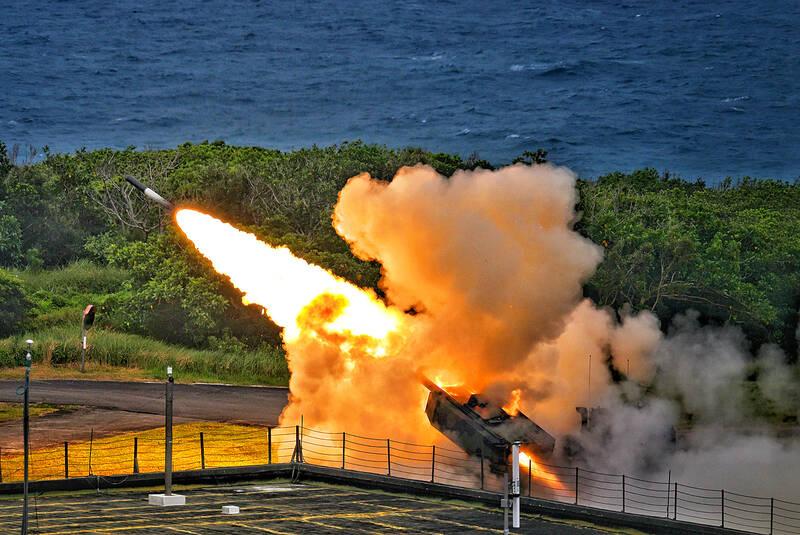
Photo: Chen Yi-kuan, Taipei Times
"Don't ask me what four these are, I cannot say, but there are still four cases yet to be notified to Congress," Hsu said, adding that he could not say more for legal reasons.
The US Department of State did not immediately respond to a request for comment outside Washington business hours.
The arms sales announced last month cover eight items, including Lockheed Martin High Mobility Artillery Rocket Systems and Altius loitering munition drones.
In November last year, President Willaim Lai (賴清德) unveiled a NT$1.25 trillion (US$39.59 billion) special defense budget from this year to 2033 to underscore Taiwan’s determination to defend itself in the face of the rising threat from China.
However, the Chinese Nationalist Party (KMT) and Taiwan People’s Party, which together hold a majority in the legislature, have not let the budget progress to the committee stage for review, saying that the spending details are vague and that they want more details.
Minister of National Defense Wellington Koo (顧立雄) would give lawmakers a confidential briefing on Monday next week, and the ministry is happy to share more details, Hsu said.
"It is not that we are unwilling to explain — give us an opportunity to explain, a legal opportunity," Hsu said. "This is not a black box."
The administration of US President Donald Trump has strongly backed Taiwan's plans to ramp up military spending, something it has been pushing its allies in Europe in particular to do.
Taiwan has to spend more given the threat, Hsu said.
"Everyone knows the threat we are facing is growing and growing," he added.
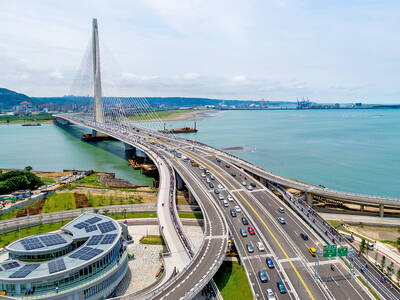
The Ministry of Transportation and Communications yesterday inaugurated the Danjiang Bridge across the Tamsui River in New Taipei City, saying that the structure would be an architectural icon and traffic artery for Taiwan. Feted as a major engineering achievement, the Danjiang Bridge is 920m long, 211m tall at the top of its pylon, and is the longest single-pylon asymmetric cable-stayed bridge in the world, the government’s Web site for the structure said. It was designed by late Iraqi-British architect Zaha Hadid. The structure, with a maximum deck of 70m, accommodates road and light rail traffic, and affords a 200m navigation channel for boats,
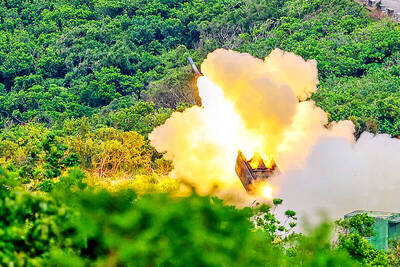
PRECISION STRIKES: The most significant reason to deploy HIMARS to outlying islands is to establish a ‘dead zone’ that the PLA would not dare enter, a source said A High Mobility Artillery Rocket System (HIMARS) would be deployed to Penghu County and Dongyin Island (東引) in Lienchiang County (Matsu) to force the Chinese military to retreat at least 100km from the coastline, a military source said yesterday. Taiwan has been procuring HIMARS and Army Tactical Missile Systems (ATACMS) from the US in batches. Once all batches have been delivered, Taiwan would possess 111 HIMARS units and 504 ATACMS, which have a range of 300km. Considering that “offense is the best defense,” the military plans to forward-deploy the systems to outlying islands such as Penghu and Dongyin so that

WHAT WAS ALL THAT FOR? Jaw Shaw-kong said that Cheng Li-wen had pushed for more drastic cuts and attacked him, just for the outcome to be nearly identical to his bill The legislature yesterday passed a supplementary budget bill to fund the purchase of separate packages of US military equipment, with the combined amount of spending capped at NT$780 billion (US$24.8 billion). The Chinese Nationalist Party (KMT) and Taiwan People’s Party (TPP) used their legislative majority to pass the bill, which runs until 2033 and has two main funding provisions. One was for NT$300 billion of arms sales already approved by the US for Taiwan on Dec. 17 last year, the other was for NT$480 billion for another arms package expected to be announced by Washington. The bill, which fell short of the NT$1.25
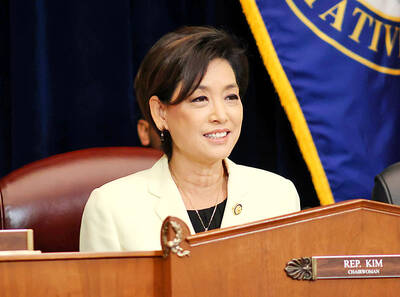
‘CLEAR MESSAGE’: The bill would set up an interagency ‘tiger team’ to review sanctions tools and other economic options to help deter any Chinese aggression toward Taiwan US Representative Young Kim has introduced a bill to deter Chinese aggression against Taiwan, calling for an interagency “tiger team” to preplan coordinated sanctions and economic measures in response to possible Chinese military or political action against Taiwan. “[Chinese President] Xi Jinping [習近平] has directed the People’s Liberation Army to be ready to invade Taiwan by 2027. China has a plan. America should have one too,” Kim said in a news release on Thursday last week. She introduced the “Deter PRC [People’s Republic of China] aggression against Taiwan act” to “ensure the US has a coordinated sanctions strategy ready should


 RSS
RSS