

Taiwan today signaled that a tariff deal with the US could come soon, after its negotiators left for the latest round of talks with Washington, saying both sides are expected to announce where they have reached a "consensus."
Taiwan, a global semiconductor powerhouse, has been in talks with the US to get the tariff on its exports cut from 20 to 15 percent.
Vice Premier Cheng Li-chiun (鄭麗君) and Minister Without Portfolio Yang Jen-ni (楊珍妮), who leads the Cabinet’s Office of Trade Negotiations, late yesterday departed for the US for a sixth round of face-to-face consultations, the Executive Yuan’s working group on Taiwan-US trade said in statement.
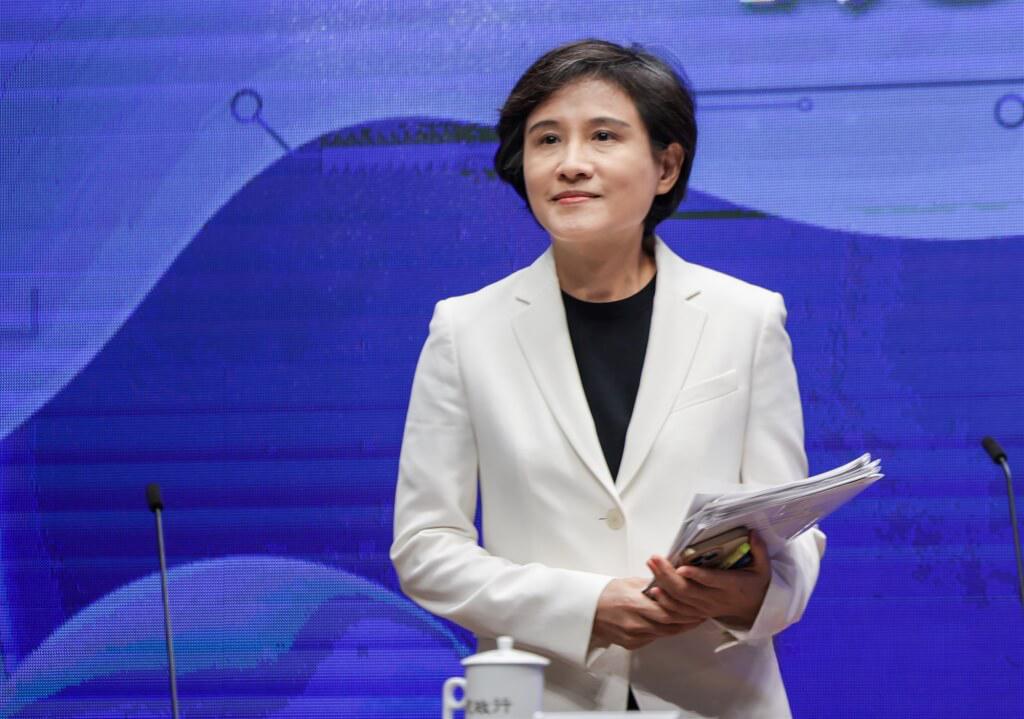
Photo: CNA
The aim is a further reduction in reciprocal tariffs, securing most-favored treatment for tariffs on chips and other products, promoting a better trade balance and forming a strategic partnership on the global artificial intelligence (AI) supply chain, the statement said.
"After this round of consultations, both sides are expected to publicly announce the content on where they have reached consensus," it added, without giving details.
Taiwan would then schedule a date to sign documents with the Office of the US Trade Representative and submit the deal for review in the Legislative Yuan, the statement said.
Two people familiar with the matter said an announcement on the tariffs deal could come by the end of the month.
However, Office of Trade Negotiations spokesman Benjamin Hsu (徐崇欽) said that as the delegation had only just left, it was hard to say when "results can be achieved."
"As for announcing the outcomes, that still requires agreement by both sides," he added.
The White House did not respond to a request for comment on the meetings in Washington. It was not immediately clear which US officials would take part.
A major semiconductor producer, Taiwan has said its offer to the US included help in replicating the nation’s success in building tech clusters around dedicated science parks.
Under the deal, it is expected that chipmaker Taiwan Semiconductor Manufacturing Co (TSMC, 台積電) would commit to building more facilities in Arizona, one of the people said.
TSMC has declined to comment on whether it would invest more in the US on top of the US$165 billion that it has already pledged.
Taiwan's chips are not subject to the US tariffs.
However, US President Donald Trump yesterday imposed a 25 percent tariff on certain AI chips, such as the Nvidia H200 AI processor, under a new national security order released by the White House.
Regarding that new order, Taiwan has previously held multiple discussions with the US and reached a consensus on preferential tariff treatment for semiconductors and related products, the statement said.
"After confirming this with the US side during the current consultations, our side will provide a public explanation," it said, without elaborating.
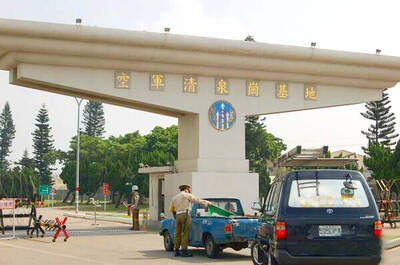
An unauthorized drone intrusion over Ching Chuan Kang Air Base (清泉崗基地) at Taichung International Airport on Tuesday night forced the temporary closure of the base, diverting eight fighter jets and delaying a commercial flight, authorities said. Air Force Command Headquarters said that clear weather had allowed for scheduled night training exercises, but after a drone was spotted entering the airspace, the control tower declared an emergency closure of the airport, forcing eight Indigenous Defense Fighter jets in the air to divert and land at Hsinchu Air Base (新竹基地). Taichung airport director Chang Jui-shu (張瑞澍) said the airspace intrusion lasted from 7:37pm to
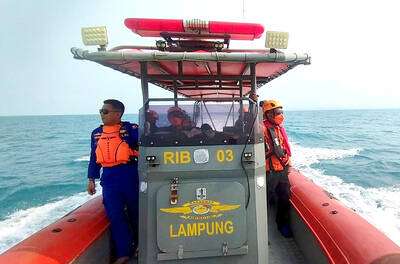
Indonesian rescuers searched for eight people who went missing at sea while heading to a volcanic island to report on an eruption there, officials said yesterday. Anak Krakatau initially erupted for about 25 hours over the weekend, and it has since continued to erupt intermittently with explosions ejecting lava, ash and incandescent volcanic material from the crater, the Indonesian Geology Agency said in a statement. A speedboat carrying five photojournalists, two crew members and a route guide lost contact after leaving Carita, a coastal town in Banten Province, for the volcanic island, Banten Province Search and Rescue Office Chief Al Amrad said. He

PRICE STABILIZATION: The Ministry of Economic Affairs has urged the legislature to support the Cabinet’s supplementary budget for state-owned energy companies State-owned oil supplier CPC Corp, Taiwan (CPC, 台灣中油) on Saturday announced that it would raise domestic gasoline prices by NT$0.7 (US$0.02) per liter and diesel prices by NT$0.6 per liter this week after international crude oil prices rose above US$100 per barrel last week. Formosa Petrochemical Corp (台塑石化) yesterday said that it matched CPC’s price adjustments for this week. The decisions end a six-week period during which CPC and Formosa kept fuel prices in Taiwan unchanged. Retail gasoline prices this week would rise to NT$31.2, NT$32.7 and NT$34.7 per liter for 92, 95 and 98-octane unleaded gasoline respectively at CPC
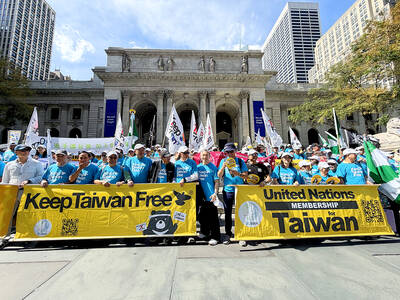
More than 100 Taiwanese-Americans, Taiwanese lawmakers and members of civic groups on Saturday marched through New York City to call for Taiwan’s participation in the UN, with Marshall Island Permanent Representative to the UN John Silk joining the event to show support. Participants chanted: “UN for Taiwan” and “Keep Taiwan Free” as they marched through central Manhattan, passing Times Square and Bryant Park before ending near the New York Public Library. The annual march brought together Taiwanese community groups from across the US East Coast. Silk expressed hope that Taiwan would one day be able to participate in UN meetings


 RSS
RSS