

President William Lai (賴清德) yesterday thanked Canada for its support during recent Chinese military drills and praised the deepening of ties between the two sides, shortly ahead of a visit to China by Canadian Prime Minister Mark Carney.
Two lawmakers from Carney’s Liberal Party this week ended a visit to Taiwan early, citing advice from the Canadian government and to “avoid confusion with Canada’s foreign policy” before Carney visits Beijing starting today.
Meeting the three remaining members of the delegation, from the opposition Conservative Party, Lai said that over the past three years, Taiwan and Canada have made substantive progress in areas such as trade and technology, including the signing of a landmark investment agreement in 2023.

Photo: CNA
“Bilateral relations continue to deepen and yield fruitful results,” Lai said at the Presidential Office in Taipei.
He also expressed appreciation for the Canadian government’s public concern over last month’s Chinese war games around Taiwan.
“I would like to thank the Canadian government for soon releasing a statement expressing its concern and opposing any unilateral attempt to change the ‘status quo,’” he added.
“This once again demonstrated that maintaining the peaceful and stable ‘status quo’ across the Taiwan Strait is not only in the interest of all parties, but also the international consensus,” he said.
Canadian warships on occasion sail through the Taiwan Strait, most recently in September last year.
Lai made no mention of Carney’s visit to China.
Melissa Lantsman, deputy coleader of Canada’s Conservatives, told Lai that Taiwan is a trusted partner.
“We are here with a clear and sincere purpose to say to Taiwan and the people of Taiwan that you have friends in Canada’s parliament,” she said.
In a statement on Monday, the two Liberal Party members — Helena Jaczek and Marie-France Lalonde — said they would end their trip to Taiwan early.
“As this portion of the visit concludes, informed by advice from the government, we are returning home,” their statement said. “It’s important that we avoid confusion with Canada’s foreign policy, given the overlap with the prime minister’s engagement in Beijing, which was only confirmed last week.”
They said Canada’s position on Taiwan has not changed.
Asked about the departure of two ruling party lawmakers, Ministry of Foreign Affairs spokesman Hsiao Kuang-wei (蕭光偉) said some members of the delegation had to leave early “for some reason.”
“The foreign ministry continues to welcome friends from all walks of life to visit Taiwan, and we will continue working with Canada to further deepen exchanges and cooperation across all fields,” Hsiao said.
Mainland Affairs Council Minister Chiu Chui-cheng (邱垂正) said that Canada is a democratic country with lawmakers who are able to make autonomous decisions.
The world is watching Beijing’s diplomatic coercion, he added.
Carney is to discuss trade and international security while in China, at a time when Canada faces uncertain relations with the US due to a trade war and annexation threats from US President Donald Trump.
Additional reporting by Chen Yu-fu
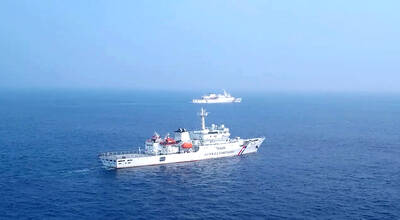
PATROL PARTNERS: The ‘Chiayi’ and the ‘Penghu’ departed for a two-day joint patrol of Palau’s exclusive economic zone, the CGA’s second diplomatic visit to the country The Coast Guard Administration (CGA) set a record for its southernmost deployment of a coast guard vessel as the vessels Chiayi and the Penghu reached Palau’s Pulo Anna Island on Saturday in a cooperative exercise between the two countries. The island, about 217 nautical miles (401km) southwest of Koror in the Palauan state of Sonsorol and 1,220 nautical miles from Taiwan’s southernmost point, Oluanpi (鵝鑾鼻), is the furthest south a CGA vessel has sailed. The two vessels are in Palau for the coast guard’s second diplomatic visit to the country. They docked at Malakal Harbor on Tuesday last week. The coast guard
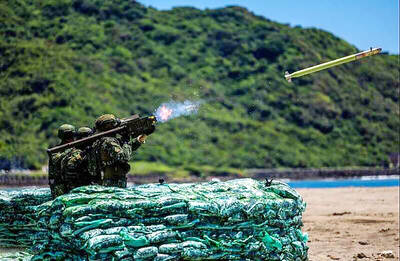
BATCH 1: The military has plans to assign the weapons to the army to defend Taiwan proper, as well as outlying islands and the navy for the Marine Corps, the official said Taiwan is to receive 500 Stinger missiles and 178 launchers from the US by the end of the year, the first batch under a planned two-stage acquisition totaling 2,621 missiles and 763 launchers, a defense official said yesterday on condition of anonymity. The portable missiles would play a vital role in the nation’s air defense capabilities, the source said. The army plans to deploy 2,235 missiles and 657 launchers to defend Taiwan proper and outlying islands, they said, citing military documents. The navy is allotted 295 missiles and 85 launchers to arm the Marine Corps and some surface vessels that lack air defense
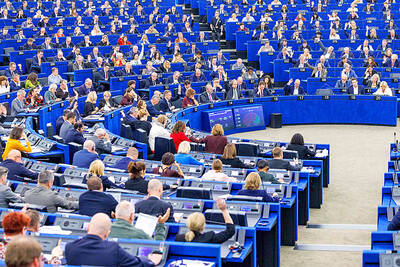
The European Parliament on Wednesday adopted a recommendation on EU-China political relations that rejected China’s efforts to restrict Taiwan’s participation in international organizations and exchanges. The recommendation, addressed to the European Council, the European Commission and EU High Representative for Foreign Affairs and Security Policy Kaja Kallas, includes several references to EU-Taiwan relations and expresses support for closer ties, saying they would bring positive benefits and have strategic importance. Describing Taiwan as a valuable partner in trade and technology, the European Parliament said it “rejects China’s attempts to coerce international organizations, third countries and other actors into restricting Taiwan’s international participation and
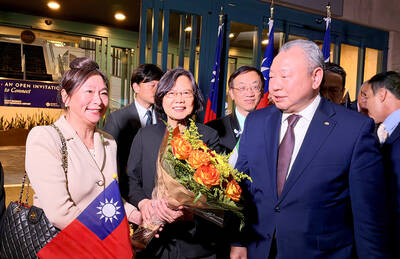
Former president Tsai Ing-wen (蔡英文) on Monday arrived in San Francisco, receiving a warm welcome from hundreds of overseas Taiwanese as she launched a week-long visit. Accompanied by Representative to the US Alexander Yui (俞大?), and head of Taiwan’s San Francisco office Wu Chih-hsiang (伍志翔), Tsai arrived at her hotel, waving, smiling and giving high-fives to Taiwanese compatriots amid cheers of “Taiwan’s democracy involves you and me” to welcome her to the San Francisco Bay Area. It is Tsai’s first visit to the US since she left office in May 2024 after serving two four-year terms as president. Tsai is today to deliver


 RSS
RSS