


Taiwan’s national intelligence community recorded 45,590 fake online accounts last year, up from 28,216 in 2024, the National Security Bureau (NSB) said in a report released yesterday.
As part of its cognitive warfare against Taiwan, the Chinese Communist Party has integrated the resources and technologies of the party, government, military and private enterprises to infiltrate online communities to reshape opinions toward “unification,” the report said.
The report, titled Analysis of China’s Cognitive Warfare Tactics Against Taiwan in 2025, outlines China’s strategic goals and five major tactics.
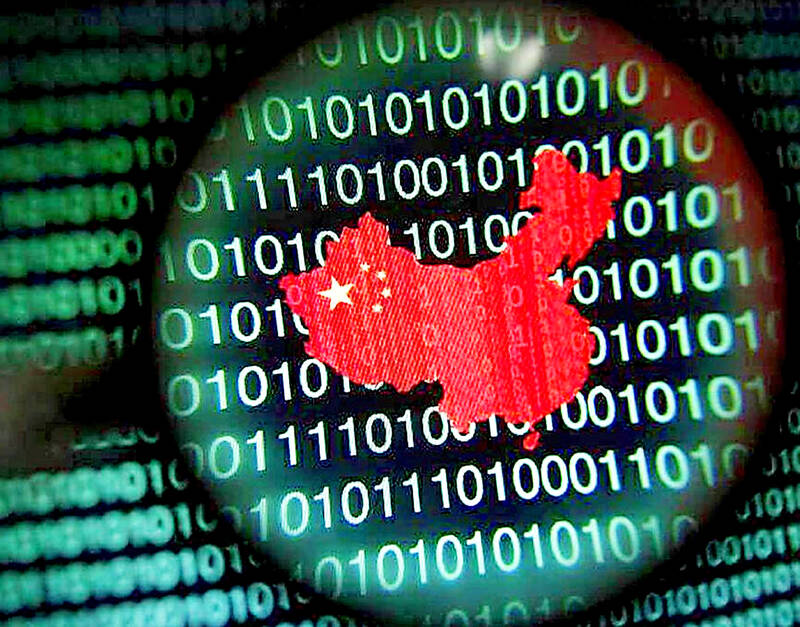
Photo: Reuters
To amplify narratives, manipulate fake accounts and expand external propaganda, China focuses on fostering skepticism toward the US, the Taiwanese military and President William Lai (賴清德), while hyping emotions around selected current events, the NSB said.
More than 2.314 million pieces of disinformation were recorded last year, up from 2.159 million in 2024, the report showed.
More than 3,200 pieces of disinformation were reported to government agencies, allowing them to address cognitive warfare attempts in real time, the bureau said.
China has utilized artificial intelligence (AI) technology to generate highly realistic disinformation and employed big data analysis to precisely disseminate it, attempting to mislead the perceptions of Taiwanese, it said.
China’s four strategic goals are exacerbating internal divisions in Taiwan, weakening the will of Taiwanese to resist China, influencing allies’ willingness to support Taiwan and winning support for China’s position on Taiwan, the bureau said.
To achieve the goals, China has adopted a government-civilian partnership model, integrating its collaborative organizations, including information technology companies, marketing firms and Internet groups, employing five major tactics, the report said.
First, the Cyberspace Administration of China (CAC), the Chinese Ministry of State Security and Political Work Department of the Central Military Commission employ Chinese information technology (IT) companies to collect personal data of Taiwanese political figures, legislators and opinion leaders, including their interpersonal connections and positions on China, it said.
The Chinese IT companies also compile polling data and monitor the social media presence of candidates to launch targeted propaganda campaigns toward Taiwan and specific people, it added.
Second, China employs a wide range of channels, including fake Web sites, content farms and cover channels, to disseminate disinformation, it said.
Third, China employs an “Internet water army” — people paid to flood the Internet with pro-Chinese comments — to conduct influence operations in more than 20 languages across more than 180 social media platforms worldwide, it said.
In addition, the CAC, United Front Work Department and the Chinese People’s Liberation Army Cyberspace Force have tasked Chinese IT companies with setting up a database of online commentators and developing automated programs managing bot accounts for spreading disinformation, the report added.
Fourth, Chinese IT enterprises have developed AI models and intelligent guidance systems to concurrently collect data on public, with automated video generation and precise delivery to targeted audiences, it said.
The companies have also been tasked with developing intelligent voice systems and to place advertisements on recruitment Web sites, aiming to entice unwitting Taiwanese users to submit online recordings, it added.
Fifth, the Chinese cyberarmy hijacked more than a dozen accounts on the Professional Technology Temple (PTT) bulletin board system during China’s military exercises around Taiwan in April last year, it said.
It hacked into Internet of Things devices and rented overseas servers as proxies to spread disinformation such as “China has blockaded Taiwan’s natural gas shipments” and “Chinese warships have entered Taiwan’s 24 nautical mile [44.44km] zone,” it added.
China has expanded the targets of its cognitive warfare to include countries in the global democratic camp, the bureau said.
Government agencies and prominent think tanks in the US, EU, Australia and France issued reports warning of China’s manipulation of information and similar threats, it said.
Taiwan is situated at the forefront of international efforts to counter China’s cognitive warfare, it said.
To expand a network in the democratic community to counter China’s cognitive warfare, the NSB last year engaged in more than 80 security dialogues and intelligence conferences with international friends and allies, it said.
In addition to implementing the reporting and response mechanism across government apparatuses, the NSB said it would step up efforts to cooperate with third-party fact-checking organizations and social media platform operators, urging them to duly disclose and take down false information.
The efforts aim to prevent hostile foreign forces from conducting influence operations against Taiwan, ensuring an unmanipulated public opinion arena, it said.

‘NO SECURITY RISK’: The Railway Bureau reassured the public that the technicians’ activities were limited to technical guidance and did not involve sensitive systems The Railway Bureau yesterday said it had invited eight Chinese technicians to assist with an airport MRT construction project. The bureau issued the confirmation after an Internet user said Chinese nationals had entered the construction zone of Taiwan Taoyuan International Airport’s Terminal 3 project. They asked why “individuals from an enemy state” were allowed access to such a major national infrastructure project, which raised serious concerns over Taiwan’s industrial safety, sensitive systems and information security. The bureau’s Northern Region Engineering Branch Office said subcontractor Taiwan Handle Industrial Co (台灣手把工業) of the Taoyuan airport MRT’s “Contract No. CU05 Project A14 Station Civil, MEP &

A US uncrewed surface vessel (USV) encountered multiple Chinese warships during an autonomous transit of the Taiwan Strait, US defense company Seasats said in a statement on Wednesday. Seasats announced that a Lightfish USV had completed the first autonomous transit of the Taiwan Strait. Over five days, the USV traversed the entire length of the Strait while constantly monitoring surface vessel traffic, the company said. The Lightfish encountered multiple Chinese warships, one of which was a Chinese People’s Liberation Army Navy (PLAN) Type 056 corvette, it said. The Chinese vessels were operating “well within Taiwan’s exclusive economic zone without transmitting their identity via the

Taiwan is still in the process of assessing the possibility of recruiting workers from Eswatini, the Ministry of Foreign Affairs said yesterday, adding that its goal is to help Eswatini upgrade its vocational training centers. If there are plans to recruit workers from Eswatini, safeguarding national security, protecting public health and ensuring the employment rights of Taiwanese would be prerequisites, Department of West Asian and African Affairs Director-General Yen Chia-liang (顏嘉良) told a news conference. Key considerations would also include filling labor shortages in specific industries, and fostering bilateral professional and technical exchanges, he said. Yen was asked about the progress of labor

‘BOOMING’: ’ The number of partners we have here is incredible. You can see from their stock prices. They’re doing so well, they’re so happy,’ Jensen Huang said Nvidia Corp’s spending in Taiwan has ballooned to about US$150 billion a year, 10 times the US$10 billion to US$15 billion the company spent five years ago, Nvidia chief executive officer Jensen Huang (黃仁勳) said yesterday, suggesting Taiwan’s strategic importance in the global artificial intelligence (AI) supply chain. “Taiwan is the epicenter of the AI revolution. This is where the chips come, packaging comes. This is where the systems are made. This is where AI supercomputers were created,” Huang said at a meeting for the company’s employees in Beitou-Shilin Technology Park (北投士林科技園區) in Taipei, the planned site of Nvidia’s Taipei headquarters. “Taiwan


 RSS
RSS