


President William Lai (賴清德), in his New Year’s Day address yesterday, urged the opposition parties to put national security before partisan politics and swiftly pass a NT$1.25 trillion (US$39.76 billion) special defense budget amid China’s “rising expansionary ambitions.”
“As president, my position has always been clear: to staunchly defend national sovereignty, strengthen national defense, and enhance whole-of-society defense and resilience, and to comprehensively establish robust deterrence and democratic defense mechanisms,” Lai said in the address titled “Island of Resilience — Light of Hope.”
To that end, Lai said that his administration has drafted legal revisions aimed at bolstering national security, and has proposed the special defense budget to strengthen Taiwan’s overall defense posture over the next eight years and boost the domestic weapons manufacturing industry.
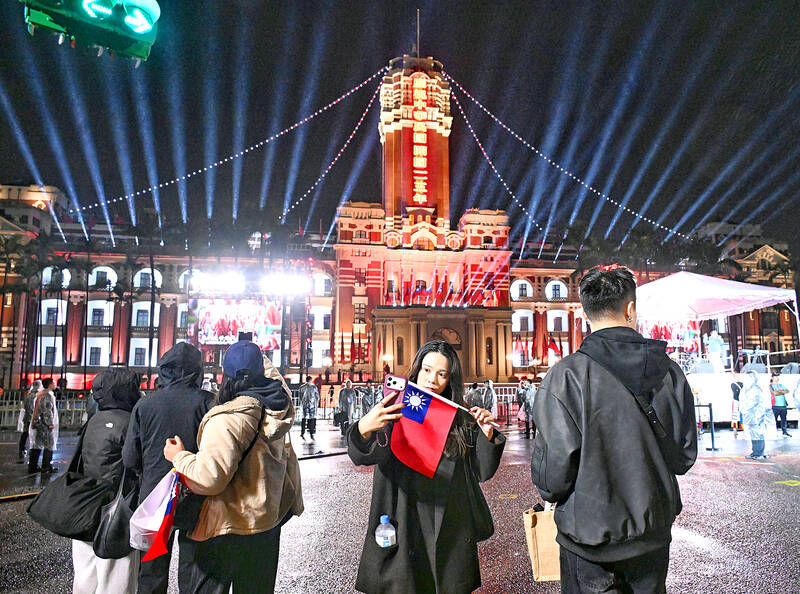
Photo: Fang Pin-chao, Taipei Times
“Facing China’s alarming military ambitions, Taiwan has no time to wait and certainly no time to consume ourselves with internal strife,” Lai said.
“We might hold different views on many issues, but without strong and resilient national defense, there will be no country, nor will there be space allowed for us to debate,” he said, adding that this should be a “national consensus across party lines.”
The opposition Chinese Nationalist Party (KMT) and Taiwan People’s Party, which together hold a legislative majority, on Tuesday blocked the review of the special budget for a fifth time, even as China was conducting massive military exercises in five maritime zones and in the airspace around Taiwan.
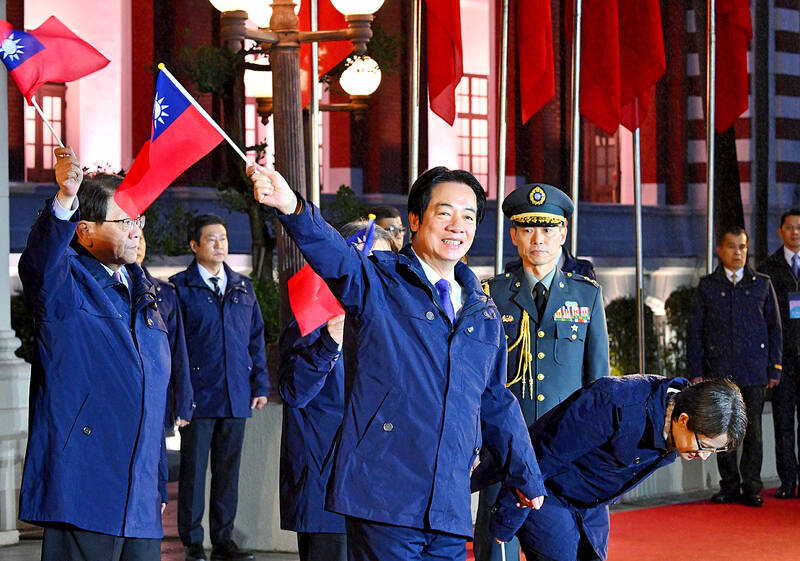
Photo: Liu Hsin-de, Taipei Times
In response to a reporter’s question after his speech, Lai said it is a worrying thought that some Taiwan-friendly countries might temper their support based on their perception of Taiwan’s commitment to self-defense, if the opposition parties continue to boycott the special budget.
“Therefore, I very much hope that the opposition parties will allow this budget to pass, to enable us to better protect this country and its people,” he said.
The president told reporters that while the international community was unanimously condemning China’s military drills around Taiwan, “the opposition parties were still finding excuses for China.”
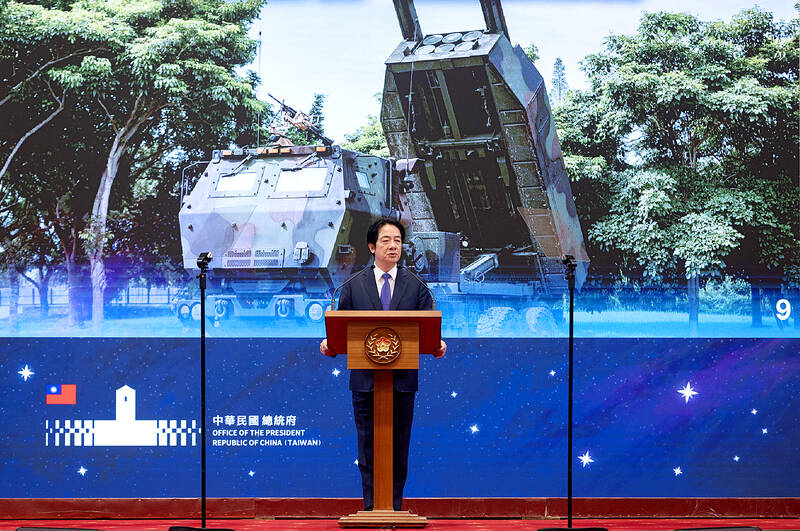
Photo: CNA
“I hope that the ruling and opposition parties will demonstrate unity,” he said. “This is the only way to avoid China getting the wrong message — that it can invade Taiwan.”
Asked about a US report saying that China was preparing to have the capability to win a fight for Taiwan by next year, Lai said that “whether China can achieve its goals on schedule is one thing.”
“The coming year, 2026, will be a crucial one for Taiwan,” he said, adding that Taiwan must “make plans for the worst, but hope for the best.”
Photo: Fang Pin-chao, Taipei Times
“We are willing to engage in exchanges and cooperation with China on an equal and dignified basis, promoting a peaceful and shared environment across the strait,” Lai said. “As long as China acknowledges the existence of the Republic of China, respects the Taiwanese people’s desire for a democratic and free way of life.”
After the address, China said Lai was trying to deceive Taiwanese and mislead the international community.
“William Lai’s address is riddled with lies and reckless assertions, hostility and malice,” a spokesperson for China’s Taiwan Affairs Office said in comments reported by state broadcaster China Central Television.
Asked to comment on the opposition’s move to impeach him, Lai said it was “impossible,” urging lawmakers instead to focus on reviewing budgets.
The impeachment vote, which would require the approval of two-thirds of all lawmakers to advance to the Constitutional Court for deliberation, would be a “waste of time,” he said.
“You know very well that you do not have a two-thirds majority, and yet you tendered the motion anyway,” Lai said, referring to opposition lawmakers.
“You should be spending that precious time reviewing the general budget, the special defense budget and bills that would drive the country’s economic growth,” he said, adding that he hoped lawmakers from opposition parties would clearly explain to the public why they were pursuing impeachment instead.
Additional reporting by Reuters
South Korea has adjusted its electronic arrival card system to no longer list Taiwan as a part of China, a move that the Ministry of Foreign Affairs said would help facilitate exchanges between the two sides. South Korea previously listed “Taiwan” as “Taiwan (China)” in the drop-down menus of its online arrival card system, where people had to fill out where they came from and their next destination. The ministry had requested South Korea make a revision and said it would change South Korea’s name on Taiwan’s online immigration system from “Republic of Korea” to “Korea (South),” should the issue not be

Tainan, Taipei and New Taipei City recorded the highest fines nationwide for illegal accommodations in the first quarter of this year, with fines issued in the three cities each exceeding NT$7 million (US$220,639), Tourism Administration data showed. Among them, Taipei had the highest number of illegal short-term rental units, with 410. There were 3,280 legally registered hotels nationwide in the first quarter, down by 14 properties, or 0.43 percent, from a year earlier, likely indicating operators exiting the market, the agency said. However, the number of unregistered properties rose to 1,174, including 314 illegal hotels and 860 illegal short-term rental
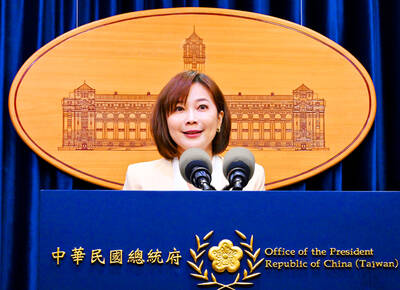
ECONOMIC COERCION: Such actions are often inconsistently applied, sometimes resumed, and sometimes just halted, the Presidential Office spokeswoman said The government backs healthy and orderly cross-strait exchanges, but such arrangements should not be made with political conditions attached and never be used as leverage for political maneuvering or partisan agendas, Presidential Office spokeswoman Karen Kuo (郭雅慧) said yesterday. Kuo made the remarks after China earlier in the day announced 10 new “incentive measures” for Taiwan, following a landmark meeting between Chinese President Xi Jinping (習近平) and Chinese Nationalist Party (KMT) Chairwoman Cheng Li-wun (鄭麗文) in Beijing on Friday. The measures, unveiled by China’s Xinhua news agency, include plans to resume individual travel by residents of Shanghai and China’s Fujian

Chinese President Xi Jinping (習近平) and Chinese Nationalist Party (KMT) Chairwoman Cheng Li-wun (鄭麗文) met in Beijing yesterday, where they vowed to bring people on both sides of the Taiwan Strait closer to facilitate the “great rejuvenation of the Chinese nation.” The meeting was held in the East Hall of the Great Hall of the People, a venue typically reserved for meetings between Xi and foreign heads of state. In public remarks prior to a closed-door meeting, Xi, in his role as head of the Chinese Communist Party (CCP), said that Taiwan is historically part of China, and remains an “inalienable” and


 RSS
RSS