


Taiwan’s stock market yesterday closed out Taiwan’s stock market yesterday closed out the year at a historic high, with the benchmark TAIEX closing at 28,963.60 points on the final trading day of 2025.
The index yesterday rose 256.47 points, or 0.89 percent, to set a new record, capping an annual gain of 5,928.5 points, or 25.73 percent.
The performance placed Taiwan among the world’s top-performing markets and pushed the market capitalization of all companies listed on the Taiwan Stock Exchange to a record NT$94.36 trillion (US$3 trillion) at the end of the year, up about NT$20.46 trillion from a year earlier, Taiwan Stock Exchange data showed.
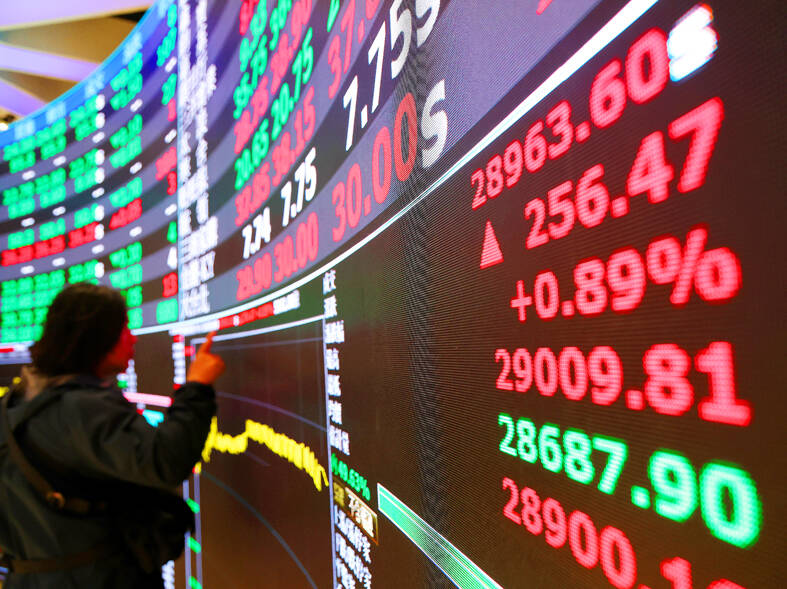
Photo: CNA
Together with the market capitalization of all companies listed on the Taipei Exchange, the combined market capitalization of all listed firms in Taiwan past the NT$100 trillion mark for the first time, highlighting the scale of last year’s rally, the data showed.
Mega International Investment Services Corp (兆豐國際投顧) analyst Alex Huang (黃國偉) said that artificial intelligence (AI)-focused stocks emerged as the dominant theme last year, driven by strong demand for local suppliers supporting the construction and expansion of AI data centers by US technology giants.
The TAIEX has posted annual gains exceeding 20 percent for three consecutive years, following increases of 26.83 percent in 2023 and 28.47 percent in 2024.
Based on the latest exchange statistics through the end of November, Taiwan had about 13.71 million securities trading accounts, translating into an average gain of about NT$1.49 million per investor last year.
The showings highlight the resilience of Taiwan’s technology-driven equity market and the strong global demand for its semiconductor exports, Huang said.
Taiwan Semiconductor Manufacturing Co (台積電) was the single largest driver of the market rally after the chipmaker raised its full-year earnings outlook twice, forecasting nearly 35 percent revenue growth in US dollar terms on robust demand for AI applications and high-performance computing.
The stock ended the year at a record NT$1,550, up 44.18 percent annually, adding NT$12.31 trillion in market value and contributing 3,813 points to the TAIEX, exchange data showed.
AI-related momentum extended across the broader market, lifting server makers, power management suppliers and memorychip producers amid structural shortages in DRAM and NAND flash chips, Huang said.
However, institutional players took profit and cut positions at the end of the year, with foreign investors selling a net NT$519 million, mutual funds offloading NT$2.65 billion and proprietary traders recording a combined net sale of NT$3.36 billion of shares on the main board.
Over the full year, foreign investors accounted for NT$599.51 billion in net sales, while mutual funds posted net purchases of NT$106.03 billion, and dealers were net sellers of NT$148.21 billion of shares.
Demand for AI infrastructure would remain the dominant theme heading into this year, while the pace and scale of US interest rate cuts would be key variables shaping global market trends, analysts said.
Global and local securities houses remain generally bullish on Taiwan equities, projecting that the TAIEX could challenge new record highs. Optimistic scenarios suggest the index would peak in the 32,000 to 34,000 range, supported by continued earnings growth, and structural drivers such as AI and technology demand.
International asset managers recommend exposure to technology-linked exchange-traded funds and growth equities, although many caution that valuation discipline and potential interim volatility would remain important considerations for investors.

‘NO SECURITY RISK’: The Railway Bureau reassured the public that the technicians’ activities were limited to technical guidance and did not involve sensitive systems The Railway Bureau yesterday said it had invited eight Chinese technicians to assist with an airport MRT construction project. The bureau issued the confirmation after an Internet user said Chinese nationals had entered the construction zone of Taiwan Taoyuan International Airport’s Terminal 3 project. They asked why “individuals from an enemy state” were allowed access to such a major national infrastructure project, which raised serious concerns over Taiwan’s industrial safety, sensitive systems and information security. The bureau’s Northern Region Engineering Branch Office said subcontractor Taiwan Handle Industrial Co (台灣手把工業) of the Taoyuan airport MRT’s “Contract No. CU05 Project A14 Station Civil, MEP &

The National Chungshan Institute of Science and Technology yesterday showcased its locally developed variants of the Vision 60 robotic patrol dog, which it plans to deploy on the nation’s outlying territories in the South China Sea. The variants were produced under the Joint Lab project — created by the institute and domestic companies — and assembled with domestically produced motors, lenses and artificial intelligence (AI) systems alongside licensed tech from the US, Missile and Rocket Systems Research Division deputy director Jen Kuo-kang (任國光) told the media event at a military base in Taipei’s Dazhi (大直) area. Taiwan has built up its strengths
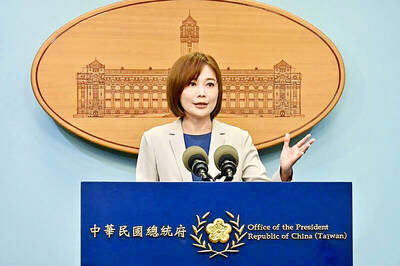
TIT-FOR-TAT: The US allegedly revoked the visa of a Chinese national working at Xinhua News Agency in the US in response to Beijing’s expulsion of Vivian Wang The Presidential Office yesterday condemned China for expelling a New York Times correspondent from Beijing following the newspaper’s interview with President William Lai (賴清德), saying the move highlighted Beijing’s suppression of press freedom and its threat to international news media. Taiwan has noted a series of recent incidents in which Beijing used similar tactics to “threaten and pressure international media outlets and journalists,” Presidential Office spokeswoman Karen Kuo (郭雅慧) said in a statement. “This concerns not only press freedom and freedom of expression, but also the safety of journalists, and Taiwan and relevant partners are paying close attention to the situation,” she

NOT IMMEDIATE: Taiwan has a chance to appeal the proposed 10 percent tariff before it starts, while other countries face a 12.5 percent tariff from the trade office Taiwan is among 60 economies determined by the US to have failed to impose or enforce a ban on the importation of goods produced with forced labor, according to a notice released on Tuesday by the Office of the US Trade Representative (USTR), which proposed imposing an additional 10 percent or more tariff on them. The USTR in a statement said that following an investigation, it had determined under Section 301 of the Trade Act of 1974 that the failure of the 60 economies to impose and effectively enforce a prohibition on the importation of goods produced with forced labor is


 RSS
RSS