

North Korean leader Kim Jong-un has ordered officials to step up production of missiles and construct more factories to meet his military’s growing need for the projectiles, state media said yesterday.
Pyongyang has significantly increased missile testing over the past few years — which analysts said aim to improve precision-strike capabilities, challenge the US and South Korea, and test weapons before exporting them to key ally Russia.
In a visit to munitions factories accompanied by top officials, the state-run Korean Central News Agency (KCNA) said Kim had ordered the factories to prepare for a busy year ahead.

Photo: AFP, KCNA via KNS
Kim said they needed “to further expand the overall production capacity” to keep pace with demand from Pyongyang’s armed forces and ordered the building of new munitions plants, KCNA reported.
“The missile and shell production sector is of paramount importance in bolstering up the war deterrent,” Kim was cited as saying.
Washington has also pointed to evidence that Russia is stepping up support for North Korea, including providing help on advanced space and satellite technology, in return for its assistance in fighting Ukraine.
Satellite launchers and intercontinental ballistic missiles (ICBMs) share much of the same underlying technology, analysts said.
“With its ICBM program already at a stage widely seen as having achieved core objectives, Pyongyang is likely to further accelerate development next year,” researcher Ahn Chan-il, said.
The country is likely to shift “focus toward testing and producing systems linked to potential exports to Russia — including medium and intermediate-range missiles,” he added.
Kim’s visit was reported a day after state media said he had toured a nuclear submarine factory and vowed to counter the “threat” of Seoul producing its own such vessels with Washington’s backing.
North Korea is expected to “seek advanced military technologies from Russia, including nuclear-powered submarine capabilities and fighter jets, as it looks to address its air force’s relative weakness,” Ahn said.
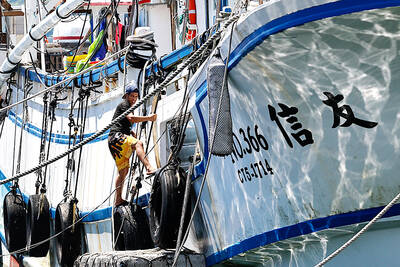
BAVI: Taipei, New Taipei City, Taoyuan and others announced work and class closures today, with the storm expected to affect Taiwan through tomorrow The outer rain bands of Typhoon Bavi would begin affecting Taiwan today, with its storm circle reaching land this evening and its level-10 wind radius covering all of northern Taiwan by noon tomorrow, an official said yesterday. The Central Weather Administration (CWA) issued a sea warning for the storm at 2:30pm yesterday, advising of heightened danger in eastern areas and in the Bashi Channel south of Taiwan. Typhoon Bavi is expected to bring strong winds, extremely heavy rainfall and rough seas to Taiwan today and tomorrow, with the heaviest rain forecast for mountainous areas and sustained winds of up to 12 on
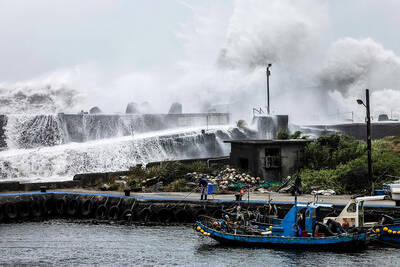
Typhoon Bavi was expected to have its strongest impact on Taiwan from last night through daytime today, with its storm circle forecast to reach areas from New Taipei City’s northeast coast to Yilan and Hualien counties early today, the Central Weather Administration (CWA) said yesterday. As of 6pm yesterday, the center of the typhoon was about 590km east of Taiwan’s southernmost tip at Oluanpi (鵝鑾鼻), moving northwest at 26kph, the CWA said. The storm was packing maximum sustained winds of 155kph near its center, with gusts reaching 191kph. It had a radius of 380km. A land warning, issued at 5:30am yesterday, remains in
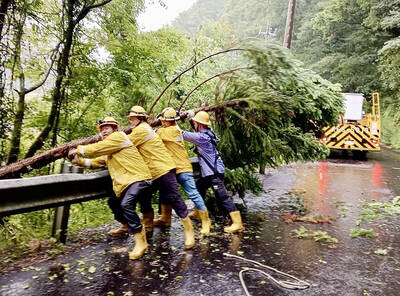
Typhoon Bavi lashed Taiwan yesterday, injuring 113 people, prompting the evacuation of 14,605 residents and knocking out power in 234,481 households, the government said. Most of the injuries were due to people falling off motorcycles or bicycles due to strong winds and slippery roads, and others occurred during the typhoon preparations, Central Emergency Operations Center (CEOC) data as of 8pm yesterday showed. No fatalities or severe injuries had been reported as of press time last night. Due to flooding and landslide risks, 14,605 people had been evacuated nationwide, led by 5,182 people in Hualien County, 2,096 in Taichung, 1,700 in New Taipei,
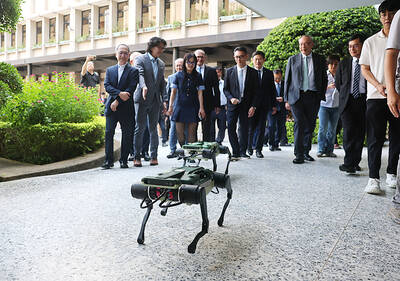
APPLICATIONS: The robots are capable of disaster and firefighting response, autonomous navigation, swarm operations as well as underground tunnel inspections, the ministry said The Ministry of Economic Affairs is working with the Industrial Technology Research Institute (ITRI) and industry partners to create a homegrown program to develop four-legged robots to tap into the US$4 billion global robot dog market. The initiative aims to leverage Taiwan’s strengths in information and communications technology, semiconductors and precision machinery to build indigenous technologies and a non-China supply chain, the ministry said. Technology is evolving from robotic arms to wheeled, quadruped and humanoid robots with autonomous mobility capabilities, it said. Driven by rapid advancements in generative artificial intelligence (AI), visual recognition, sensors and high-performance computing, robots are now capable of


 RSS
RSS