


The north concourse of Taiwan Taoyuan International Airport’s Terminal 3 officially began operations yesterday and is expected to ease congestion during early-morning transfer and departure peak hours, the airport operator said.
About 40 flights are to use the north concourse every day, Taoyuan International Airport Corp (TIAC, 桃園國際機場) said.
The new concourse is expected to significantly cut the use of remote aircraft stands, where passengers have to be bused to and from planes, improving passenger flow, the airport company added.
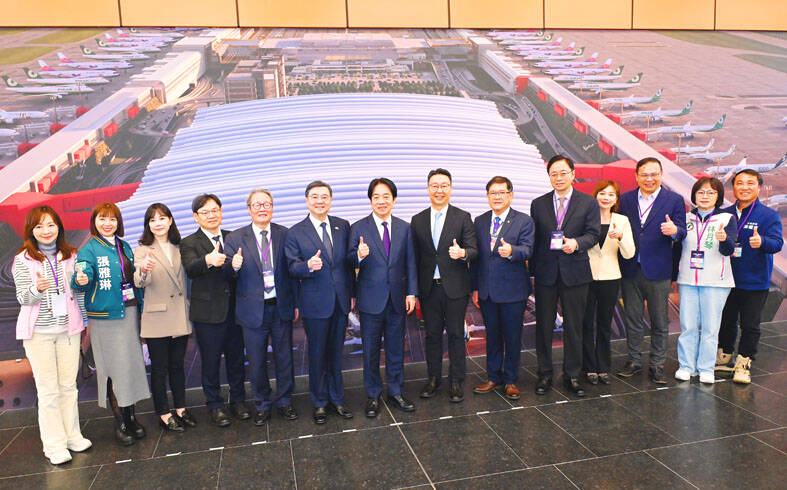
Photo: Liu Hsin-de, Taipei Times
During a trial period, which began on Dec. 1, 259 takeoffs and landings were recorded, with passenger traffic of 58,801, it said.
Terminal 3 was designed by British architect Richard Rogers, who also designed the Pompidou Centre in Paris.
The terminal’s design incorporates traditional Taiwanese roof tiles, mountain ridges, ocean waves and clouds.
The north concourse features a bright, modern design with silver-gray and orange accents.
Besides regular seating and standing areas with power outlets, 30 massage chairs are available free of charge.
The north concourse extends from Gate D10 in Terminal 2 and connects to gates D11 through D18.
As the main Terminal 3 complex is to be completed and opened in 2027, passengers using the concourse need to clear immigration and security at Terminal 2.
At a ceremony marking the concourse’s opening, President William Lai (賴清德) said that goals to be completed include finishing Terminal 3 by 2027 to allow construction of the airport’s third runway to begin.
Another goal is to ensure external transport links to the airport are completed on schedule, Lai said.
Another is for Taoyuan airport to handle 83 million passengers, 3.85 million tonnes of cargo, and 435,000 takeoffs and landings annually by 2045, creating an economic impact of NT$2.2 trillion (US$69.89 billion), he said.
The ceremony was attended by airport officials including and TIAC chairman Yang Wei-fuu (楊偉甫) and other politicians, including Premier Cho Jung-tai (卓榮泰) and Taoyuan Mayor Chang San-cheng (張善政).
Separately, a global ranking found that Taipei-to-Hong Kong was the busiest cross-border airline route this year, with 6.8 million seats sold.
The route, which is serviced by seven carriers, has consistently topped the ranking, including last year and in 2019, Official Aviation Guide said.
The average fare was US$115, down 6 percent from last year, it said.
Taipei was also represented in ninth, with the Taipei-Tokyo (Narita) route ferrying 4 million passengers, it said.
Additional reporting by Kayleigh Madjar
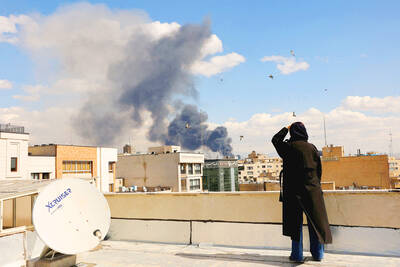
CHAOS: Iranians took to the streets playing celebratory music after reports of Khamenei’s death on Saturday, while mourners also gathered in Tehran yesterday Iranian Supreme Leader Ayatollah Ali Khamenei was killed in a major attack on Iran launched by Israel and the US, throwing the future of the Islamic republic into doubt and raising the risk of regional instability. Iranian state television and the state-run IRNA news agency announced the 86-year-old’s death early yesterday. US President Donald Trump said it gave Iranians their “greatest chance” to “take back” their country. The announcements came after a joint US and Israeli aerial bombardment that targeted Iranian military and governmental sites. Trump said the “heavy and pinpoint bombing” would continue through the week or as long
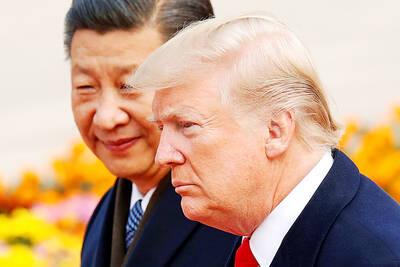
TRUST: The KMT said it respected the US’ timing and considerations, and hoped it would continue to honor its commitments to helping Taiwan bolster its defenses and deterrence US President Donald Trump is delaying a multibillion-dollar arms sale to Taiwan to ensure his visit to Beijing is successful, a New York Times report said. The weapons sales package has stalled in the US Department of State, the report said, citing US officials it did not identify. The White House has told agencies not to push forward ahead of Trump’s meeting with Chinese President Xi Jinping (習近平), it said. The two last month held a phone call to discuss trade and geopolitical flashpoints ahead of the summit. Xi raised the Taiwan issue and urged the US to handle arms sales to
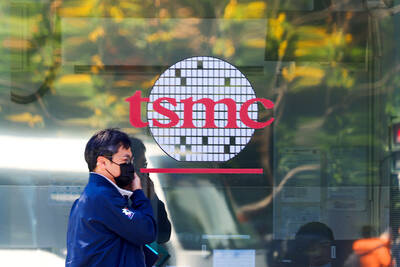
BIG SPENDERS: Foreign investors bought the most Taiwan equities since 2005, signaling confidence that an AI boom would continue to benefit chipmakers Taiwan Semiconductor Manufacturing Co’s (TSMC, 台積電) market capitalization swelled to US$2 trillion for the first time following a 4.25 percent rally in its American depositary receipts (ADR) overnight, putting the world’s biggest contract chipmaker sixth on the list of the world’s biggest companies by market capitalization, just behind Amazon.com Inc. The site CompaniesMarketcap.com ranked TSMC ahead of Saudi Aramco and Meta Platforms Inc. The Taiwanese company’s ADRs on Tuesday surged to US$385.75 on the New York Stock Exchange, as strong demand for artificial intelligence (AI) applications led to chip supply constraints and boost revenue growth to record-breaking levels. Each TSMC ADR represents
State-run CPC Corp, Taiwan (CPC, 台灣中油) yesterday said that it had confirmed on Saturday night with its liquefied natural gas (LNG) and crude oil suppliers that shipments are proceeding as scheduled and that domestic supplies remain unaffected. The CPC yesterday announced the gasoline and diesel prices will rise by NT$0.2 and NT$0.4 per liter, respectively, starting Monday, citing Middle East tensions and blizzards in the eastern United States. CPC also iterated it has been reducing the proportion of crude oil imports from the Middle East and diversifying its supply sources in the past few years in response to geopolitical risks, expanding


 RSS
RSS