


Taiwan has “direct contact” with Honduras’ new president-elect, and with the assistance of the US, the restoration of formal diplomatic relations is “something to look forward to,” a senior foreign affairs official said yesterday.
The National Party of Honduras’ Nasry Asfura on Wednesday was declared the winner of the presidential vote with 40.3 percent of the vote in a tight race against Salvador Nasralla of the Liberal Party, who garnered 39.5 percent.
During the campaign, Asfura and Nasralla both pledged to restore formal diplomatic ties with Taiwan, which were severed in 2023 by Honduran President Xiomara Castro in favor of China, ending an 82-year alliance.
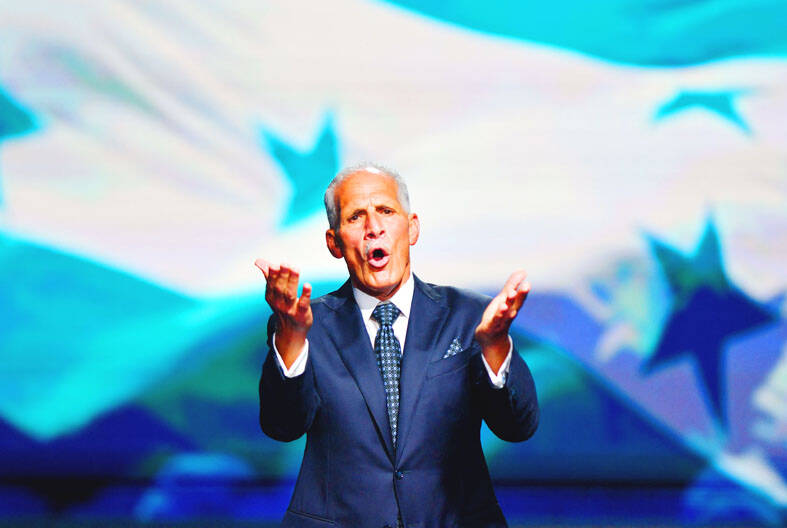
Photo: AFP
In July, Asfura told Bloomberg that Honduras was “100 times better off” with Taiwan.
He identified a triangle of cooperation involving Taiwan, the US and Israel as his primary strategy for boosting the national economy.
The Ministry of Foreign Affairs in a statement yesterday said that it would maintain an “open and pragmatic” attitude toward developments with Honduras.
The ministry called on Asfura to implement policies based on the welfare of the public, but also said it remained committed to its consistent stance of maintaining an “open and pragmatic” approach to relations, without offering any further comment on the possibility of restoring ties.
It congratulated Asfura via special channels following the contentious election, a high-ranking ministry official said on condition of anonymity.
Taiwan had established contact with Asfura and Nasralla, as both had taken a pro-Taiwan stance, the source said.
Taipei is confident that Asfura would implement his campaign promise to restore his country’s official relationship with Taiwan, the source said, citing the president-elect’s record for consistency in policy and messaging.
The ministry is optimistic about progress in re-establishing formal diplomatic relations between the two nations, the source said.
However, the government is refraining from making overt comments on the Honduran election in light of the political situation there, they said.
Taiwan is being represented by people engaged in talks with Asfura in the country toward restoring formal diplomatic relations, they said.
US President Donald Trump publicly supported Asfura’s bid for the presidency and backs Taiwan’s quest to repair its relationship with Honduras, the source said.
Additionally, Taipei’s Diplomatic Allies Prosperity Project is compatible to Trump’s New Monroe Doctrine, which taken together would likely have a positive effect on regional economic development, the official said.
Taiwanese efforts to bolster the economies of Guatemala and Belize are in sharp contrast with Beijing’s failed implementation of its Belt and Road Initiative in the region, the source said.
The outcome of the election in Honduras can be seen as voters’ rejection of unfulfilled Chinese promises and backlash against its economic coercion, they said.
Taiwan believes that Costa Rican voters might also distance their nation from Beijing in general elections there in February, the source said.
The push to restore ties with Honduras has followed a period of severe economic hardship for the nation’s aquaculture sector.
In July, El Heraldo cited data from the National Association of Aquaculturists of Honduras showing that shrimp exports to Taiwan plummeted by 74 percent in the first six months of this year compared with 2023, with China not picking up the slack.
Customs Administration data showed that the value of Honduran shrimp imports dropped from US$106 million in 2023 to just US$22.36 million in the first 11 months of this year.
Despite Asfura’s win, Nasralla and Honduran Congress President Luis Redondo of the ruling Libre Party have rejected the outcome, alleging the exclusion of ballots that should have been counted, despite the Honduran electoral council declaring the 67-year-old Asfura the victor.
“Honduras: I’m ready to govern. I won’t let you down,” Asfura wrote on X after the win was declared, thanking election officials for validating the result.
He is to take office on Jan. 27.
Additional reporting by AFP
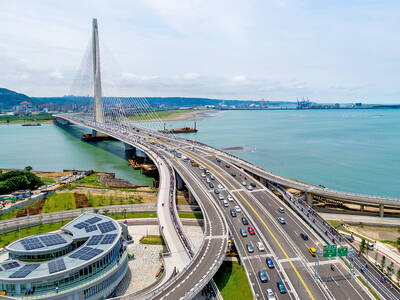
The Ministry of Transportation and Communications yesterday inaugurated the Danjiang Bridge across the Tamsui River in New Taipei City, saying that the structure would be an architectural icon and traffic artery for Taiwan. Feted as a major engineering achievement, the Danjiang Bridge is 920m long, 211m tall at the top of its pylon, and is the longest single-pylon asymmetric cable-stayed bridge in the world, the government’s Web site for the structure said. It was designed by late Iraqi-British architect Zaha Hadid. The structure, with a maximum deck of 70m, accommodates road and light rail traffic, and affords a 200m navigation channel for boats,
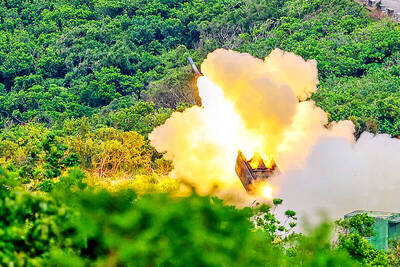
PRECISION STRIKES: The most significant reason to deploy HIMARS to outlying islands is to establish a ‘dead zone’ that the PLA would not dare enter, a source said A High Mobility Artillery Rocket System (HIMARS) would be deployed to Penghu County and Dongyin Island (東引) in Lienchiang County (Matsu) to force the Chinese military to retreat at least 100km from the coastline, a military source said yesterday. Taiwan has been procuring HIMARS and Army Tactical Missile Systems (ATACMS) from the US in batches. Once all batches have been delivered, Taiwan would possess 111 HIMARS units and 504 ATACMS, which have a range of 300km. Considering that “offense is the best defense,” the military plans to forward-deploy the systems to outlying islands such as Penghu and Dongyin so that

Taiwan Semiconductor Manufacturing Co (TSMC, 台積電), the world’s largest foundry service provider, yesterday said that global semiconductor revenue is projected to hit US$1.5 trillion in 2030, after the figure exceeds US$1 trillion this year, as artificial intelligence (AI) demand boosts consumption of token and compute power. “We are still at the beginning of the AI revolution, but we already see a significant impact across the whole semiconductor ecosystem,” TSMC deputy cochief operating officer Kevin Zhang (張曉強) said at the company’s annual technology symposium in Hsinchu City. “It is fair to say that in the past decade, smartphones and other mobile devices were
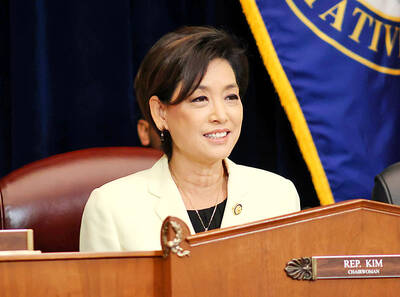
‘CLEAR MESSAGE’: The bill would set up an interagency ‘tiger team’ to review sanctions tools and other economic options to help deter any Chinese aggression toward Taiwan US Representative Young Kim has introduced a bill to deter Chinese aggression against Taiwan, calling for an interagency “tiger team” to preplan coordinated sanctions and economic measures in response to possible Chinese military or political action against Taiwan. “[Chinese President] Xi Jinping [習近平] has directed the People’s Liberation Army to be ready to invade Taiwan by 2027. China has a plan. America should have one too,” Kim said in a news release on Thursday last week. She introduced the “Deter PRC [People’s Republic of China] aggression against Taiwan act” to “ensure the US has a coordinated sanctions strategy ready should


 RSS
RSS