


The M1A2T Abrams tanks that Taiwan purchased from the US participated in a combat readiness exercise in Hsinchu on Tuesday, marking the first time they had operated outside their base.
The army’s 584th Armored Brigade conducted a battalion-level exercise to test troops’ ability to respond to contingencies and protect key facilities, the Military News Agency reported.
The drill involved the deployment of Abrams main battle tanks alongside armored and support vehicles, including CM-32, CM-33 and CM-34 infantry fighting vehicles, CM-22 mortar carriers and Humvees equipped with TOW anti-tank missiles, it reported.

Photo courtesy of the Military News Agency
Through the use of live troops, real terrain and actual vehicles, the exercise aimed to deepen battlefield familiarity while demonstrating the mobility and combat capabilities of the tanks, it said.
Before dawn, personnel completed checks of equipment, communications and vehicles. After receiving orders, the brigade commander delivered a mission briefing and issued operational instructions before leading the convoy out of the base, it said.
Upon arrival at the target area, the unit moved into tactical positions to conduct force protection tasks. By simulating realistic combat scenarios, troops familiarized themselves with the surrounding terrain, while continuing to refine joint operations and inter-unit coordination, the report said.
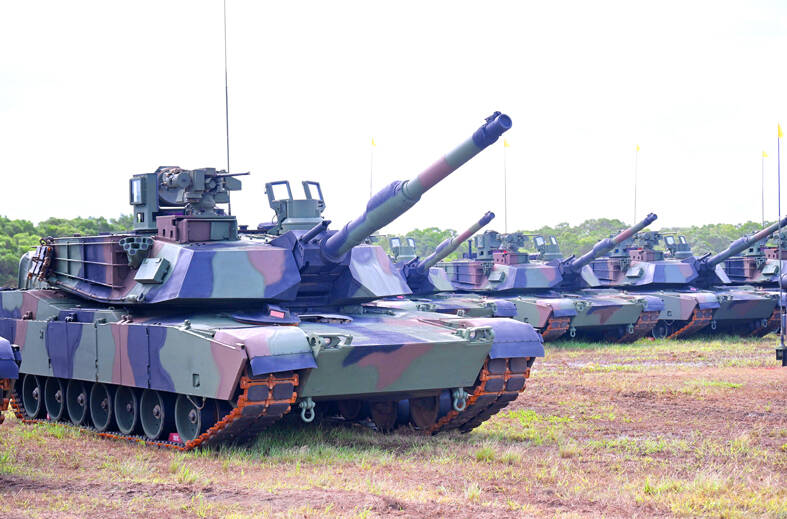
Photo: Fang Bin-chao, Taipei Times
Part of the exercise was to assess commanders’ ability to apply tactics and respond to changing situations, it said.
Taiwan in 2019 earmarked NT$40.52 billion (US$1.29 billion) to procure 108 Abrams tanks from the US. As of this month, it had received 80 of the tanks, with the remaining 28 scheduled to arrive in the first quarter of next year.
The tanks have shown that they can drive on civilian roads and bridges without damaging them, the report said, adding that this was a major concern over use of the heavily armored vehicles.
Weight concerns were mitigated by focusing on correct formation and allowing only one tank to cross a span at a time, it said.
Chen Kuo-ming (陳國銘), editor of Defense International magazine, said he observed only faint markings left by the rubber pads of tank tracks on Hsinchu’s roads, suggesting that infrastructure in the area could support armor without issue.
The new tanks have powerful engines that make them faster and more agile than the army’s older CM-11 and M60A3 tanks, necessitating practice runs to familiarize the tank crews with the new machines, Chen said.
Shu Hsiao-huang (舒孝煌), a research fellow at the state-run Institute for National Defense and Security Research, said the patrol enabled officers and enlisted soldiers to adjust road march planning, tactics and driving methods to the Abrams tanks’ higher speed and larger size.

A signaling system malfunction disrupted high-speed rail (HSR) services beginning at 8am today, with trains temporarily reduced to three northbound and three southbound trains per hour as authorities conduct inspections. The malfunction occurred on a section of track in Miaoli County during pre-operation checks early this morning, forcing northbound and southbound trains to use a single track, the HSR operator said. The regular schedule has been replaced with three hourly trains offering only nonreserved seating in each direction, stopping at every station, it said, adding that business class cars would still have reserved seating. Departures from terminal stations are scheduled at the top

Taiwan is still in the process of assessing the possibility of recruiting workers from Eswatini, the Ministry of Foreign Affairs said yesterday, adding that its goal is to help Eswatini upgrade its vocational training centers. If there are plans to recruit workers from Eswatini, safeguarding national security, protecting public health and ensuring the employment rights of Taiwanese would be prerequisites, Department of West Asian and African Affairs Director-General Yen Chia-liang (顏嘉良) told a news conference. Key considerations would also include filling labor shortages in specific industries, and fostering bilateral professional and technical exchanges, he said. Yen was asked about the progress of labor

A US uncrewed surface vessel (USV) encountered multiple Chinese warships during an autonomous transit of the Taiwan Strait, US defense company Seasats said in a statement on Wednesday. Seasats announced that a Lightfish USV had completed the first autonomous transit of the Taiwan Strait. Over five days, the USV traversed the entire length of the Strait while constantly monitoring surface vessel traffic, the company said. The Lightfish encountered multiple Chinese warships, one of which was a Chinese People’s Liberation Army Navy (PLAN) Type 056 corvette, it said. The Chinese vessels were operating “well within Taiwan’s exclusive economic zone without transmitting their identity via the

VERBOSE VESSELS: A CGA cutter and a China Coast Guard exchanged verbal barbs for more than a day in Taiwanese-controlled waters before the Chinese vessel left The Taiwanese and Chinese coast guards had a standoff near the strategically located Pratas Islands (Dongsha Islands, 東沙群島) in the north of the South China Sea, the Coast Guard Administration (CGA) said yesterday. The two sides engaged in intense radio exchanges over sovereignty claims during the 33-hour standoff. China Coast Guard vessel 3501 eventually left the restricted waters, 26.6 nautical miles (49.2km) west of the Pratas Islands, at 5pm yesterday, the CGA said. Lying approximately between southern Taiwan and Hong Kong, the Taiwan-controlled Pratas are seen by some security experts as vulnerable to Chinese attack due to their distance — more than


 RSS
RSS