


The Taipei metro knife attack last week was a reminder of solidarity and vigilance, President William Lai (賴清德) said yesterday, in a call to improve Taiwan’s emergency response capabilities.
He made the remarks in his opening speech for a Whole-of-Society Defense Resilience Committee workshop.
Since its first meeting in September last year, the committee has conducted multiple tabletop and field exercises to strengthen national preparedness, he said.
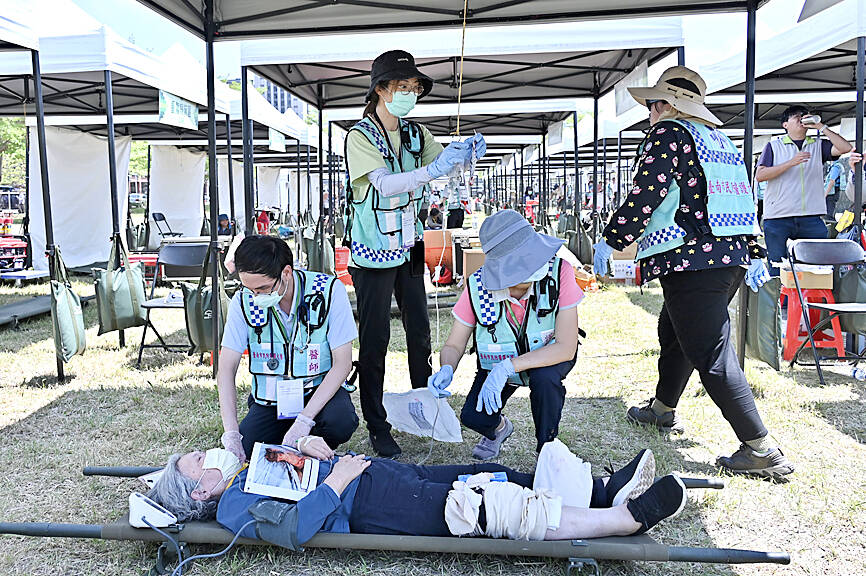
Photo: Tu Chien-jung, Taipei Times
The nation in the past few months has experienced many shocks in the form of natural disasters and a mass stabbing that together resulted in the loss of life and damage to infrastructure, he said.
However, the unyielding Taiwanese spirit shone through the crises, Lai said.
Citing the attack in Taipei on Friday last week, he said that governments and medical care organizations across all levels showed initiative in responding to the crisis.
Developing national resilience requires not only military preparations, but also measures to toughen institutions, infrastructure and the mindset of ordinary Taiwanese, he said.
Officials attending the workshop would be briefed by officials from ministries on the progress made to improve Taiwan’s resilience, as well as the lessons from the handling of extensive flooding in Hualien County in September, Lai said.
Regarding field exercises, Minister of the Interior Liu Shyh-fang (劉世芳) in her report said that future exercises would be conducted on-site, using real equipment, personnel and scenarios.
This year’s joint exercise included a hostage situation on a train car, which is applicable to last Friday’s attack, she said.
Presidential Office spokeswoman Karen Kuo (郭雅慧) said that field exercises, particularly on critical transportation infrastructure, have been ongoing.
The exercises include scenarios such as hostage situations and unidentified gas attacks, she said, adding that scenario planning would be further enhanced to incorporate violent attacks.
During the workshop, Minister of Agriculture Chen Junne-jih (陳駿季) reported on the inventory and distribution of essential consumer goods.
With 240,000 hectares of land in cultivation, Taiwan is fully self-sufficient when it comes to rice supply, Chen said.
About 1.21 million tonnes of rice can be produced annually, meaning that reserves are maintained at more than three months of consumption, he said.
Reserves as of the end of last month totaled 1.06 million tonnes, enough supply for 11 months, he added.
Regarding grain reserves for disaster relief, 384 tonnes of grain were stored this year across 18 administrative regions where transportation is easily disrupted, sufficient to supply 960,000 people for a day, Chen said.
To enhance rice supply resilience, the government is to strengthen public grain infrastructure through a special budget of NT$800 million (US$25.4 million) to install low-temperature storage and purchase mobile generators, he added.
Minister of Health and Welfare Shih Chung-liang (石崇良) in his report said that construction of the first domestic blood bag factory has been completed, capable of producing 2.3 million blood bags annually.
A blood supply mechanism for large-scale disasters is being planned to expand capacity, he said.
Training is also under way to use underground spaces in hospitals for medical services, he said.
In the future, new hospitals would be required to dedicate 10 percent of their basement space for emergency medical services, he said.
Enough essential medicines and medical supplies for external injuries are stockpiled for 120,000 people, Shih said, adding that the government would work to establish a stable supply chain for these items.
Minister of Digital Affairs Lin Yi-jing (林宜敬) said that a defense communications network is being established over land, sea and air to ensure there are no network disruptions in the event of an emergency.
Units are also working to back up data and create system redundancies, and cybersecurity drills are being held to ensure continuous operation of critical information systems and robust system security against hacking, Lin said.
Taiwan Semiconductor Manufacturing Co (TSMC, 台積電), the world’s largest foundry service provider, yesterday said that global semiconductor revenue is projected to hit US$1.5 trillion in 2030, after the figure exceeds US$1 trillion this year, as artificial intelligence (AI) demand boosts consumption of token and compute power. “We are still at the beginning of the AI revolution, but we already see a significant impact across the whole semiconductor ecosystem,” TSMC deputy cochief operating officer Kevin Zhang (張曉強) said at the company’s annual technology symposium in Hsinchu City. “It is fair to say that in the past decade, smartphones and other mobile devices were
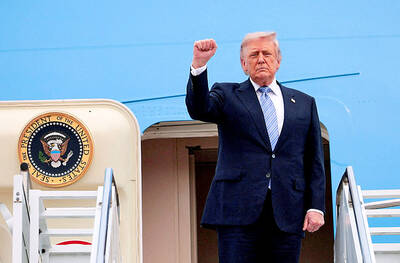
US-CHINA SUMMIT: MOFA welcomed US reassurance of no change in its Taiwan policy; Trump said he did not comment when Xi talked of opposing independence US President Donald Trump yesterday said he has not made a decision on whether to move forward with a major arms package for Taiwan after hearing concerns about it from Chinese President Xi Jinping (習近平). Trump’s comments on Taiwan came as he flew back to Washington after wrapping up critical talks in which both leaders said important progress was made in stabilizing US-China relations even as deep differences persist between the world’s two biggest powers on Iran and Taiwan. “I will make a determination,” Trump said, adding: “I’ll be making decisions. But, you know, I think the last thing we need right
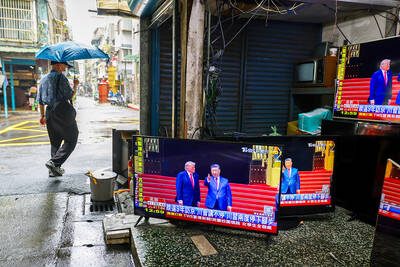
TAIWAN ISSUE: US treasury secretary Scott Bessent said on the first day of meetings that ‘it wouldn’t be a US-China summit without the Taiwan issue coming up’ There were no surprises on the first day of the summit between US President Donald Trump and Chinese President Xi Jinping (習近平), the Mainland Affairs Council (MAC) said yesterday, as the government reiterated that cross-strait stability is crucial to the Asia-Pacific region, as well as the world. As the two presidents met for a highly anticipated summit yesterday, Chinese state media reported that Xi warned Trump that missteps regarding Taiwan could push their two countries into “conflict.” Trump arrived in China with accolades for his host, calling Xi a “great leader” and “friend,” and extending an invitation to visit the White House
SECURITY: Taipei presses the US for arms supplies, saying the arms sales are not only a reflection of the US security commitment to Taiwan but also serve as a mutual deterrent against regional threats Taiwan is committed to preserving the cross-strait “status quo” and contributing to regional peace and stability, the Presidential Office said yesterday. “It is an undeniable fact that the Republic of China is a sovereign and independent democratic nation,” Presidential Office spokeswoman Karen Kuo (郭雅慧) reiterated, adding that Beijing has no right to claim sovereignty over Taiwan. The statements came after US President Donald Trump warned against Taiwanese independence. Trump wrapped up a state visit to Beijing on Friday, during which Chinese President Xi Jinping (習近平) had pressed him not to support Taiwan. Taiwan depends heavily on US security backing to deter China from carrying


 RSS
RSS