


The Presidential Office and the Executive Yuan have decided on “no countersignature and no promulgation” of an amendment to a government revenue allocation law passed by the Legislative Yuan, sources said yesterday, which would be a first in the nation’s history.
President William Lai (賴清德) would address the public over the issue tomorrow, the sources said, adding that Premier Cho Jung-tai (卓榮泰) would also hold a news conference to explain the reasons for not countersigning.
Amendments to the Act Governing the Allocation of Government Revenues and Expenditures (財政收支劃分法) passed on Nov. 14 state that local governments would receive a larger share of the central government revenue each year.
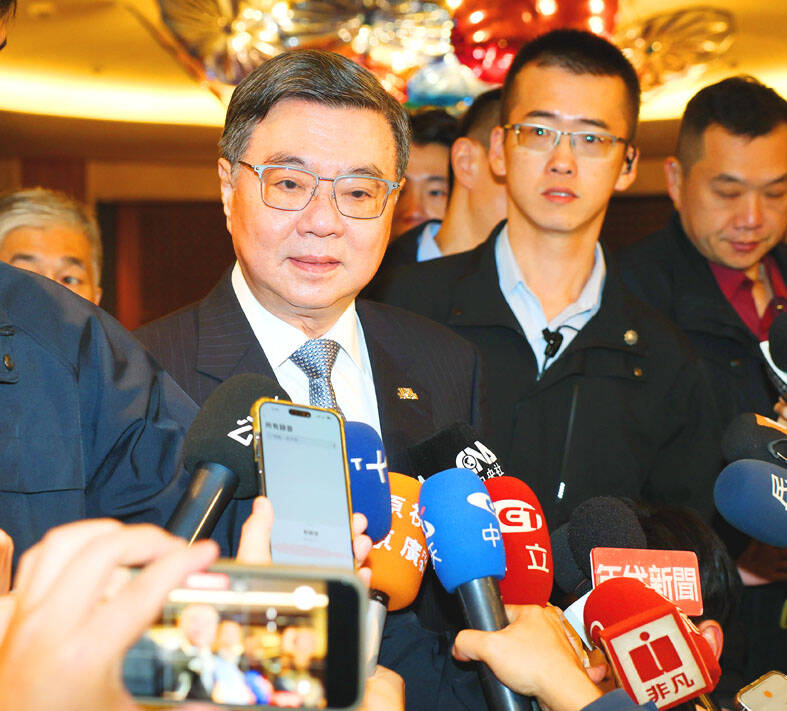
Photo: CNA
The amendments also stipulate a minimum budget of project-based subsidies to be allocated to local governments, which would increase expenses by about NT$264.6 billion (US$8.48 billion).
However, the Executive Yuan said the amendments “cannot be implemented,” as they would force the central government to increase borrowing for the 2026 budget by NT$264.6 billion, pushing it beyond the statutory debt ceiling.
The Cabinet last month asked the legislature to revisit the amendments, but the request was denied by the opposition 59-50 on Friday last week, with votes to uphold the original version.
The opposition said the real reason behind Cho’s rejection of the legislation was because he wanted to keep government revenues under the control of the central government, rather than distributing them to local governments.
After the motion was voted down, Cho suggested that the Executive Yuan might ignore the amendments, saying he was “under no pressure to execute” them, citing procedural flaws in their review.
In a Friday meeting held by Lai as Democratic Progressive Party (DPP) head, which was attended by all 51 DPP lawmakers and Cabinet Secretary-General Xavier Chang (張惇涵), the party caucus pledged full support for any countermeasure adopted by the Cabinet.
DPP caucus chief executive Chung Chia-pin (鍾佳濱) said that with the Constitutional Court paralyzed, Lai has asked Cho to consider not countersigning the amendment, in which case the president would not be able to promulgate the legislation.
DPP lawmakers unanimously agreed to counter what they see as potentially “unconstitutional” laws passed by the opposition, Chung said.
Lai said the amendments, along with the opposition’s blocking of a NT$1.25 trillion special defense budget, undermine national security, social stability, fiscal sustainability and civil rights.
“Under these grim circumstances, it is incumbent upon me to meet with the DPP legislative caucus to discuss how to respond,” he said.
Meanwhile, regarding amendments to the Civil Servants Retirement, Discharge and Pensions Act (公務人員退休資遣撫卹法) and the Public School Employee Retirement, Discharge and Pensions Act (公立學校教職員退休資遣撫卹條例) passed by the legislature on Friday, which would suspend cuts to civil servants’ pensions and reverse fiscal reform, sources said the executive branch also plans to adopt a “no countersignature and no promulgation” approach on the grounds that pension reform cannot be rolled back.
Lai hoped the Legislative Yuan would re-examine the amendments, so he has invited Legislative Speaker Han Kuo-yu (韓國瑜) to a “National Affairs Tea Gathering” tomorrow in hopes that Han would refrain from sending out the bill, sources said.
Han has declined the invitation.


Japan has deployed long-range missiles in a southwestern region near China, the Japanese defense minister said yesterday, at a time when ties with Beijing are at their lowest in recent years. The missiles were installed in Kumamoto in the southern region of Kyushu, as Japan is attempting to shore up its military capacity as China steps up naval activity in the East China Sea. “Standoff defense capabilities enable us to counter the threat of enemy forces attempting to invade our country ... while ensuring the safety of our personnel,” Japanese Minister of Defense Shinjiro Koizumi said. “This is an extremely important initiative for

MORE POPULAR: Taiwan Pass sales increased by 59 percent during the first quarter compared with the same period last year, the Tourism Administration said The Tourism Administration yesterday said that it has streamlined the Taiwan Pass, with two versions available for purchase beginning today. The tourism agency has made the pass available to international tourists since 2024, allowing them to access the high-speed rail, Taiwan Railway Corp services, four MRT systems and four Taiwan Tourist Shuttles. Previously, five types of Taiwan Pass were available, but some tourists have said that the offerings were too complicated. The agency said only two types of Taiwan Pass would be available, starting from a three-day pass with the high-speed rail and a three-day pass with Taiwan Railway Corp. The former costs NT$2,800

NEW LOW: The council in 2024 based predictions on a pessimistic estimate for the nation’s total fertility rate of 0.84, but last year that rate was 0.69, 17 percent lower An expected National Development Council (NDC) report expects the nation’s population to drop below 12 million by 2065, with the old-age dependency ratio to top 100 percent sooner than 2070, sources said yesterday. The council is slated to release its latest population projections in August, using an ultra-low fertility model, the sources said. The previous report projected that Taiwan’s population would fall to 14.37 million by 2070, but based on a new estimate of the total fertility rate (TFR) — the average number of children born to a woman over her lifetime — the population is expected to reach 12 million by

COUNTERING HOSTILITY: The draft bill would require the US to increase diplomatic pressure on China and would impose sanctions on those who sabotage undersea cable networks US lawmakers on Thursday introduced a bipartisan bill to bolster the resilience of Taiwan’s submarine cables to counter China’s hostile activities. The proposal, titled the critical undersea infrastructure resilience initiative act, was cosponsored by Republican representatives Mike Lawler and Greg Stanton, and Democratic Representative Dave Min. US Senators John Curtis and Jacky Rosen also introduced a companion bill in the US Senate, which has passed markup at the chamber’s Committee on Foreign Relations. The House’s version of the bill would prioritize the deployment of sensors to detect disruptions or potential sabotage in real-time and enhance early warning capabilities through global intelligence sharing frameworks,


 RSS
RSS