


New military hardship loans would start next month to counter Chinese espionage and fraud syndicate efforts targeting economically vulnerable military service members, the Ministry of National Defense said yesterday.
The announcement comes on the heels of multiple legal cases involving military personnel who allegedly sold state secrets to pay debts to gang-affiliated lenders with connections to Chinese spies.
The military is to provide low-interest loans to help keep service members from entering compromising deals with unregistered money lenders, Major General Hsin Yi-tsung (辛宜聰) from the ministry’s Comptroller Bureau told a news conference.
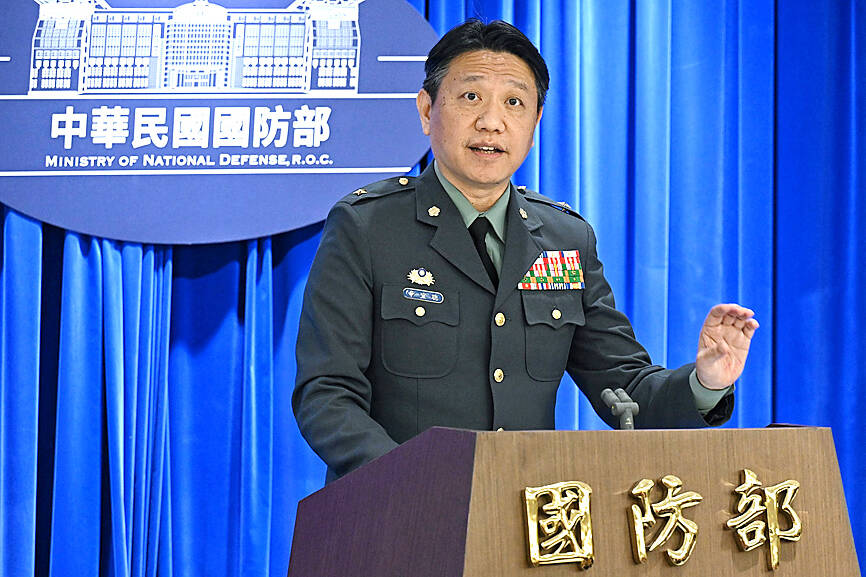
Photo: Chang Chia-ming, Taipei Times
The plan is modeled after civil servant financial relief loans, Hsin said.
Service members would be eligible for loans of up to NT$1.2 million (US$38,452) with interest rates as low as 1.695 percent if they or their immediate family have financial needs related to injuries or sickness, spousal death, natural disasters, childbirth, post-natal care or long-term care, he said.
Those who apply must have at least six months of service remaining to qualify, he said, adding that the loans would be provided in NT$600,000 increments, except for small-sum relief loans of no more than NT$200,000.
The floating interest rate on the loans would be 0.025 percent lower than the rate on postal savings accounts, he said.
Military personnel may take out the loans without a guarantor if they borrow NT$100,000 or less, have at least one year remaining of their service term and a credit score higher than 401, Hsin said.
Service members interested in the loans should request a credit report from banking institutions to apply, he added.
They can apply for the loans online via the armed forces salary and wealth management platform or by contacting the military’s regional fiscal office, Hsin said.
Repayments are deducted from pay with the expectation that all of the debt would be paid by the time the borrower retires from the military, he said.
The financial institutions that issue the loans would foreclose on assets should debtors be unable to repay them, he added.
The plan is to be authorized via expected amendments to regulations governing the management and use of military production and service funds, Hsin said.
In related news, the Army Matsu Defense Command on Monday said that authorities have launched a probe into the alleged use of bank accounts belonging to more than 60 service members in connection to financial fraud.
The investigation by the Lienchiang District Prosecutors’ Office said that a staff sergeant collected financial information and online vendor accounts from colleagues for use by a fraud group, the command said.
Military personnel involved in the scheme would be prosecuted to the fullest extent of the law, it said.
Major General Sun Li-fang (孫立方), the ministry’s spokesman, said that harms the military and is also a serious threat to the public.
Aside from emergency loans, the ministry is taking measures — including improving the personal finance skills of service members, teaching them to identify fraud methods, and promoting education regarding the law and discipline — to help military personnel avoid debt traps and involvement in espionage, Sun said.
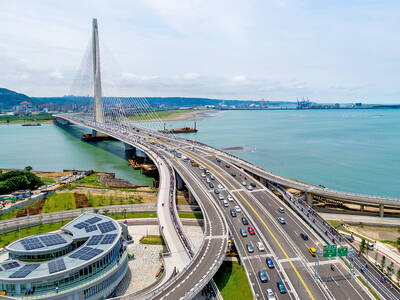
The Ministry of Transportation and Communications yesterday inaugurated the Danjiang Bridge across the Tamsui River in New Taipei City, saying that the structure would be an architectural icon and traffic artery for Taiwan. Feted as a major engineering achievement, the Danjiang Bridge is 920m long, 211m tall at the top of its pylon, and is the longest single-pylon asymmetric cable-stayed bridge in the world, the government’s Web site for the structure said. It was designed by late Iraqi-British architect Zaha Hadid. The structure, with a maximum deck of 70m, accommodates road and light rail traffic, and affords a 200m navigation channel for boats,
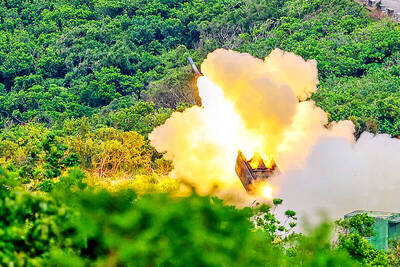
PRECISION STRIKES: The most significant reason to deploy HIMARS to outlying islands is to establish a ‘dead zone’ that the PLA would not dare enter, a source said A High Mobility Artillery Rocket System (HIMARS) would be deployed to Penghu County and Dongyin Island (東引) in Lienchiang County (Matsu) to force the Chinese military to retreat at least 100km from the coastline, a military source said yesterday. Taiwan has been procuring HIMARS and Army Tactical Missile Systems (ATACMS) from the US in batches. Once all batches have been delivered, Taiwan would possess 111 HIMARS units and 504 ATACMS, which have a range of 300km. Considering that “offense is the best defense,” the military plans to forward-deploy the systems to outlying islands such as Penghu and Dongyin so that
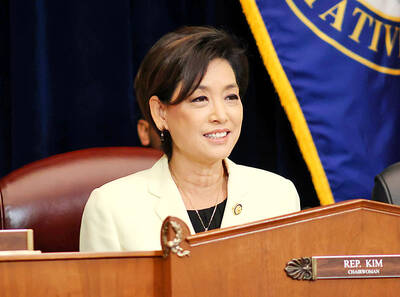
‘CLEAR MESSAGE’: The bill would set up an interagency ‘tiger team’ to review sanctions tools and other economic options to help deter any Chinese aggression toward Taiwan US Representative Young Kim has introduced a bill to deter Chinese aggression against Taiwan, calling for an interagency “tiger team” to preplan coordinated sanctions and economic measures in response to possible Chinese military or political action against Taiwan. “[Chinese President] Xi Jinping [習近平] has directed the People’s Liberation Army to be ready to invade Taiwan by 2027. China has a plan. America should have one too,” Kim said in a news release on Thursday last week. She introduced the “Deter PRC [People’s Republic of China] aggression against Taiwan act” to “ensure the US has a coordinated sanctions strategy ready should

TAIWAN ISSUE: US treasury secretary Scott Bessent said on the first day of meetings that ‘it wouldn’t be a US-China summit without the Taiwan issue coming up’ There were no surprises on the first day of the summit between US President Donald Trump and Chinese President Xi Jinping (習近平), the Mainland Affairs Council (MAC) said yesterday, as the government reiterated that cross-strait stability is crucial to the Asia-Pacific region, as well as the world. As the two presidents met for a highly anticipated summit yesterday, Chinese state media reported that Xi warned Trump that missteps regarding Taiwan could push their two countries into “conflict.” Trump arrived in China with accolades for his host, calling Xi a “great leader” and “friend,” and extending an invitation to visit the White House


 RSS
RSS