


Taiwan has continued to take action to bolster human rights, President William Lai (賴清德) said in an address at the Asia Democracy and Human Rights Award ceremony in Taipei on Human Rights Day yesterday, adding that the need to defend freedom and democracy has never been more urgent in the face of a global democratic retreat and China’s multifaceted threats.
The Taiwan Foundation for Democracy, a non-profit organization funded by the Ministry of Foreign Affairs, presented the award to the Indonesian Legal Aid and Human Rights Association (PBHI) at the ceremony, which Lai presided over, and was attended by foreign diplomats and association members.
Lai presented the award and a US$100,000 grant to PBHI chairman Julius Ibrani.
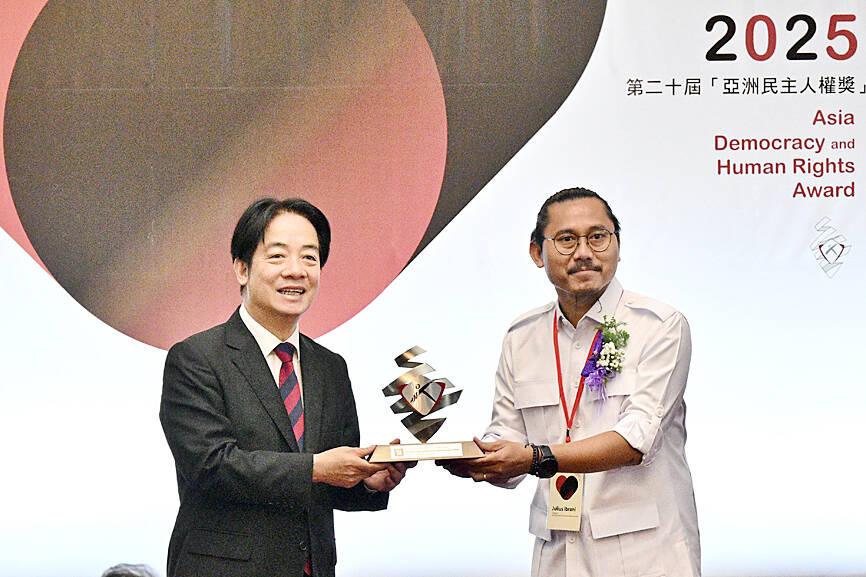
Photo: George Tsorng, Taipei Times
The PBHI is a defender of human rights that has built a “cross-border human rights network that deserves our deepest respect,” Lai said.
He also spoke about Taiwan’s journey to democracy, referencing former authoritarian rule and the Martial Law period.
Taiwan has taken steps to safeguard human rights, including releasing the National Human Rights Action Plan in 2022 and this year establishing human rights indicators that follow UN standards, he said.
The need to defend freedom and democracy has “never been more urgent” in the face of a global democratic retreat and China’s multifaceted threats, he said.
“Defending democracy is no easy task and consolidating democracy requires great determination,” Lai said, adding that the spirit of PBHI and many other human rights groups that never give up hope in the midst of difficulties is the best inspiration.
“We hope that people from all regions, countries and parties can stand together and defend universal values so that everyone can enjoy their rights as human beings, and the light of democracy can continue to shine out into the world,” he said.
The award recognizes those who promote international human rights, as well as representing the determination of Taiwan and its democratic partners around the world to jointly defend human rights, deepen freedom and put democracy into practice, he added.
Founded in 1996, the PBHI promotes human rights protections and access to justice in Indonesia through legal aid, advocacy actions and policy reform.
Ibrani facilitated discussions on alleged human rights abuses in what at the time was the Indonesian province of East Timor, leading to the establishment of the Indonesia-East Timor Commission of Truth and Friendship.
The PHBI helped the region gain independence as Timor-Leste in 1999.
Ibrani dedicated the award to people who faced human rights abuses and “those who were willing and courageous enough to stand with us, even when it put their safety, their freedom and even their lives at risk.”
That includes women who faced sexual violence and discrimination, indigenous people whose nature and heritage were destroyed, and students who protested for a clean government, he said.
The award “puts a spotlight on all the human rights defenders who may never stand on a stage,” he added.
Today, the civic space is “literally dead,” as Indonesians face a democratic setback under a newly elected military-authoritarian regime, Ibrani said.
“The human desire for dignity and freedom will never fade away. It adapts, persists and rises, stronger and stronger,” he said.
Legislative Speaker Han Kuo-yu (韓國瑜), who is chairman of the foundation, told the ceremony that the PHBI symbolizes “the resilience and moral force of civil society across Asia.”
The latest Freedom House report said that last year was the 19th consecutive year in which global freedom declined, Han said, adding that the ceremony was a message to the world that “the defense of democracy and human rights is always worthy of support, remembrance and continuation.”
Additional reporting by CNA

A signaling system malfunction disrupted high-speed rail (HSR) services beginning at 8am today, with trains temporarily reduced to three northbound and three southbound trains per hour as authorities conduct inspections. The malfunction occurred on a section of track in Miaoli County during pre-operation checks early this morning, forcing northbound and southbound trains to use a single track, the HSR operator said. The regular schedule has been replaced with three hourly trains offering only nonreserved seating in each direction, stopping at every station, it said, adding that business class cars would still have reserved seating. Departures from terminal stations are scheduled at the top

Taiwan is still in the process of assessing the possibility of recruiting workers from Eswatini, the Ministry of Foreign Affairs said yesterday, adding that its goal is to help Eswatini upgrade its vocational training centers. If there are plans to recruit workers from Eswatini, safeguarding national security, protecting public health and ensuring the employment rights of Taiwanese would be prerequisites, Department of West Asian and African Affairs Director-General Yen Chia-liang (顏嘉良) told a news conference. Key considerations would also include filling labor shortages in specific industries, and fostering bilateral professional and technical exchanges, he said. Yen was asked about the progress of labor

VERBOSE VESSELS: A CGA cutter and a China Coast Guard exchanged verbal barbs for more than a day in Taiwanese-controlled waters before the Chinese vessel left The Taiwanese and Chinese coast guards had a standoff near the strategically located Pratas Islands (Dongsha Islands, 東沙群島) in the north of the South China Sea, the Coast Guard Administration (CGA) said yesterday. The two sides engaged in intense radio exchanges over sovereignty claims during the 33-hour standoff. China Coast Guard vessel 3501 eventually left the restricted waters, 26.6 nautical miles (49.2km) west of the Pratas Islands, at 5pm yesterday, the CGA said. Lying approximately between southern Taiwan and Hong Kong, the Taiwan-controlled Pratas are seen by some security experts as vulnerable to Chinese attack due to their distance — more than
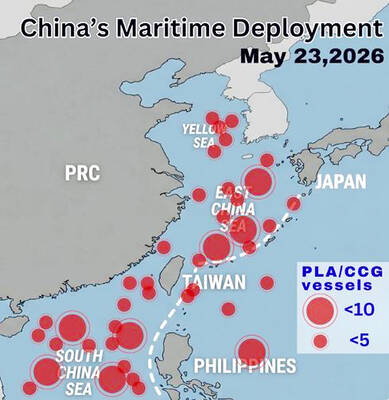
WARNING: China should stop engaging in actions that undermine regional peace and stability, as it would only build resentment among people across the Strait, the CGA said China has deployed more than 100 navy, coast guard and other vessels in waters from the Yellow Sea to the South China Sea and the western Pacific since US President Donald Trump and Chinese President Xi Jinping (習近平) met in Beijing, National Security Council Secretary-General Joseph Wu (吳釗燮) said yesterday. “In this part of the world, #China is the one & only PROBLEM wrecking the #StatusQuo & threatening regional peace & stability,” Wu wrote on X. In a separate post, he said Beijing was coercing Taiwan’s maritime domain, calling it illegal and provocative, after the Coast Guard Administration (CGA) expelled a


 RSS
RSS