


Taiwan reiterated its commitment to bolstering its self-defense to uphold regional peace, as ranking officials expressed appreciation to the US for prioritizing deterring a conflict over Taiwan and highlighting the importance of the security of the first island chain in the US’ latest National Security Strategy.
“Greatly appreciate that the #US National Security Strategy prioritizes deterring a conflict over Taiwan & highlights the security of the First Island Chain. #Taiwan will continue to be a reliable partner deeply committed to strengthening our self-defense to uphold regional peace,” President William Lai (賴清德) wrote on X yesterday.
The 33-page report comes as Beijing increases pressure on Taiwan and Japan, deploying vessels across East Asian waters last week in its largest maritime show of force to date.
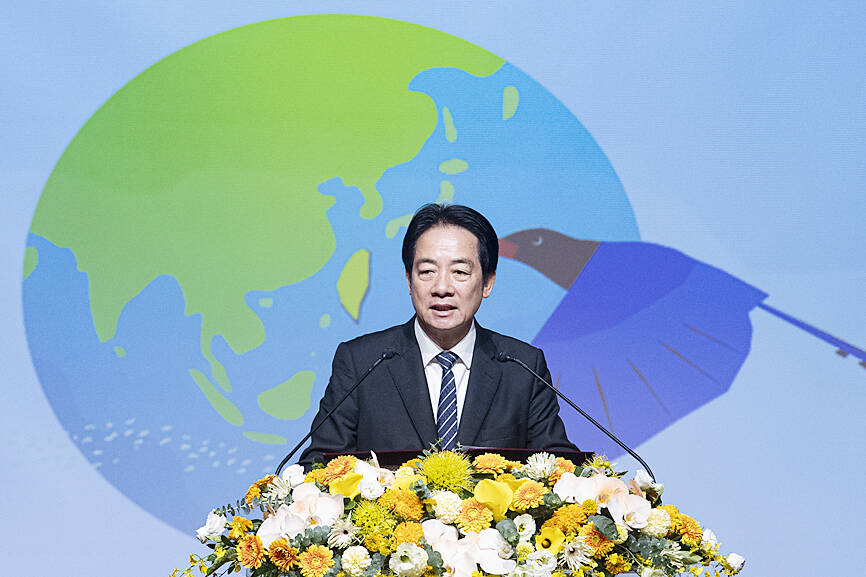
Photo: CNA
The document’s language on Taiwan is stronger than the National Security Strategy produced during US President Donald Trump’s first term in office. The document in 2017 mentioned Taiwan three times in a single sentence, echoing longstanding diplomatic language.
“Taiwan” was mentioned seven times in the report published under former US president Joe Biden’s administration.
The new report mentions Taiwan eight times across three paragraphs, and concludes that “there is, rightly, much focus on Taiwan,” because of its strategic location in trade-rich waters and dominance in semiconductor manufacturing.
“We will build a military capable of denying aggression anywhere,” in the chain of islands stretching from Japan to Southeast Asia, it said.
“But the American military cannot, and should not have to, do this alone. Our allies must step up and spend — and more importantly do — much more for collective defense,” it added.
That would reinforce “US and allies’ capacity to deny any attempt to seize Taiwan” or any other steps that would “make defending that island impossible,” the report said.
The Ministry of Foreign Affairs yesterday thanked the US for pointing out Taiwan’s importance in key supply chains and geopolitical strategy, as well as stressing that the US and its allies would collaborate to ensure the nation’s safety.
The Trump administration has demonstrated support for Taiwan, including Trump signing the amended Taiwan Assurance Implementation Act and the US announcing planned arms sale to the nation, the ministry added.
Taiwan will continue to work with the US on security to ensure safety and stability in the Taiwan Strait and the Indo-Pacific region, the ministry said.
The government would also continue to take actions that would enhance the nation’s defense capabilities, such as the eight-year NT$1.25 trillion (US$39.8 billion) special defense budget proposed by Lai, to demonstrate Taiwan’s determination and willpower to firmly defend itself and the “status quo,” it added.
Minister of Foreign Affairs Lin Chia-lung (林佳龍) said China’s authoritarian expansion does not only affect Taiwan, but also impacts the entire Indo-Pacific region and the international community.
“National security is the basic condition for survival; without security as a guarantee, prosperity cannot be discussed,” Lin wrote on Facebook yesterday, expressing hope that Taiwan could build a security communication mechanism with countries that share the same ideals.
Commenting on Taiwan-US economic and trade cooperation, Lin said that given the US-China competition and the reshuffling of the global supply chain, investments made by Taiwanese companies in the US represent “not risks, but opportunities.”
Taiwan is willing to establish mutually beneficial cooperation with the US in industries such as semiconductors, servers, robotics and artificial intelligence (AI), he said, adding that by building a comprehensive AI industry and integrating into the US’ innovation ecosystem, Taiwan and the US could achieve shared prosperity.
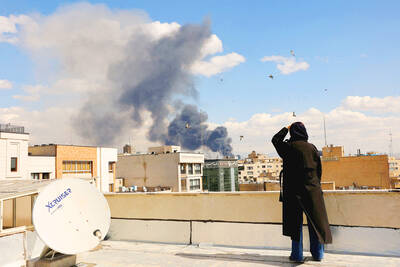
CHAOS: Iranians took to the streets playing celebratory music after reports of Khamenei’s death on Saturday, while mourners also gathered in Tehran yesterday Iranian Supreme Leader Ayatollah Ali Khamenei was killed in a major attack on Iran launched by Israel and the US, throwing the future of the Islamic republic into doubt and raising the risk of regional instability. Iranian state television and the state-run IRNA news agency announced the 86-year-old’s death early yesterday. US President Donald Trump said it gave Iranians their “greatest chance” to “take back” their country. The announcements came after a joint US and Israeli aerial bombardment that targeted Iranian military and governmental sites. Trump said the “heavy and pinpoint bombing” would continue through the week or as long
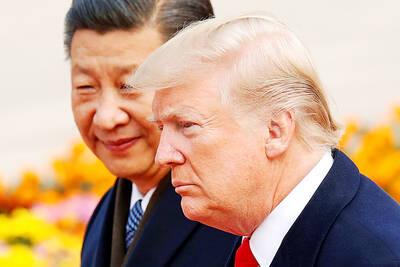
TRUST: The KMT said it respected the US’ timing and considerations, and hoped it would continue to honor its commitments to helping Taiwan bolster its defenses and deterrence US President Donald Trump is delaying a multibillion-dollar arms sale to Taiwan to ensure his visit to Beijing is successful, a New York Times report said. The weapons sales package has stalled in the US Department of State, the report said, citing US officials it did not identify. The White House has told agencies not to push forward ahead of Trump’s meeting with Chinese President Xi Jinping (習近平), it said. The two last month held a phone call to discuss trade and geopolitical flashpoints ahead of the summit. Xi raised the Taiwan issue and urged the US to handle arms sales to
BIG SPENDERS: Foreign investors bought the most Taiwan equities since 2005, signaling confidence that an AI boom would continue to benefit chipmakers Taiwan Semiconductor Manufacturing Co’s (TSMC, 台積電) market capitalization swelled to US$2 trillion for the first time following a 4.25 percent rally in its American depositary receipts (ADR) overnight, putting the world’s biggest contract chipmaker sixth on the list of the world’s biggest companies by market capitalization, just behind Amazon.com Inc. The site CompaniesMarketcap.com ranked TSMC ahead of Saudi Aramco and Meta Platforms Inc. The Taiwanese company’s ADRs on Tuesday surged to US$385.75 on the New York Stock Exchange, as strong demand for artificial intelligence (AI) applications led to chip supply constraints and boost revenue growth to record-breaking levels. Each TSMC ADR represents
State-run CPC Corp, Taiwan (CPC, 台灣中油) yesterday said that it had confirmed on Saturday night with its liquefied natural gas (LNG) and crude oil suppliers that shipments are proceeding as scheduled and that domestic supplies remain unaffected. The CPC yesterday announced the gasoline and diesel prices will rise by NT$0.2 and NT$0.4 per liter, respectively, starting Monday, citing Middle East tensions and blizzards in the eastern United States. CPC also iterated it has been reducing the proportion of crude oil imports from the Middle East and diversifying its supply sources in the past few years in response to geopolitical risks, expanding


 RSS
RSS