


French President Emmanuel Macron yesterday appealed to Chinese President Xi Jinping (習近平) to help end the war in Ukraine and to tackle trade deficits as the two leaders met in Beijing, where they were also expected to talk about Taiwan.
China has been looking for support from France — one of the five permanent members of the UN Security Council — in its dispute with Japan over Taiwan’s status.
Tensions escalated after Japanese Prime Minister Sanae Takaichi suggested last month that a conflict over Taiwan could pose a threat to Japan.
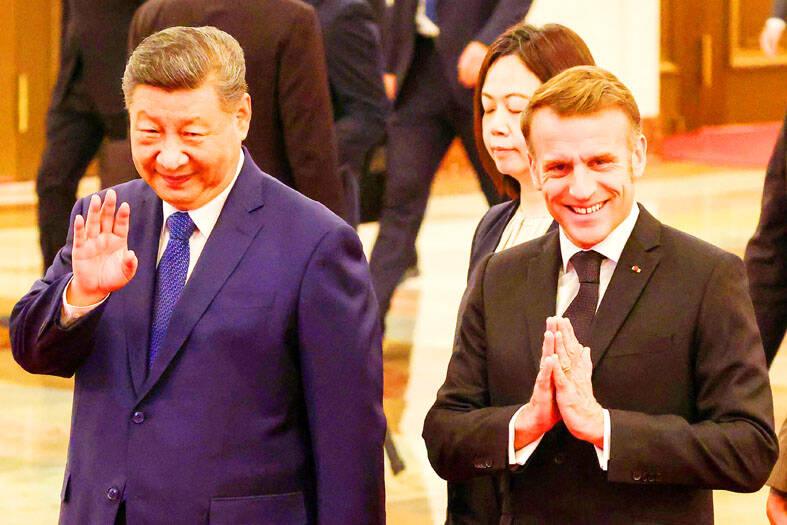
Photo: AFP
On the eve of the Macron-Xi meeting, Chinese Minister of Foreign Affairs Wang Yi (王毅) told his French counterpart, Jean-Noel Barrot, that as World War II victors, China and France must not allow Japan to “stir up troubles” over Taiwan or repeat historical mistakes.
Macron yesterday did not publicly address Taiwan. In the past few days, French officials have reiterated the need to respect the “one China” policy.
For the French president, making his fourth visit to China while in office, the three-day trip is an opportunity to shore up support for a ceasefire in Europe’s deadliest conflict since World War II, as well as to attract more Chinese investment in France.
Speaking in the Great Hall of the People, where the meeting took place, Xi said he and Macron had agreed to push for more “balanced” economic ties, two-way investment and a “nondiscriminatory” environment for businesses in both countries.
Beijing has long sought to avoid EU tariffs on Chinese products, including steel and electric vehicles that Brussels says are sold at unfair prices due to state subsidies.
Xi also reiterated his support for an end to the hostilities in Ukraine, telling Macron that “China supports all efforts committed to peace and hopes that all parties will reach a fair, lasting and binding peace agreement that is acceptable to all parties.”
China — a major Russian trading partner — has said it takes a neutral stance on the war, refraining from condemning Moscow’s invasion.
“We must continue to work towards peace and stability in the world, and in Ukraine and other regions affected by war,” Macron told Xi, adding: “Our capacity to work together is decisive.”
“I hope that China will join our call and our efforts to achieve, as soon as possible, at least a ceasefire in the form of a moratorium on strikes targeting critical infrastructure,” he said.
Macron’s visit to Beijing follows a trip to Paris by Ukrainian President Volodymyr Zelenskiy, who urged Europe to stand by Kyiv as Washington pushes a plan to end the war.
China regularly calls for peace talks and respect for the territorial integrity of all countries, but has never condemned Russia for its 2022 invasion.

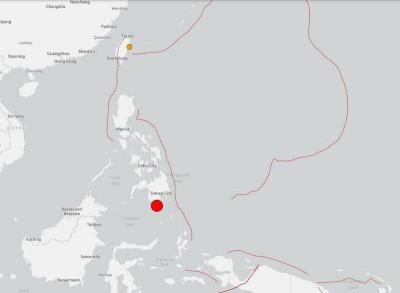
A magnitude 7.8 earthquake struck off the southern coast of Mindanao in the Philippines at 7:38am today, prompting the US Tsunami Warning System to issue an alert for neighboring countries, including Taiwan. The system issued a purple alert indicating a "tsunami threat." The potential threat zone includes Taiwan, the Philippines, Papua New Guinea, Yap and Palau. Philippine authorities were assessing the damage from the quake, with the office of civil defense seeking to verifying initial reports that 15 people had been killed and 129 injured in the region, mostly from falling debris. Arlene Hollero, disaster chief of Maasim town in the Philippines' Sarangani Province,

RESILIENCE: Taiwan plays a key role in semiconductors, energy, information infrastructure and advanced manufacturing, AIT Director Raymond Greene said Taiwan’s continued investment in deterrence and resilience remains vital, especially in uncrewed systems and other emerging technologies, American Institute in Taiwan (AIT) Director Raymond Greene said yesterday. Greene made the remarks at the annual National Strategic Summit on Supply Chain Resilience held by the Research Institute for Democracy, Society and Emerging Technology (DSET), a government-backed think tank. As Taiwan last year became the US’ fourth-largest trading partner and supply chain security is becoming more important, cooperation in emerging technologies continues to deepen between the two countries, he said. The US is committed to accelerating innovation, building key infrastructure, strengthening cooperation

The National Chungshan Institute of Science and Technology yesterday showcased its locally developed variants of the Vision 60 robotic patrol dog, which it plans to deploy on the nation’s outlying territories in the South China Sea. The variants were produced under the Joint Lab project — created by the institute and domestic companies — and assembled with domestically produced motors, lenses and artificial intelligence (AI) systems alongside licensed tech from the US, Missile and Rocket Systems Research Division deputy director Jen Kuo-kang (任國光) told the media event at a military base in Taipei’s Dazhi (大直) area. Taiwan has built up its strengths

RIGHT DIRECTION: Taiwan’s efforts to prevent forced labor include a proposal to ‘fully prohibit’ employers from withholding workers’ documents, an official said Taiwan is to establish a mechanism to restrict imports of goods linked to forced labor, the Executive Yuan said yesterday, after the US proposed imposing additional tariffs on Taiwanese goods over labor concerns. “The Ministry of Labor and the Ministry of Economic Affairs are to establish an interministerial review procedure,” Executive Yuan spokesperson Michelle Lee (李慧芝) said at a news briefing in Taipei. “The government is to use the Foreign Trade Act [貿易法] as the legal basis to restrict imports of goods produced with forced labor” and bring its supply chain governance more in line with international standards on human rights, resilience


 RSS
RSS