


Taiwan’s long-anticipated domestic stablecoin could debut as early as June or July, as regulators move closer to establishing a legal framework for the oversight of digital assets, Financial Supervisory Commission (FSC) Chairman Peng Jin-lung (彭金隆) said yesterday.
Peng told lawmakers during a meeting of the legislature’s Finance Committee that a draft bill for regulating virtual asset service providers is set to be sent to the Cabinet for review later this week before being submitted to the legislature.
If the bill advances smoothly, the legislative process could be completed in the first half of next year, allowing the act to take effect in the second half, he said.

Photo: Wang Yi-sung, Taipei Times
“The introduction of a domestic stablecoin would mark an important milestone in bringing virtual-asset activities into a fully regulated environment,” Peng said.
Stablecoins are a type of cryptocurrency designed to maintain a stable value, typically by being pegged to a fiat currency or a commodity such as gold.
A draft bill for virtual asset service providers would establish a regulatory framework for companies handling virtual assets by requiring them to register or obtain licenses, meet capital and operational thresholds, implement controls to counter money laundering, and adhere to consumer-protection and reporting requirements.
The FSC and the central bank have reached a consensus on how stablecoins should be implemented, Peng said.
In the initial stage, issuance would be restricted to licensed financial institutions — a measure regulators view as necessary to manage risks and safeguard user funds, he said.
The agencies are continuing to coordinate on regulatory details, including reserve requirements, audit mechanisms and investor-protection rules, he said.
Only after the rules are finalized would the FSC authorize the issuance of stablecoins, meaning that the earliest rollout of a New Taiwan dollar-backed stablecoin would be in the middle of next year, Peng said.
The initiative is seen as a crucial step toward building a regulated digital-asset ecosystem, particularly after several years of rapid growth in cryptocurrency trading and rising concerns over financial stability, he said.
Industry experts have closely followed the government’s progress, viewing the legalization of stablecoin as the foundation for developing compliant digital-finance products, improving payment efficiency and strengthening money-laundering controls.
Banks and fintech firms are expected to explore pilot applications once the regulatory pathway becomes clearer.
While details regarding the first issuers and technical standards are still being discussed, Taiwan’s approach would underscore prudential supervision, consumer protection and alignment with international regulatory trends, Peng said.
Local banks have signaled interest in issuing stablecoins, but emphasize that the tokens would need to be interoperable across institutions to function effectively in real-world financial applications.

A signaling system malfunction disrupted high-speed rail (HSR) services beginning at 8am today, with trains temporarily reduced to three northbound and three southbound trains per hour as authorities conduct inspections. The malfunction occurred on a section of track in Miaoli County during pre-operation checks early this morning, forcing northbound and southbound trains to use a single track, the HSR operator said. The regular schedule has been replaced with three hourly trains offering only nonreserved seating in each direction, stopping at every station, it said, adding that business class cars would still have reserved seating. Departures from terminal stations are scheduled at the top

DRONE CENTRAL: Taiwan aims to become Asia’s democratic hub for drones, with most exports focused on high-quality military-grade models, an official said Taiwan’s drone industry is expected to expand significantly by 2030, producing 100,000 units per month and exporting half of them, the Ministry of Economic Affairs said yesterday. Current drone production capacity is about 15,000 units per month, but the industry can quickly scale up as demand increases, Industrial Development Administration Director-General Chiou Chyou-huey (邱求慧) told a news conference in Taipei. Taiwan’s drone output grew 2.5-fold last year to NT$12.9 billion (US$408.3 million) under a government program to develop the uncrewed vehicle sector, he said. The Executive Yuan in October last year approved plans to invest NT$44.2 billion into domestic production of uncrewed aerial
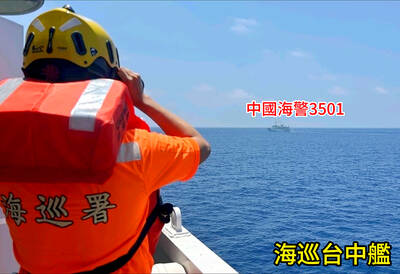
VERBOSE VESSELS: A CGA cutter and a China Coast Guard exchanged verbal barbs for more than a day in Taiwanese-controlled waters before the Chinese vessel left The Taiwanese and Chinese coast guards had a standoff near the strategically located Pratas Islands (Dongsha Islands, 東沙群島) in the north of the South China Sea, the Coast Guard Administration (CGA) said yesterday. The two sides engaged in intense radio exchanges over sovereignty claims during the 33-hour standoff. China Coast Guard vessel 3501 eventually left the restricted waters, 26.6 nautical miles (49.2km) west of the Pratas Islands, at 5pm yesterday, the CGA said. Lying approximately between southern Taiwan and Hong Kong, the Taiwan-controlled Pratas are seen by some security experts as vulnerable to Chinese attack due to their distance — more than
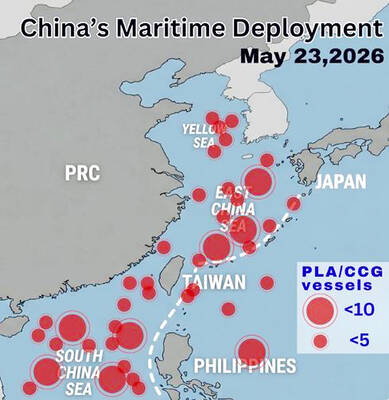
WARNING: China should stop engaging in actions that undermine regional peace and stability, as it would only build resentment among people across the Strait, the CGA said China has deployed more than 100 navy, coast guard and other vessels in waters from the Yellow Sea to the South China Sea and the western Pacific since US President Donald Trump and Chinese President Xi Jinping (習近平) met in Beijing, National Security Council Secretary-General Joseph Wu (吳釗燮) said yesterday. “In this part of the world, #China is the one & only PROBLEM wrecking the #StatusQuo & threatening regional peace & stability,” Wu wrote on X. In a separate post, he said Beijing was coercing Taiwan’s maritime domain, calling it illegal and provocative, after the Coast Guard Administration (CGA) expelled a


 RSS
RSS