


A peace treaty cannot guarantee peace, and a strong military force must back up any form of reconciliation to safeguard national interests, President William Lai (賴清德) said yesterday.
“Peace cannot be achieved through a mere piece of paper called a peace agreement, nor can it — nor will it ever — be achieved by yielding to the demands of an aggressor,” Lai said during a visit to observe army reservists’ training exercises in Yilan County.
“Even when engaging in reconciliation, we must have strong power to back us up to protect our national interests. Without sufficient strength as support, reconciliation will ultimately degenerate into surrender,” he said, adding that the training and preparation of reservists are therefore essential to the nation.
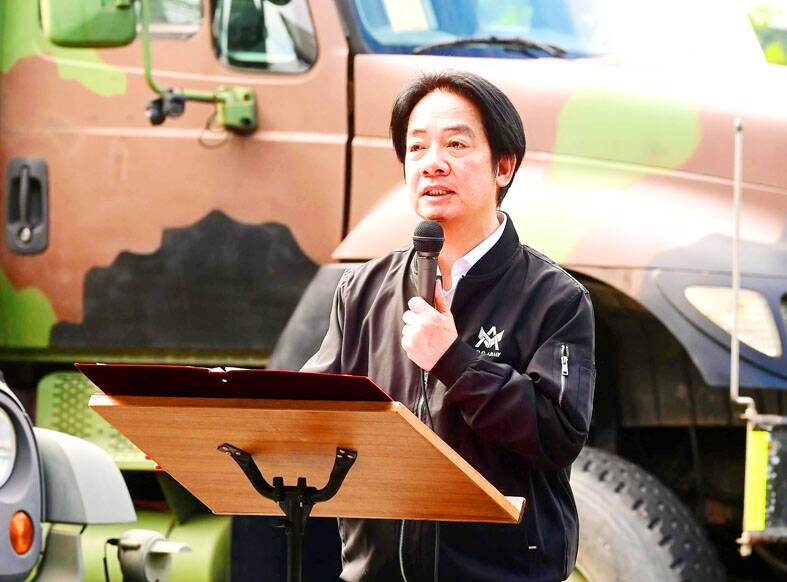
Photo: Wang Yi-sung, Taipei Times
The introduction of drone training is a milestone in reservist training from which participants could learn valuable skills that could aid their careers and benefit the country if they were called to action, Lai told the Third Battalion of reservists.
This particular reservist training incorporates all the necessary skills and techniques for urban combat, such as setting up barriers, small-unit combat and first-aid training, and prepares every reservist with the required skills should that time arise, he said.
US-trained instructors led the training course, allowing reservists to learn to use and operate drones and enhance overall combat capability, he added.
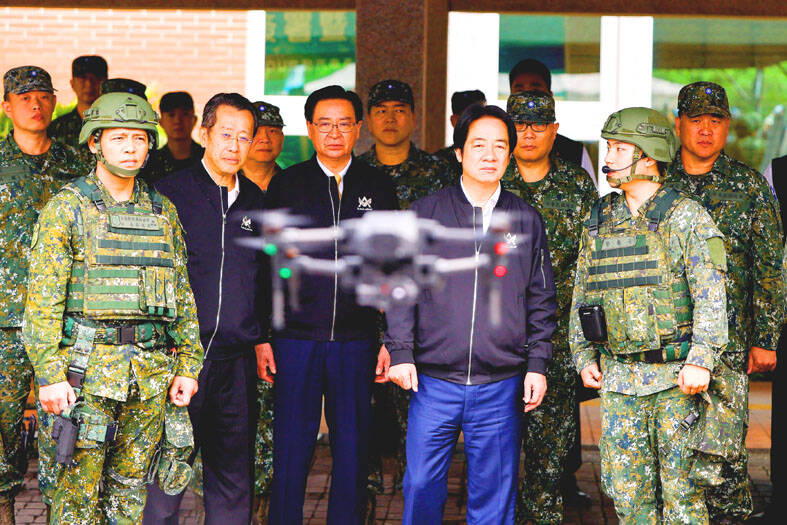
Photo: Ann Wang, Reuters
In the face of China’s coercion and harassment, the government has to spend more on the nation’s defense, he said.
“National security allows absolutely no room for compromise. National sovereignty and the core values of freedom and democracy are the very foundation of our nation,” he added.
VP INTERVIEW
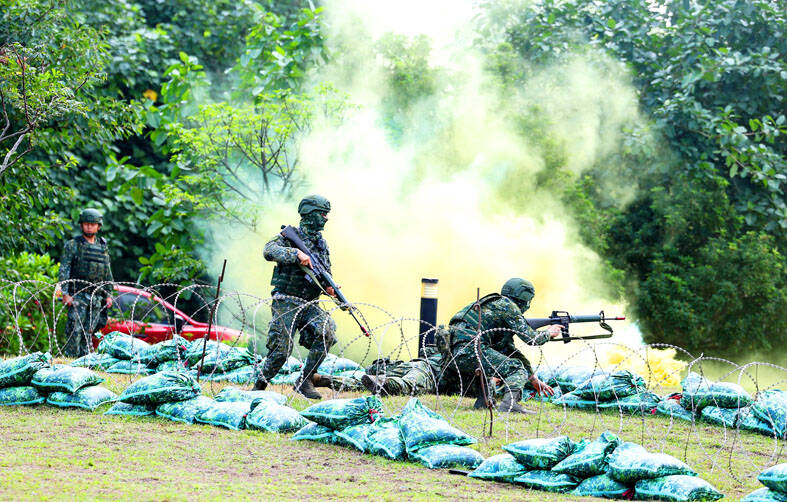
Photo: I-Hwa Cheng, AFP
Separately, in an interview with US podcast host Natalie Winters that aired on Monday, Vice President Hsiao Bi-khim (蕭美琴) said that Taiwan is aspiring for “enduring, and sustainable peace,” and that Taiwan does not have a timeline for peace.
“From Taiwan’s perspective, peace cannot involve domination by one side over another... As long as there is domination, repression or suppression of others, there will always be resistance, and that is not a sustainable form of peace,” she said.
Ideally, if both sides mutually respected one another, “we can work with each other,” she said, but added that “the reality [is] that there is a lot of nationalistic animosity coming from China towards Taiwan, there is very aggressive military posturing, there is a threat to use force against Taiwanese people and none of that is conducive to ... mutual respect and sustainable peace.”

Photo courtesy of the Presidential Office via CNA
Highlighting Taiwan’s role as a responsible member of the international community, she said: “We are not just a victim of coercion and military threats. We are a proactive partner, and we can contribute.”
Asked whether she foresaw any scenario in which “American boots would ever be on the ground in Taiwan,” Hsiao said that “everything we are doing” is to ensure that “particular hypothetical situation” stays hypothetical and never actually happens.
“And that’s why deterrence is so important, that is why strengthening Taiwan’s capabilities is just so important,” she added.
Taiwan will continue increasing defense spending, not only to procure weapons from the US, but also to expand investments in locally developed systems, such as drones, robotics and artificial intelligence, that can enhance national security.
“I think there are areas where cooperation with secure supply chains and innovation with the US, and other democratic partners, will help to expedite our ability to sustain that asymmetric edge, and the ability to deter and defend,” the vice president said.
Additional reporting by Reuters and CNA
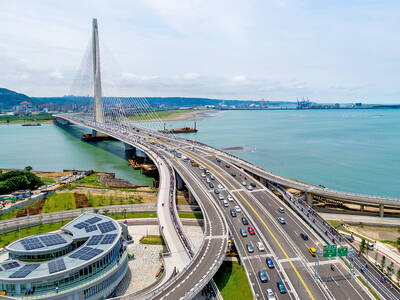
The Ministry of Transportation and Communications yesterday inaugurated the Danjiang Bridge across the Tamsui River in New Taipei City, saying that the structure would be an architectural icon and traffic artery for Taiwan. Feted as a major engineering achievement, the Danjiang Bridge is 920m long, 211m tall at the top of its pylon, and is the longest single-pylon asymmetric cable-stayed bridge in the world, the government’s Web site for the structure said. It was designed by late Iraqi-British architect Zaha Hadid. The structure, with a maximum deck of 70m, accommodates road and light rail traffic, and affords a 200m navigation channel for boats,
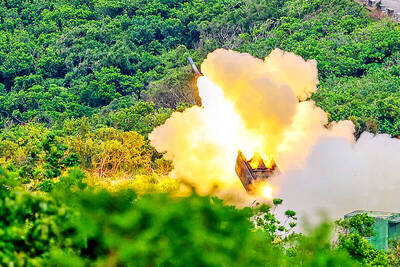
PRECISION STRIKES: The most significant reason to deploy HIMARS to outlying islands is to establish a ‘dead zone’ that the PLA would not dare enter, a source said A High Mobility Artillery Rocket System (HIMARS) would be deployed to Penghu County and Dongyin Island (東引) in Lienchiang County (Matsu) to force the Chinese military to retreat at least 100km from the coastline, a military source said yesterday. Taiwan has been procuring HIMARS and Army Tactical Missile Systems (ATACMS) from the US in batches. Once all batches have been delivered, Taiwan would possess 111 HIMARS units and 504 ATACMS, which have a range of 300km. Considering that “offense is the best defense,” the military plans to forward-deploy the systems to outlying islands such as Penghu and Dongyin so that
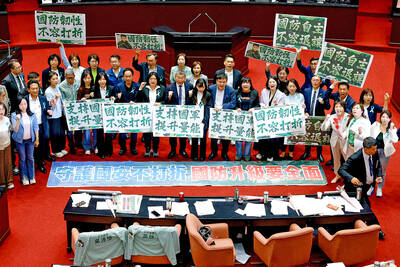
WHAT WAS ALL THAT FOR? Jaw Shaw-kong said that Cheng Li-wen had pushed for more drastic cuts and attacked him, just for the outcome to be nearly identical to his bill The legislature yesterday passed a supplementary budget bill to fund the purchase of separate packages of US military equipment, with the combined amount of spending capped at NT$780 billion (US$24.8 billion). The Chinese Nationalist Party (KMT) and Taiwan People’s Party (TPP) used their legislative majority to pass the bill, which runs until 2033 and has two main funding provisions. One was for NT$300 billion of arms sales already approved by the US for Taiwan on Dec. 17 last year, the other was for NT$480 billion for another arms package expected to be announced by Washington. The bill, which fell short of the NT$1.25

‘CLEAR MESSAGE’: The bill would set up an interagency ‘tiger team’ to review sanctions tools and other economic options to help deter any Chinese aggression toward Taiwan US Representative Young Kim has introduced a bill to deter Chinese aggression against Taiwan, calling for an interagency “tiger team” to preplan coordinated sanctions and economic measures in response to possible Chinese military or political action against Taiwan. “[Chinese President] Xi Jinping [習近平] has directed the People’s Liberation Army to be ready to invade Taiwan by 2027. China has a plan. America should have one too,” Kim said in a news release on Thursday last week. She introduced the “Deter PRC [People’s Republic of China] aggression against Taiwan act” to “ensure the US has a coordinated sanctions strategy ready should


 RSS
RSS