


The army’s Hualien Defense Command is taking measures to bolster defenses along the east coast of Taiwan proper amid a growing threat from China, a source said on Sunday.
The command is to conduct six days of live-fire exercises this month at the mouth of Taimali River (太麻里溪口) in Taitung, using tanks, mortars and machine guns to help troops familiarize themselves with combat conditions and improve coastal-defense capabilities, the source said.
“With the Chinese military fielding an expanding fleet of amphibious landing vessels, threats to Taiwan’s east coast have increased significantly, prompting the armed forces to accelerate deployments across the region,” they said.
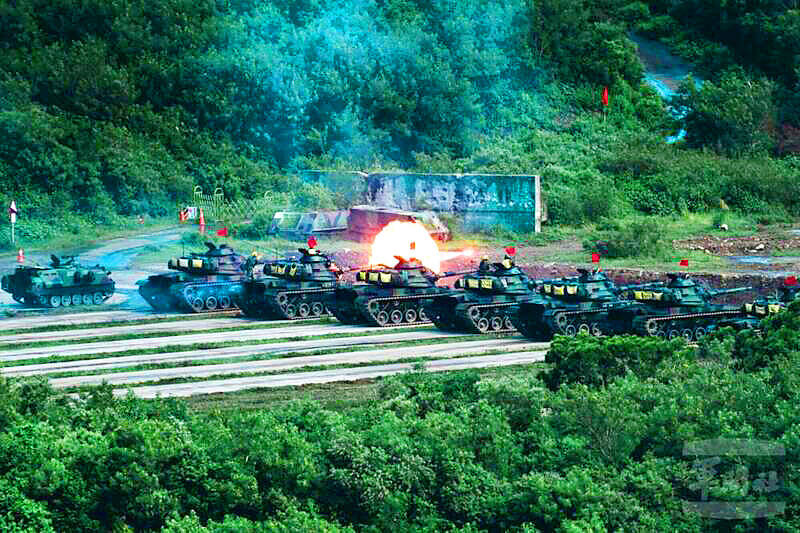
Photo courtesy of Military News Agency
In addition to the 66 F-16V Block 70 jets set for delivery next year and deployment to Chihhang Air Base in Taitung, the navy is establishing a new coastal operations command on the east coast to reinforce Pacific defenses with anti-ship missile forces, they added.
Concerns have been raised over the Chinese People’s Liberation Army’s (PLA) efforts to strengthen its amphibious assault capability, including Type-075 amphibious assault ships, Type-071 dock landing ships and the new Type-076 amphibious assault ship Sichuan now undergoing tests — a large platform believed to be capable of operating helicopters, drones and air-cushion landing craft, they said.
The PLA has also intensified training activities off Taiwan’s eastern waters, they said.
“To improve defense preparedness, the military has designated beaches such as Chihsingtan in Hualien and Chihpen in Taitung as “red beaches,” where they conduct anti-landing exercises during the annual Han Kuang drills to simulate real combat scenarios,” they said.
The navy’s new coastal operations command — scheduled to be formally established in July next year — would integrate mobile anti-ship missile launchers, fast-attack missile boats and radar units, they said, citing information published by the Ministry of National Defense.
Units are expected to be posted at Sincheng Township (新城) in Hualien and Beinan Township (卑南) in Taitung, among the possible sites, they added.
These sites would deploy domestically produced Hsiung Feng II, Hsiung Feng III, extended-range Hsiung Feng III, as well as US-made land-launched Harpoon missiles to deliver multiwave strikes against approaching invasion fleets, they said, citing information released by the defense ministry.
Separately, the US Marine Corps plans to develop Japan’s Yonaguni Island into a strategic logistics and operational hub, validated during the Resolute Dragon 2025 exercise, during which material was transported to the island for operational testing, Web site Naval News said.
The US Marine Corps envisions Yonaguni as a core node of its “first-island-chain” strategy, enabling the movement of medical supplies and disaster-response equipment, it said.
Material delivered during the annual exercise this year included standard shipping containers, cold-storage equipment and potable water units. Within two days, the US Marines transported 18 twenty-foot-equivalent containers, two water tanks and a forty-foot-equivalent refrigerated container, unloading them at the Japan Self-Defense Forces’ Yonaguni garrison, it said.
A second transport mission, completed two months later, involved a contracted civilian barge delivering additional humanitarian assistance and disaster-response equipment.
Then, during a separate Japanese disaster-resilience drill conducted in late October, US CH-53E “Super Stallion” helicopters landed on Yonaguni, and established a forward arming and refueling point (FARP). The equipment for the FARP was airlifted from Okinawa, with KC-130J tankers providing aerial refueling en route. Once operational, the FARP enabled refueling for CH-53E helicopters.
In wartime, Yonaguni could serve as a forward refueling point for transporting equipment and personnel to Taiwan, it said, adding that it could function as an emergency divert airfield for F-35B jets, as it already has a port and runway.
Chinese media have reported that US Marines and Japan’s Self-Defense Forces are expanding ports and runways across Japan to support emergency F-35B operations on islands including Yonaguni.
Analysts said the US Marines’ presence on Yonaguni would allow the deployment of High Mobility Artillery Rocket Systems and Navy Marine Expeditionary Ship Interdiction System, to establish a denial zone, preventing the PLA Navy from entering the Pacific, it said.
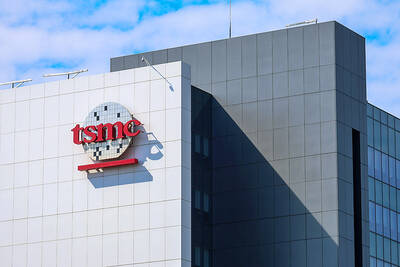
Taiwan Semiconductor Manufacturing Co (TSMC, 台積電), the world’s largest foundry service provider, yesterday said that global semiconductor revenue is projected to hit US$1.5 trillion in 2030, after the figure exceeds US$1 trillion this year, as artificial intelligence (AI) demand boosts consumption of token and compute power. “We are still at the beginning of the AI revolution, but we already see a significant impact across the whole semiconductor ecosystem,” TSMC deputy cochief operating officer Kevin Zhang (張曉強) said at the company’s annual technology symposium in Hsinchu City. “It is fair to say that in the past decade, smartphones and other mobile devices were
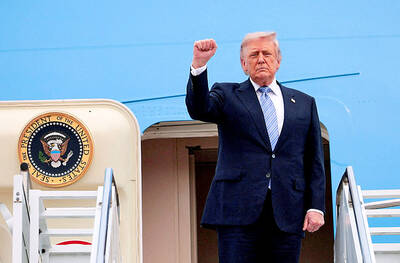
US-CHINA SUMMIT: MOFA welcomed US reassurance of no change in its Taiwan policy; Trump said he did not comment when Xi talked of opposing independence US President Donald Trump yesterday said he has not made a decision on whether to move forward with a major arms package for Taiwan after hearing concerns about it from Chinese President Xi Jinping (習近平). Trump’s comments on Taiwan came as he flew back to Washington after wrapping up critical talks in which both leaders said important progress was made in stabilizing US-China relations even as deep differences persist between the world’s two biggest powers on Iran and Taiwan. “I will make a determination,” Trump said, adding: “I’ll be making decisions. But, you know, I think the last thing we need right

TAIWAN ISSUE: US treasury secretary Scott Bessent said on the first day of meetings that ‘it wouldn’t be a US-China summit without the Taiwan issue coming up’ There were no surprises on the first day of the summit between US President Donald Trump and Chinese President Xi Jinping (習近平), the Mainland Affairs Council (MAC) said yesterday, as the government reiterated that cross-strait stability is crucial to the Asia-Pacific region, as well as the world. As the two presidents met for a highly anticipated summit yesterday, Chinese state media reported that Xi warned Trump that missteps regarding Taiwan could push their two countries into “conflict.” Trump arrived in China with accolades for his host, calling Xi a “great leader” and “friend,” and extending an invitation to visit the White House
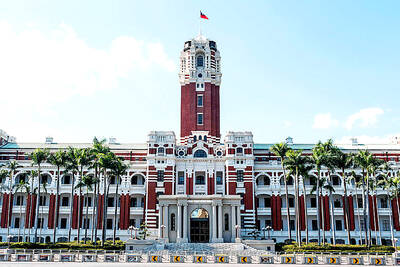
SECURITY: Taipei presses the US for arms supplies, saying the arms sales are not only a reflection of the US security commitment to Taiwan but also serve as a mutual deterrent against regional threats Taiwan is committed to preserving the cross-strait “status quo” and contributing to regional peace and stability, the Presidential Office said yesterday. “It is an undeniable fact that the Republic of China is a sovereign and independent democratic nation,” Presidential Office spokeswoman Karen Kuo (郭雅慧) reiterated, adding that Beijing has no right to claim sovereignty over Taiwan. The statements came after US President Donald Trump warned against Taiwanese independence. Trump wrapped up a state visit to Beijing on Friday, during which Chinese President Xi Jinping (習近平) had pressed him not to support Taiwan. Taiwan depends heavily on US security backing to deter China from carrying


 RSS
RSS