


Nasry Asfura, the conservative National Party candidate backed by US President Donald Trump, was yesterday leading in Honduras’ presidential election with more than 40 percent of votes counted, preliminary results showed.
A former mayor of Tegucigalpa, 67-year-old Asfura had 41 percent of the votes counted so far. His Liberal Party rival, Salvador Nasralla, was in second place with about 39 percent. Rixi Moncada, of the ruling LIBRE party, was third with 20 percent.
Whichever candidate wins a simple majority would govern the country from next year to 2030.
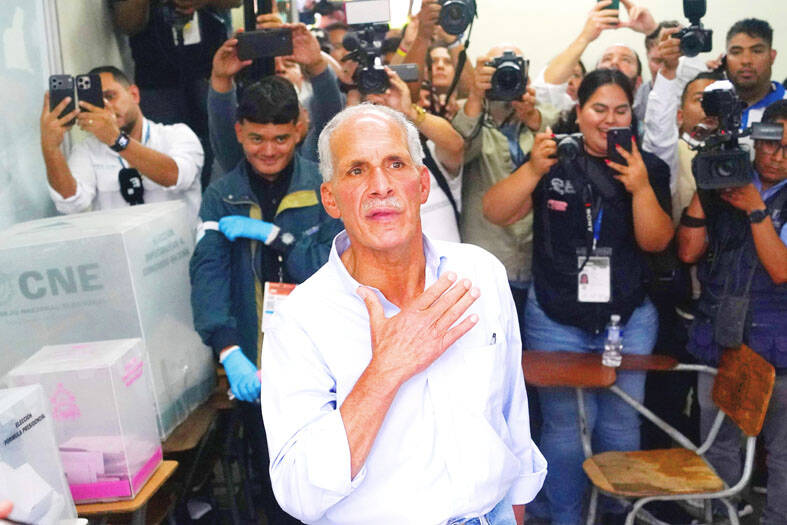
Photo: AFP
Outgoing Honduran President Xiomara Castro reposted on X a message from her husband, former president Manuel Zelaya, calling for vigilance while “awaiting the final count, with 100 percent of the presidential ballots tallied.”
In the run-up, Trump weighed in on the tightly contested race to throw his support behind Asfura in a series of social media posts, saying he could work with him to counter drug trafficking and that “if he doesn’t win, the United States will not be throwing good money after bad.”
On Friday, Trump also said he would grant a pardon to former Honduran president Juan Orlando Hernandez, who is serving a 45-year prison sentence in the US for drug trafficking and firearms charges. Hernandez, who led Honduras from 2014 to 2022, was also from the National Party.
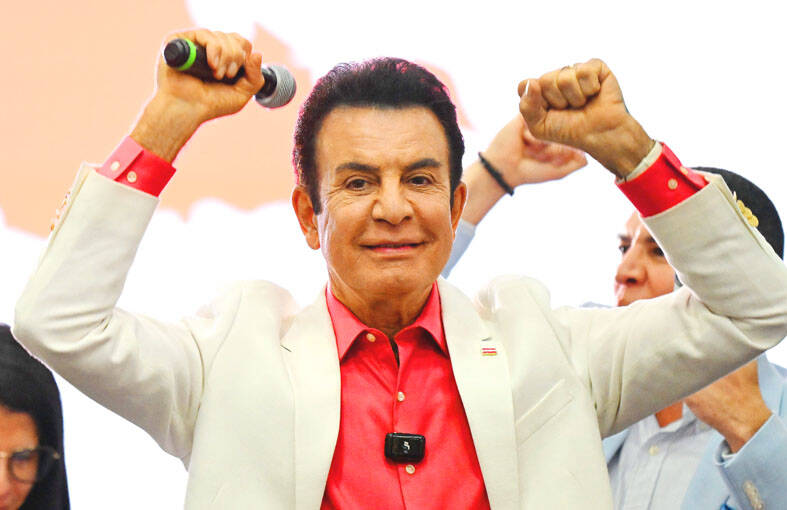
Photo: AFP
Argentine President Javier Milei threw in his lot with Asfura as well, writing on social media that “he is the candidate who best represents opposition to the leftist tyrants who destroyed Honduras.”
Asfura and Nasralla have said they might resume diplomatic relations with Taiwan, which were severed in 2023. Such a move would mark the biggest diplomatic setback for China in the region for decades.
Sunday’s vote, in which the 128 members of Congress, hundreds of mayors and thousands of other public officials are also being chosen, took place in a highly polarized climate. Moncada has suggested she would not recognize the official results.
Most polls showed a virtual tie between the three candidates heading into election day. The Organization of American States expressed concerns about the electoral process.
US Deputy Secretary of State Christopher Landau warned that Washington would respond “swiftly and decisively to anyone who undermines the integrity of the democratic process in Honduras.”
On Sunday, some frustrated voters and electoral observers denounced officials for turning away citizens still waiting to vote.
Honduras, where six out of every 10 citizens live in poverty, suffered a coup in 2009 when an alliance of right-wing military figures, politicians and businessmen overthrew Zelaya. In 2021, Hondurans voted massively for Castro, ending more than a century of rule by the National and Liberal parties.
Honduras’ Attorney General’s Office, aligned with the ruling party, has accused the opposition parties of planning to commit voter fraud, a claim they deny.
Prosecutors have opened an investigation into audio recordings in which a high-ranking National Party politician allegedly discussed plans with an unidentified military officer to influence the election. Those recordings, which the National Party says were created using artificial intelligence, were central to Moncada’s campaign.
The Honduran military has also come under criticism for asking the National Election Council to give it copies of the tally sheets on election day in contravention of Honduran law.
The tensions contributed to growing public distrust of the electoral authorities and the electoral process in general.
Castro, the first woman to govern Honduras, increased public investment and social spending. The economy has grown moderately, and poverty and inequality have decreased, but remain high. The IMF has praised her government’s prudent fiscal management.
The country’s homicide rate has also fallen to its lowest level in recent history, but violence persists.
Human rights groups have criticized Castro for maintaining a prolonged state of emergency in parts of Honduras and for continuing to rely on the military for policing, the approach of her predecessor Hernandez.

PROVOCATIVE: Chinese Deputy Ambassador to the UN Sun Lei accused Japan of sending military vessels to deliberately provoke tensions in the Taiwan Strait China denounced remarks by Japan and the EU about the South China Sea at a UN Security Council meeting on Monday, and accused Tokyo of provocative behavior in the Taiwan Strait and planning military expansion. Ayano Kunimitsu, a Japanese vice foreign minister, told the Council meeting on maritime security that Tokyo was seriously concerned about the situation in the East China and South China seas, and reiterated Japan’s opposition to any attempt to change the “status quo” by force, and obstruction of freedom of navigation and overflight. Stavros Lambrinidis, head of the EU delegation to the UN, also highlighted South China Sea

The final batch of 28 M1A2T Abrams tanks purchased from the US arrived at Taipei Port last night and were transported to the Armor Training Command in Hsinchu County’s Hukou Township (湖口), completing the military’s multi-year procurement of 108 of the tanks. Starting at 12:10am today, reporters observed more than a dozen civilian flatbed trailers departing from Taipei Port, each carrying an M1A2T tank covered with black waterproof tarps. Escorted by military vehicles, the convoy traveled via the West Coast Expressway to the Armor Training Command, with police implementing traffic control. The army operates about 1,000 tanks, including CM-11 Brave Tiger
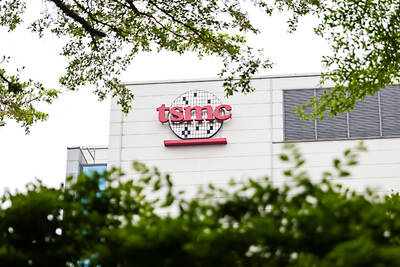
Taiwan Semiconductor Manufacturing Co (TSMC, 台積電), the world’s largest contract chipmaker, said it expects its 2-nanometer (2nm) chip capacity to grow at a compound annual rate of 70 percent from this year to 2028. The projection comes as five fabs begin volume production of 2-nanometer chips this year — two in Hsinchu and three in Kaohsiung — TSMC senior vice president and deputy cochief operating officer Cliff Hou (侯永清) said at the company’s annual technology symposium in Silicon Valley, California, last week. Output in the first year of 2-nanometer production, which began in the fourth quarter of last year, is expected to

Taiwan’s drone exports surged past US$100 million in the first quarter, exceeding last year’s full-year total, with the Czech Republic emerging as the largest buyer, the Ministry of Economic Affairs said. Exports of complete drones reached US$115.85 million in the period, about 1.2 times the total recorded for all of last year, the ministry said in a report. Exports to the Czech Republic accounted for about US$100 million, far outpacing other markets. Poland, last year’s top destination, recorded about US$11.75 million in the first quarter. Taiwan’s drone exports have expanded rapidly in the past few years, with last year’s total


 RSS
RSS