


Not long before he was reportedly detained, Miles Kwan (關靖豐) approached commuters outside a Hong Kong train station, urging them to demand accountability for the deadly inferno that tore through nearby apartment blocks.
“We all feel unhappy that [Hong Kong] has come to this and we want things to improve,” the 24-year-old student said on Friday, while handing out flyers that called for an independent probe into the blaze, which killed at least 146 people last week.
“We need to be frank about how today’s Hong Kong is riddled with holes, inside and out,” he said.
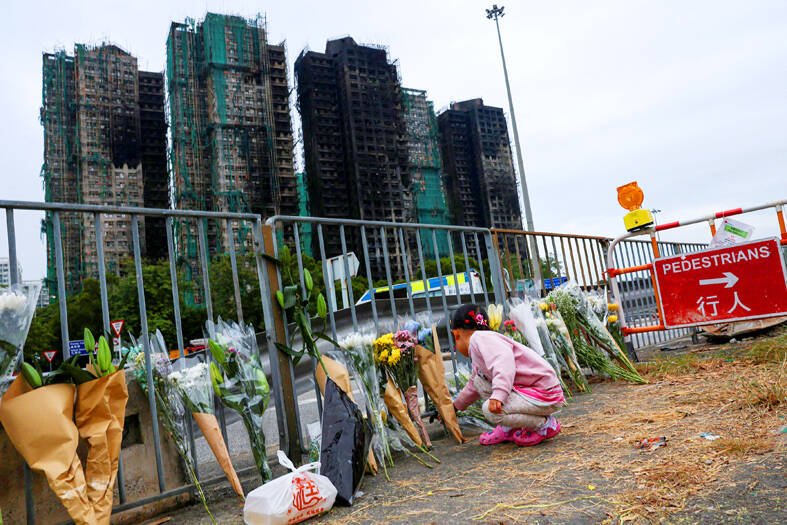
Photo: REUTERS
Kwan and other organizers’ demands turned into an online petition that gained more than 10,000 signatures in less than a day.
However, local media reported on Saturday night that Kwan was arrested on suspicion of sedition by national security police and the text of the online petition had been deleted, showing how under Beijing’s watchful eye, dissenting voices in Hong Kong can vanish as quickly as they appear.
Police declined to confirm the arrest, saying only that they “will take actions according to actual circumstances and in accordance with the law.”
Agence France-Presse sought further comment from the police yesterday, while calls to Kwan went unanswered.
Kwan was reportedly detained not long after Beijing’s national security arm in Hong Kong publicly condemned “anti-China forces” for exploiting the disaster and “inciting social division and stirring hatred against authorities.”
Asked on Friday if he feared being arrested, Kwan said he was only “proposing very basic demands.”
“If these ideas are deemed seditious or ‘crossing the line,’ then I feel I can’t predict the consequences of anything anymore, and I can only do what I truly believe,” he said.
Kwan and a handful of activists gave out flyers at the train station near the charred residential estate on Friday, demanding government accountability, an independent probe into possible corruption, proper resettlement for residents and a review of construction oversight.
The demands reflected a belief that the fire was “not an accident,” but a human-caused disaster, he said.
Authorities have arrested 11 people in connection to the blaze that tore through the high-rise blocks of Wang Fuk Court, the world’s deadliest residential building fire since 1980.
Hong Kong has previously used judge-led commissions of inquiry to undertake complex fact-finding exercises in a public forum — a practice left over from British colonial rule.
By contrast, territory officials have so far announced only an interdepartmental task force to investigate the blaze.
When the UK was grappling with public fury over the devastating Grenfell Tower fire in 2017, which killed 72 people, the government announced a public inquiry.
Lawyer Imran Khan, who represented the bereaved and survivors in the inquiry, said “the lessons from Grenfell apply around the world,” as all governments need to ensure high-rise residential buildings are safe.
Khan said a public inquiry with court-like powers was a better option for the situation in Hong Kong because “an internal investigation will not get to the truth and there will be no faith in it by the bereaved, survivors and residents.”
At the Hong Kong station on Friday, many commuters took the flyers demanding action, although few stopped to chat with Kwan or his companions.
Near the site of the blaze a short walk away, a long queue snaked through a park as mourners brought flowers and handwritten notes of remembrance.
One unsigned note left on the ground read: “This is not just an accident, it is the evil fruit of an unjust system, which landed on you. It’s not right.”
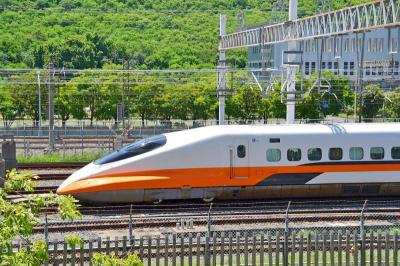
A signaling system malfunction disrupted high-speed rail (HSR) services beginning at 8am today, with trains temporarily reduced to three northbound and three southbound trains per hour as authorities conduct inspections. The malfunction occurred on a section of track in Miaoli County during pre-operation checks early this morning, forcing northbound and southbound trains to use a single track, the HSR operator said. The regular schedule has been replaced with three hourly trains offering only nonreserved seating in each direction, stopping at every station, it said, adding that business class cars would still have reserved seating. Departures from terminal stations are scheduled at the top
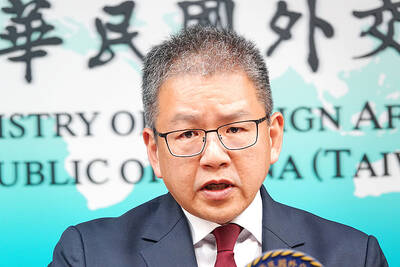
Taiwan is still in the process of assessing the possibility of recruiting workers from Eswatini, the Ministry of Foreign Affairs said yesterday, adding that its goal is to help Eswatini upgrade its vocational training centers. If there are plans to recruit workers from Eswatini, safeguarding national security, protecting public health and ensuring the employment rights of Taiwanese would be prerequisites, Department of West Asian and African Affairs Director-General Yen Chia-liang (顏嘉良) told a news conference. Key considerations would also include filling labor shortages in specific industries, and fostering bilateral professional and technical exchanges, he said. Yen was asked about the progress of labor
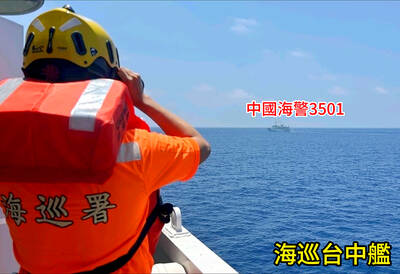
VERBOSE VESSELS: A CGA cutter and a China Coast Guard exchanged verbal barbs for more than a day in Taiwanese-controlled waters before the Chinese vessel left The Taiwanese and Chinese coast guards had a standoff near the strategically located Pratas Islands (Dongsha Islands, 東沙群島) in the north of the South China Sea, the Coast Guard Administration (CGA) said yesterday. The two sides engaged in intense radio exchanges over sovereignty claims during the 33-hour standoff. China Coast Guard vessel 3501 eventually left the restricted waters, 26.6 nautical miles (49.2km) west of the Pratas Islands, at 5pm yesterday, the CGA said. Lying approximately between southern Taiwan and Hong Kong, the Taiwan-controlled Pratas are seen by some security experts as vulnerable to Chinese attack due to their distance — more than

A US uncrewed surface vessel (USV) encountered multiple Chinese warships during an autonomous transit of the Taiwan Strait, US defense company Seasats said in a statement on Wednesday. Seasats announced that a Lightfish USV had completed the first autonomous transit of the Taiwan Strait. Over five days, the USV traversed the entire length of the Strait while constantly monitoring surface vessel traffic, the company said. The Lightfish encountered multiple Chinese warships, one of which was a Chinese People’s Liberation Army Navy (PLAN) Type 056 corvette, it said. The Chinese vessels were operating “well within Taiwan’s exclusive economic zone without transmitting their identity via the


 RSS
RSS