


Democratic Progressive Party legislators Wang Ting-yu (王定宇) and Wang Yi-chuan (王義川) have proposed amendments to the Anti-infiltration Act (反滲透法) to prevent the Chinese Communist Party (CCP) from undermining democracy in Taiwan by conducting “united front” propaganda under the guise of freedom of speech.
The proposal to amend Article 5 of the act prohibits people from accepting instructions, commissions or funding from infiltration sources to engage in activities that cooperate with “united front” work or carry out politically motivated propaganda.
According to the draft, those who contravene the act would be fined between NT$100,000 and NT$500,000 (US$3,184 and US$15,919), with related materials to be confiscated.
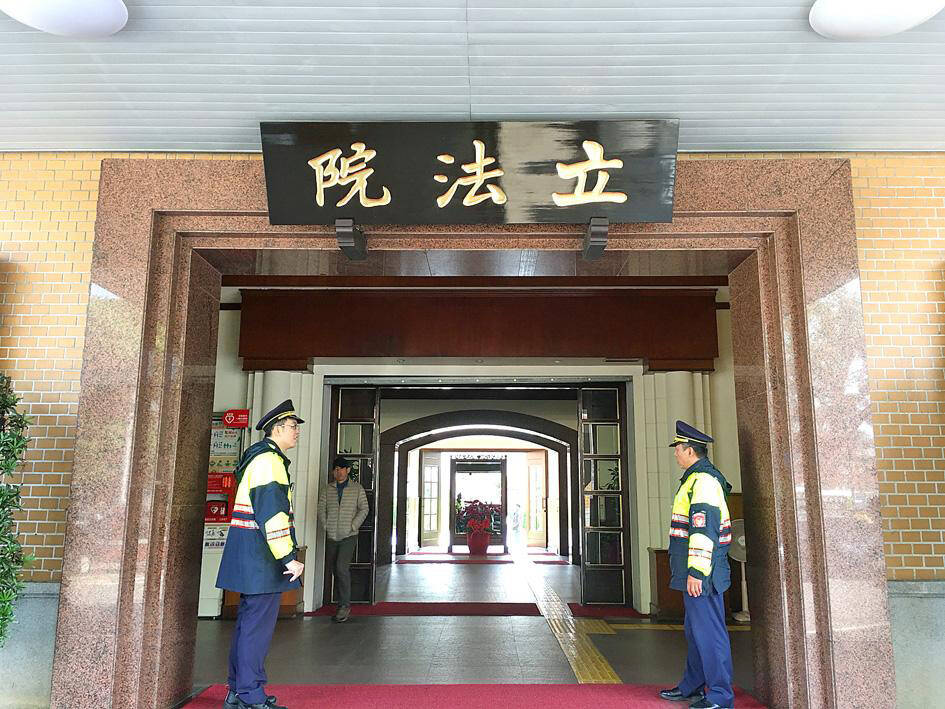
Photo: Lin Liang-sheng, Taipei Times
The draft also proposed that anyone who contravenes the aforementioned provisions by raising, hanging, displaying, holding, or waving the flags or symbols of foreign hostile forces, or their party, government or military in public places would be fined between NT$50,000 and NT$300,000, with related items to be confiscated.
However, it would not apply to conferences or activities approved by the competent authority or to actions carried out in accordance with international treaties or conventions, according to the bill.
The proposal was sent to a legislative committee for review on Friday.
China is good at using local Taiwanese collaborators to blur the line between friend and foe, and engage in actions that aid the enemy, while disguising their behavior as legitimate expressions of Taiwanese political identity, the lawmakers said.
Whether such expression of political identity falls under the constitutional protection of freedom of speech is disputed, they said.
Local collaborators have become tools manipulated and controlled by China to sabotage the nation’s democratic system, meaning they are not entitled to constitutional free speech protections, they said.
China’s cognitive warfare against Taiwan has intensified, with Beijing operating a “central kitchen” to push specific political agendas, Wang Ting-yu said yesterday.
Local collaborators and information companies hired for such purpose deploy large numbers of online trolls to steer public opinion in Taiwan, he added.
The content promoted by such actors almost perfectly mirrors the political agenda being advanced by the CCP, he said.
The CCP is exploiting Taiwan’s open society and freedom of speech in an attempt to destroy that freedom by using distortion and orchestrated campaigns to drown out legitimate voices, Wang Ting-yu said.
It has happened before, but the situation has become much worse, he said.
The proposed legislative amendments are not intended to restrict freedom of expression, he added.
“It is fine if you want to say something on your own. However, if you are taking money from the CCP or accepting commissions from the Chinese government, military or affiliated organizations, then we believe there should be legal consequences,” he said.
There is a clear distinction between exercising personal free speech and being paid by the CCP to spread its propaganda, Wang Ting-yu said.
Meanwhile, the two lawmakers have also proposed amendments to the Lobbying Act (遊說法) to prohibit people from China, Hong Kong or Macau from lobbying.
The draft would impose fines of up to NT$5 million for those who contravene the act, with the same penalties applying to those who knowingly accept such lobbying or deliberately conceal it.
The bill was also sent to a legislative committee for review on Friday last week.
Article 7 of the act currently prohibits foreign governments, legal persons, organizations and natural persons from lobbying matters related to national defense, foreign affairs and mainland affairs concerned with national security or national secrets, while the same applies to people and organizations from China, Hong Kong and Macau, they said.
Without corresponding penalties, the law is toothless, they said.
The draft amendment would introduce fines ranging from NT$500,000 to NT$2.5 million for contraventions of rules, with the same penalties applying to those who fail to refuse illegal lobbying attempts.
It also proposed to amend Article 8 of the act by adding references to “foreign hostile forces” and “people dispatched or acting on their behalf,” in accordance with amendments to the Criminal Code, the National Security Act (國家安全法) and the Classified National Security Information Protection Act (國家機密保護法).
The draft stipulates that people or organizations from China, Hong Kong, Macau, foreign forces or people acting on their behalf shall not engage in lobbying themselves or commission others to do so.
Those who contravene the act would be fined NT$1 million to NT$5 million, with the same penalties applying to those who accept such lobbying or intentionally conceal violations.

A signaling system malfunction disrupted high-speed rail (HSR) services beginning at 8am today, with trains temporarily reduced to three northbound and three southbound trains per hour as authorities conduct inspections. The malfunction occurred on a section of track in Miaoli County during pre-operation checks early this morning, forcing northbound and southbound trains to use a single track, the HSR operator said. The regular schedule has been replaced with three hourly trains offering only nonreserved seating in each direction, stopping at every station, it said, adding that business class cars would still have reserved seating. Departures from terminal stations are scheduled at the top

Taiwan is still in the process of assessing the possibility of recruiting workers from Eswatini, the Ministry of Foreign Affairs said yesterday, adding that its goal is to help Eswatini upgrade its vocational training centers. If there are plans to recruit workers from Eswatini, safeguarding national security, protecting public health and ensuring the employment rights of Taiwanese would be prerequisites, Department of West Asian and African Affairs Director-General Yen Chia-liang (顏嘉良) told a news conference. Key considerations would also include filling labor shortages in specific industries, and fostering bilateral professional and technical exchanges, he said. Yen was asked about the progress of labor

A US uncrewed surface vessel (USV) encountered multiple Chinese warships during an autonomous transit of the Taiwan Strait, US defense company Seasats said in a statement on Wednesday. Seasats announced that a Lightfish USV had completed the first autonomous transit of the Taiwan Strait. Over five days, the USV traversed the entire length of the Strait while constantly monitoring surface vessel traffic, the company said. The Lightfish encountered multiple Chinese warships, one of which was a Chinese People’s Liberation Army Navy (PLAN) Type 056 corvette, it said. The Chinese vessels were operating “well within Taiwan’s exclusive economic zone without transmitting their identity via the

VERBOSE VESSELS: A CGA cutter and a China Coast Guard exchanged verbal barbs for more than a day in Taiwanese-controlled waters before the Chinese vessel left The Taiwanese and Chinese coast guards had a standoff near the strategically located Pratas Islands (Dongsha Islands, 東沙群島) in the north of the South China Sea, the Coast Guard Administration (CGA) said yesterday. The two sides engaged in intense radio exchanges over sovereignty claims during the 33-hour standoff. China Coast Guard vessel 3501 eventually left the restricted waters, 26.6 nautical miles (49.2km) west of the Pratas Islands, at 5pm yesterday, the CGA said. Lying approximately between southern Taiwan and Hong Kong, the Taiwan-controlled Pratas are seen by some security experts as vulnerable to Chinese attack due to their distance — more than


 RSS
RSS