


The first satellite of the Taiwan-made Formosat-8 constellation project successfully lifted off yesterday morning from the Vandenberg Space Force Base in California, according to the Taiwan Space Agency (TASA).
SpaceX’s Transporter-15 rocket carried the satellite, named the “Chi Po-lin Satellite” (齊柏林衛星) after the late Taiwanese documentary director known for recording Taiwan through aerial imagery, into space at 2:44am after a slight delay from the scheduled launch time of 2:18am, to avoid a possible collision with another satellite in orbit, TASA said.
The satellite, codenamed FS-8A, is one of eight in the Formosat-8 constellation and is expected to capture ground details at a resolution of 1m, sharpening to 0.7m after processing, to study the frequent natural disasters and security risks Taiwan faces.
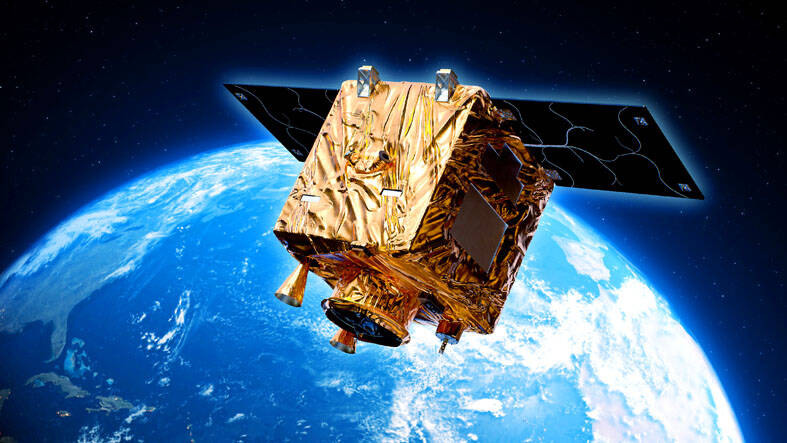
Photo courtesy of the Taiwan Space Agency
During the countdown of the launch, TASA Director-General Wu Jong-shinn (吳宗信) said he was very nervous, as the FS-8A felt like his own baby.
Now the satellite has been launched, Wu said he has embraced high expectations that it would leverage high-resolution imagery to collect data multiple times a day to provide comprehensive observation capabilities.
The launch of FS-8A had been postponed five times due to conflicts in launch schedules, a US government shutdown and the need for more preparatory work, project leader Cynthia Liu (劉小菁) said.
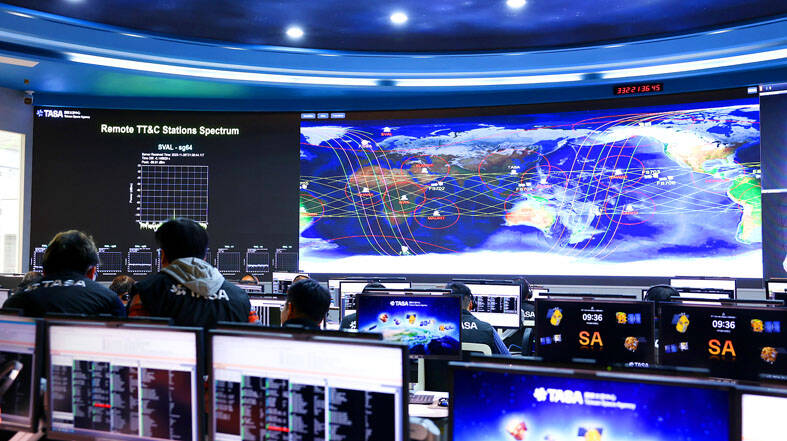
Photo courtesy of the Taiwan Space Agency
According to TASA, the Formosat-8 constellation would be able to do more than just provide clearer images; it would be operating in a sun-synchronous orbit 561km above Earth.
With more satellites, Formosat-8’s revisit rate — the frequency of imaging the same location on Earth — would also improve, according to Liu.
President William Lai (賴清德), who named the satellite, in a recorded video said that the successful launch of FS-8A is not only the beginning of the Formosat-8 project, but also a milestone in Taiwan’s space industry development.
Citing an ambition unveiled in his inauguration speech on May 20 last year, Lai said the government would continue to work with industry and academia to develop the next generation of medium and low-orbit communications satellites to put Taiwan’s space and aerospace industries on the international stage.
Lai expressed gratitude for the efforts of the local space industry to make the launch of FS-8A a reality, to allow the Chi Po-lin Satellite to safeguard Taiwan, and to let the world witness Taiwan’s ambitions, courage and achievements.
National Science and Technology Council Minister Wu Cheng-wen (吳誠文) said the satellite showcased Taiwan’s strength in the space industry, and the launch is expected to pave the way for diversified applications and value-added services in aerial imagery, which would bring tremendous business opportunities for Taiwanese tech firms.
Chi’s son, Chi Yen-huan (齊延洹), described the launch as replacing his father as a protector of Taiwan, but from a higher perspective.
His father filmed eye-opening aerial imagery and videos of Taiwan, which showed its natural beauty, but also environmental degradation when its land and rivers are exploited for profit and not well taken care of, he said.
Chi Po-lin died in a helicopter crash in 2017.
“Chi Po-lin is not only a person’s name or an individual, but will represent Taiwan’s spirit,” the Chi Yen-huan said.
The Formosat-8 constellation is expected to be fully deployed in 2031, and would “support disaster management, national security and global collaboration,” according to a TASA video released last month to introduce the program.

A signaling system malfunction disrupted high-speed rail (HSR) services beginning at 8am today, with trains temporarily reduced to three northbound and three southbound trains per hour as authorities conduct inspections. The malfunction occurred on a section of track in Miaoli County during pre-operation checks early this morning, forcing northbound and southbound trains to use a single track, the HSR operator said. The regular schedule has been replaced with three hourly trains offering only nonreserved seating in each direction, stopping at every station, it said, adding that business class cars would still have reserved seating. Departures from terminal stations are scheduled at the top

Taiwan is still in the process of assessing the possibility of recruiting workers from Eswatini, the Ministry of Foreign Affairs said yesterday, adding that its goal is to help Eswatini upgrade its vocational training centers. If there are plans to recruit workers from Eswatini, safeguarding national security, protecting public health and ensuring the employment rights of Taiwanese would be prerequisites, Department of West Asian and African Affairs Director-General Yen Chia-liang (顏嘉良) told a news conference. Key considerations would also include filling labor shortages in specific industries, and fostering bilateral professional and technical exchanges, he said. Yen was asked about the progress of labor

VERBOSE VESSELS: A CGA cutter and a China Coast Guard exchanged verbal barbs for more than a day in Taiwanese-controlled waters before the Chinese vessel left The Taiwanese and Chinese coast guards had a standoff near the strategically located Pratas Islands (Dongsha Islands, 東沙群島) in the north of the South China Sea, the Coast Guard Administration (CGA) said yesterday. The two sides engaged in intense radio exchanges over sovereignty claims during the 33-hour standoff. China Coast Guard vessel 3501 eventually left the restricted waters, 26.6 nautical miles (49.2km) west of the Pratas Islands, at 5pm yesterday, the CGA said. Lying approximately between southern Taiwan and Hong Kong, the Taiwan-controlled Pratas are seen by some security experts as vulnerable to Chinese attack due to their distance — more than

A US uncrewed surface vessel (USV) encountered multiple Chinese warships during an autonomous transit of the Taiwan Strait, US defense company Seasats said in a statement on Wednesday. Seasats announced that a Lightfish USV had completed the first autonomous transit of the Taiwan Strait. Over five days, the USV traversed the entire length of the Strait while constantly monitoring surface vessel traffic, the company said. The Lightfish encountered multiple Chinese warships, one of which was a Chinese People’s Liberation Army Navy (PLAN) Type 056 corvette, it said. The Chinese vessels were operating “well within Taiwan’s exclusive economic zone without transmitting their identity via the


 RSS
RSS