


Ecuadoran voters roundly rejected the return of US military bases to the country in a referendum on Sunday, a major political blow to the US-friendly Ecuadoran President Daniel Noboa.
With three-quarters of the vote counted, about 60 percent of Ecuadorans had voted “no” to lifting a longstanding ban on foreign bases. The rejection effectively blocks the US military from returning to an airbase at Manta on the Pacific coast — once a hub for Washington’s anti-drug operations.
It is a serious defeat for Noboa, who has staked his political fortunes on tackling rampant cartel violence and forging an alliance with US President Donald Trump.
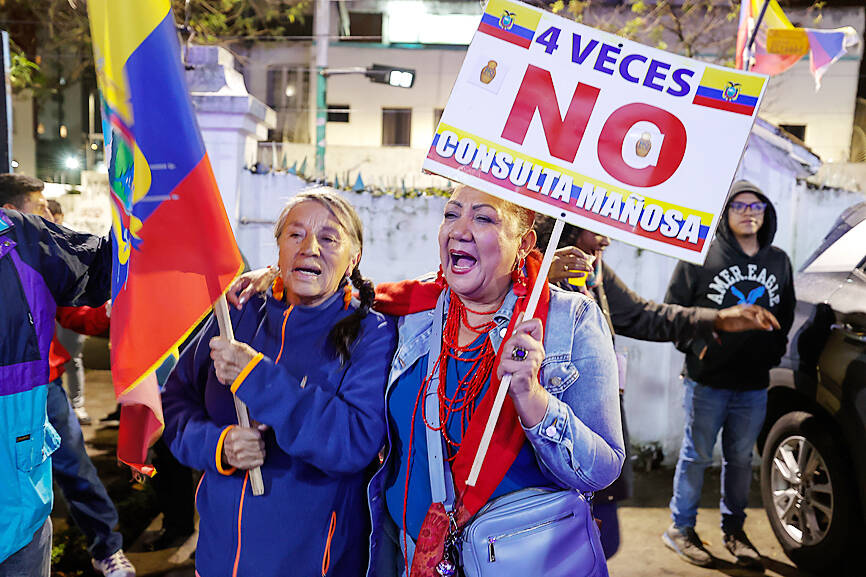
Photo: EPA
The vote came against the backdrop of US military airstrikes against alleged drug smuggling boats in the Caribbean and Pacific, a divisive policy that Noboa has backed.
“They wanted to scrap our rights, sell our sovereignty and hand it to Trump, so he could install gringo military bases,” said Ricardo Moreno, 70.
Nearly 14 million Ecuadorans were eligible to cast ballots on whether to overturn a 2008 ban on foreign military bases.
Voters were also asked three other questions: whether they should end public funding for political parties, reduce the number of lawmakers and create an elected body that would draft a new constitution. The early count showed those proposals failing by a large margin, too.
“We respect the will of the Ecuadoran people,” Noboa said, accepting the results.
Noboa had hoped a new constitution would give him more powers to tackle crime, curb the power of the judiciary and reform the economy.
The result is a shock. Polls had predicted that Noboa would win on all four questions, and he remains popular, having recently won a second term in office.
However, Sunday’s results carried signs that under pressure from still-high crime rates Noboa’s might be dimming.
“I had the wrong idea about him. I made a mistake, I voted for him,” said Andres Delgado, a 23-year-old university student.
“I’m celebrating because the nation should not be treated this way by this inept president,” he added.
Noboa won on a promise to tackle violence sparked by turf wars between drug trafficking gangs who transport cocaine from Latin America to North America, Europe and Asia.
He has deployed soldiers on the streets and in prisons, launched dramatic raids on drug strongholds and declared frequent states of emergency, which were criticized by human rights groups.
Once much safer, Ecuador now has one of the highest homicide rates in Latin America, and some would like to give Noboa freer rein.
“It is the only way to toughen the laws a bit and put an end to the insecurity our country is experiencing,” Teresa Jacome, 60, said in the crime-ridden largest city of Guayaquil.
Regarding the other questions on the ballot, Noboa argued that the current constitution, at 400-plus articles, was too long and has “many errors.”
However, he had been coy about what parts of the constitution he would like to change, leading to allegations he wants to consolidate power and curb rights.
The body to draft a new constitution would likely be dominated by Noboa’s allies, given his approval rating of about 56 percent.
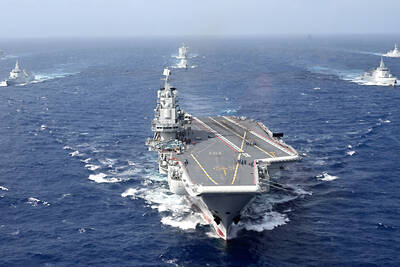
PROVOCATIVE: Chinese Deputy Ambassador to the UN Sun Lei accused Japan of sending military vessels to deliberately provoke tensions in the Taiwan Strait China denounced remarks by Japan and the EU about the South China Sea at a UN Security Council meeting on Monday, and accused Tokyo of provocative behavior in the Taiwan Strait and planning military expansion. Ayano Kunimitsu, a Japanese vice foreign minister, told the Council meeting on maritime security that Tokyo was seriously concerned about the situation in the East China and South China seas, and reiterated Japan’s opposition to any attempt to change the “status quo” by force, and obstruction of freedom of navigation and overflight. Stavros Lambrinidis, head of the EU delegation to the UN, also highlighted South China Sea
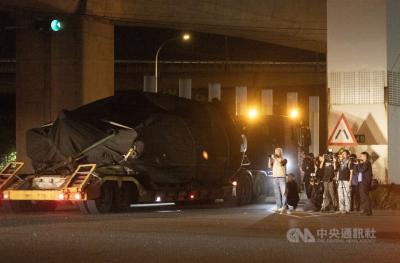
The final batch of 28 M1A2T Abrams tanks purchased from the US arrived at Taipei Port last night and were transported to the Armor Training Command in Hsinchu County’s Hukou Township (湖口), completing the military’s multi-year procurement of 108 of the tanks. Starting at 12:10am today, reporters observed more than a dozen civilian flatbed trailers departing from Taipei Port, each carrying an M1A2T tank covered with black waterproof tarps. Escorted by military vehicles, the convoy traveled via the West Coast Expressway to the Armor Training Command, with police implementing traffic control. The army operates about 1,000 tanks, including CM-11 Brave Tiger
Taiwan Semiconductor Manufacturing Co (TSMC, 台積電), the world’s largest contract chipmaker, said it expects its 2-nanometer (2nm) chip capacity to grow at a compound annual rate of 70 percent from this year to 2028. The projection comes as five fabs begin volume production of 2-nanometer chips this year — two in Hsinchu and three in Kaohsiung — TSMC senior vice president and deputy cochief operating officer Cliff Hou (侯永清) said at the company’s annual technology symposium in Silicon Valley, California, last week. Output in the first year of 2-nanometer production, which began in the fourth quarter of last year, is expected to

Taiwan’s drone exports surged past US$100 million in the first quarter, exceeding last year’s full-year total, with the Czech Republic emerging as the largest buyer, the Ministry of Economic Affairs said. Exports of complete drones reached US$115.85 million in the period, about 1.2 times the total recorded for all of last year, the ministry said in a report. Exports to the Czech Republic accounted for about US$100 million, far outpacing other markets. Poland, last year’s top destination, recorded about US$11.75 million in the first quarter. Taiwan’s drone exports have expanded rapidly in the past few years, with last year’s total


 RSS
RSS