


University students who complete enough courses taught in English may apply to partner universities in the US without needing to provide English-language test scores, the Ministry of Education (MOE) said yesterday.
If a student has taken enough courses with English as a medium of instruction (EMI), they can submit their grades in those courses rather than their Test of English as a Foreign Language (TOEFL) results when applying to US partner universities, ministry officials told a news conference in Taipei.
Taiwan is the first non-English-speaking country to have EMI coursework formally recognized by top US universities, it said.
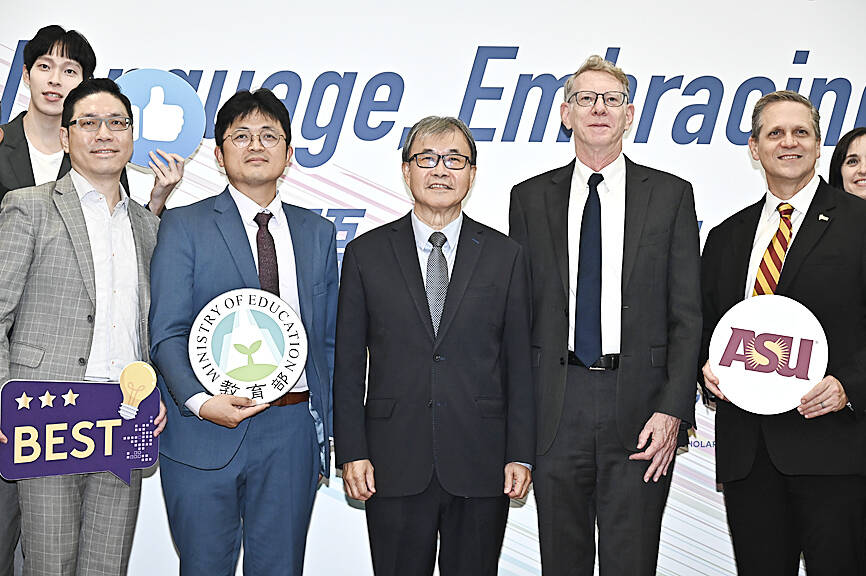
Photo: Tu Chien-jung, Taipei Times
The program is a partnership between the ministry and Fulbright Taiwan, involving National Sun Yat-sen University (NSYSU), National Cheng Kung University, National Taiwan University, National Taiwan Normal University (NTNU), Arizona State University, New York University, Columbia University’s Teachers College and the University of Maryland.
Delegations from the four US schools visited the Taiwanese universities to observe classes, Department of Higher Education Director Chen Hao-hui (陳浩會) said.
The first group of Taiwanese students participating in the program would go to the US in February next year, Chen said.
The number of spots would be decided by the eight universities, he said.
In addition to meeting EMI coursework requirements, students applying to graduate programs must also meet Graduate Record Examination or Graduate Management Admission Test standards, he said.
This milestone program shows that Taiwan’s bilingual education has gained international credibility, Minister of Education Cheng Ying-yao (鄭英耀) said.
The ministry in 2021 launched a program promoting bilingual education in universities, he said, adding that today’s announcement is the first step toward TOEFL exemptions on the national level.
The ministry will continue to systematically support bilingual education, enhance the quality of EMI courses and deepen international cooperation, he said.
NSYSU vice president Kuo Chih-wen (郭志文) said that the university has offered 1,340 EMI courses — accounting for 30 percent of its courses — in the five years since the program was launched.
NSYSU fourth-year student Fu Kuan-wen (傅冠文) said that he uses English to welcome foreign guests and tutor math, which has given him extra income and more confidence for his future career.
NTNU vice president Ying Yung-hsiang (印永翔) said that all undergraduate departments offer at least 18 credits of EMI courses.

LEVERAGE: China did not ‘need to fire a shot’ to deny Taiwan airspace over Africa when it owns ‘half the continent’s debt,’ a US official said, calling it economic warfare The EU has raised concerns about overflight rights following the delay of President William Lai’s (賴清德) planned state visit to the Kingdom of Eswatini after three African nations denied overflight clearance for his charter at the last minute. Taiwanese allies Paraguay and Saint Kitts and Nevis, as well as several US lawmakers and the Inter-Parliamentary Alliance on China (IPAC) condemned China for allegedly pressuring the countries. Lai was scheduled to fly directly to Taiwan’s only African ally from yesterday to Sunday to celebrate the 40th anniversary of King Mswati III’s accession and his 58th birthday, but Seychelles, Mauritius and Madagascar suddenly revoked
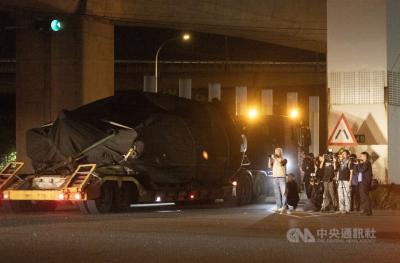
The final batch of 28 M1A2T Abrams tanks purchased from the US arrived at Taipei Port last night and were transported to the Armor Training Command in Hsinchu County’s Hukou Township (湖口), completing the military’s multi-year procurement of 108 of the tanks. Starting at 12:10am today, reporters observed more than a dozen civilian flatbed trailers departing from Taipei Port, each carrying an M1A2T tank covered with black waterproof tarps. Escorted by military vehicles, the convoy traveled via the West Coast Expressway to the Armor Training Command, with police implementing traffic control. The army operates about 1,000 tanks, including CM-11 Brave Tiger
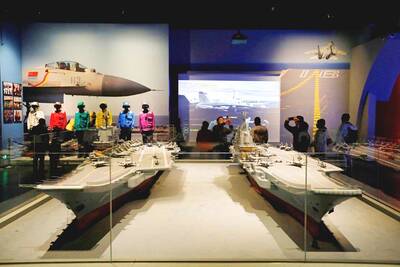
China on Wednesday teased in a video an aircraft carrier that could be its fourth, and the first using nuclear power, while making an allusion to Taiwan and vowing to further build up its islands, as it looks to boost maritime power, secure resources and bolster territorial claims. The video, issued on the eve of the 77th founding anniversary of the Chinese People’s Liberation Army Navy, featured fictional officers with names that are homophones of three commissioned aircraft carriers, the Liaoning (遼寧), Shandong (山東) and Fujian (福建). Titled Into the Deep, it showed a 19-year-old named “Hejian” (何劍) joining the group, sparking
BIG YEAR: The company said it would also release its A12 chip the same year to keep a ‘reliable stream of new silicon technologies’ flowing to its customers Taiwan Semiconductor Manufacturing Co (TSMC, 台積電) yesterday said its newest A13 chip is to enter volume production in 2029 as the chipmaker seeks to hold onto its tech leadership and demand for next-generation chips used in artificial intelligence (AI), high-performance-computing (HPC) and mobile applications. TSMC, the world’s biggest contract chipmaker, also unveiled its A12 chip at its annual technology symposium in Santa Clara, California. The A12 chip, which features TSMC’s super-power-rail technology to provide backside power delivery for AI and HPC applications, is also to enter volume production in 2029, a year after the scheduled release of the A14 chip. The technology moves


 RSS
RSS