


A dedicated, child-centered agency supporting children’s physical and mental health development would be established under the Ministry of Health and Welfare, President William Lai (賴清德) said yesterday during his opening remarks at the Healthy Taiwan Sustainability Forum at National Taiwan University Hospital.
Lai said Cardiac Children’s Foundation Taiwan honorary chairperson and NTU emeritus professor of pediatrics Lue Hung-chi (呂鴻基) visited him when he was premier and vice president, advocating for years for better children’s healthcare policies.
Lai said now that he is president, he wants to tell Lue and everyone that an agency specializing on the topic is to be established.

Photo: Chen Yi-kuan, Taipei Times
“The ministry will establish a children and family administration in the future, a specialized governmental agency for the care of children,” he said.
As the first physician to become president, Lai said he established the Healthy Taiwan Promotion Committee to increase the healthy life expectancy of Taiwanese, address the sustainability issues of the National Health Insurance (NHI) and create a better healthcare environment.
To improve the healthcare environment, the government would continue to push institutional reforms to improve holistic healthcare services that serve all, from children to elderly people and those with critical or chronic illnesses, he said.
In response to a shortage in pediatricians over the past few years, the government implemented a children’s healthcare improvement program, which Taiwan Pediatric Association chairman Ni Yen-hsuan (倪衍玄) said has been effective, Lai said, adding that Ni expressed hope that the program would continue.
“From this year to 2028, we will continue with the second phase of the program,” he said. “We plan to allocate NT$13.56 billion [US$435.31 million] to the program over four years, to improve the children’s healthcare capacity and help retain healthcare workers in the profession.”
A budget of NT$2.7 billion has been allocated this year for the establishment of a three-tiered triage system for pediatric healthcare, with eight hospitals responsible for the care of children with critical, severe and rare conditions, Lai said.
Subsidies were also provided to 27 key hospitals so that they could integrate medical resources needed for perinatal care and critical care, and provide more comprehensive prenatal or intensive care, he said.
The ministry launched a “Project of Holistic Physicians for Young Children,” and as of September, there were more than 2,500 physicians at about 1,200 healthcare facilities providing care for more than 268,000 children younger than 3 years old, or a coverage rate of about 65 percent, Lai said.
The National Health Insurance Administration (NHIA) also allocated NT$24.9 billion of its budget for pediatric care for children from birth until they are 6 years old, he said.
The NHIA from last year to this year allocated NT$857 million to increase NHI payments for pediatric medical care services, and it is planning to further increase NHI payments for pediatric ward and intensive care unit consultation fees, as well as provide bonuses to retain pediatricians, he added.
Minister of Health and Welfare Shih Chung-liang (石崇良) on the sidelines of the forum said that as Taiwan faces low birthrate and childcare issues, the ministry hopes to consolidate scattered childcare services and welfare resources under one specialized agency for management.
In accordance with Lai’s instructions, the new agency would be handling children’s healthcare promotion, preventive care, welfare and protection, and early intervention and development, Shih said, adding that the draft organization law would be sent to the Executive Yuan for review by the end of the year.
Additional reporting by CNA

‘NO SECURITY RISK’: The Railway Bureau reassured the public that the technicians’ activities were limited to technical guidance and did not involve sensitive systems The Railway Bureau yesterday said it had invited eight Chinese technicians to assist with an airport MRT construction project. The bureau issued the confirmation after an Internet user said Chinese nationals had entered the construction zone of Taiwan Taoyuan International Airport’s Terminal 3 project. They asked why “individuals from an enemy state” were allowed access to such a major national infrastructure project, which raised serious concerns over Taiwan’s industrial safety, sensitive systems and information security. The bureau’s Northern Region Engineering Branch Office said subcontractor Taiwan Handle Industrial Co (台灣手把工業) of the Taoyuan airport MRT’s “Contract No. CU05 Project A14 Station Civil, MEP &

A US uncrewed surface vessel (USV) encountered multiple Chinese warships during an autonomous transit of the Taiwan Strait, US defense company Seasats said in a statement on Wednesday. Seasats announced that a Lightfish USV had completed the first autonomous transit of the Taiwan Strait. Over five days, the USV traversed the entire length of the Strait while constantly monitoring surface vessel traffic, the company said. The Lightfish encountered multiple Chinese warships, one of which was a Chinese People’s Liberation Army Navy (PLAN) Type 056 corvette, it said. The Chinese vessels were operating “well within Taiwan’s exclusive economic zone without transmitting their identity via the

Taiwan is still in the process of assessing the possibility of recruiting workers from Eswatini, the Ministry of Foreign Affairs said yesterday, adding that its goal is to help Eswatini upgrade its vocational training centers. If there are plans to recruit workers from Eswatini, safeguarding national security, protecting public health and ensuring the employment rights of Taiwanese would be prerequisites, Department of West Asian and African Affairs Director-General Yen Chia-liang (顏嘉良) told a news conference. Key considerations would also include filling labor shortages in specific industries, and fostering bilateral professional and technical exchanges, he said. Yen was asked about the progress of labor
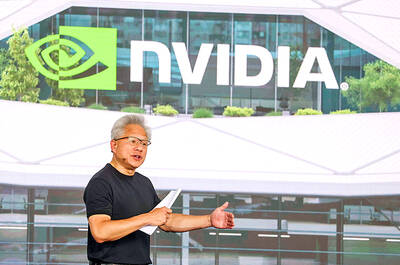
‘BOOMING’: ’ The number of partners we have here is incredible. You can see from their stock prices. They’re doing so well, they’re so happy,’ Jensen Huang said Nvidia Corp’s spending in Taiwan has ballooned to about US$150 billion a year, 10 times the US$10 billion to US$15 billion the company spent five years ago, Nvidia chief executive officer Jensen Huang (黃仁勳) said yesterday, suggesting Taiwan’s strategic importance in the global artificial intelligence (AI) supply chain. “Taiwan is the epicenter of the AI revolution. This is where the chips come, packaging comes. This is where the systems are made. This is where AI supercomputers were created,” Huang said at a meeting for the company’s employees in Beitou-Shilin Technology Park (北投士林科技園區) in Taipei, the planned site of Nvidia’s Taipei headquarters. “Taiwan


 RSS
RSS