


In the face of authoritarian challenges, resilience is key to the survival of democracy, former president Tsai Ing-wen (蔡英文) said in a keynote speech yesterday at the Berlin Freedom Conference.
Authoritarian regimes use similar methods, and now is a crucial moment for democratic countries to connect with each other and adjust their strategies, she said.
Democracies must deepen security cooperation, establish mechanisms for communication and information sharing, she said.

Photo: Screen grab from the conference's livestream
Tsai also called on like-minded countries to speak out for peace and stability in the Indo-Pacific region, adding that “clear and consistent support for Taiwan’s security is itself an effective deterrent against authoritarian expansion.”
“Today, Taiwan stands at the forefront of the democratic defense line, but tomorrow, any country could face the same challenge,” she said.
“Strengthening cooperation and enhancing defense should become a shared priority for all democratic nations. Only in this way can we ensure that security and the democratic way of life are preserved for future generations,” she said.
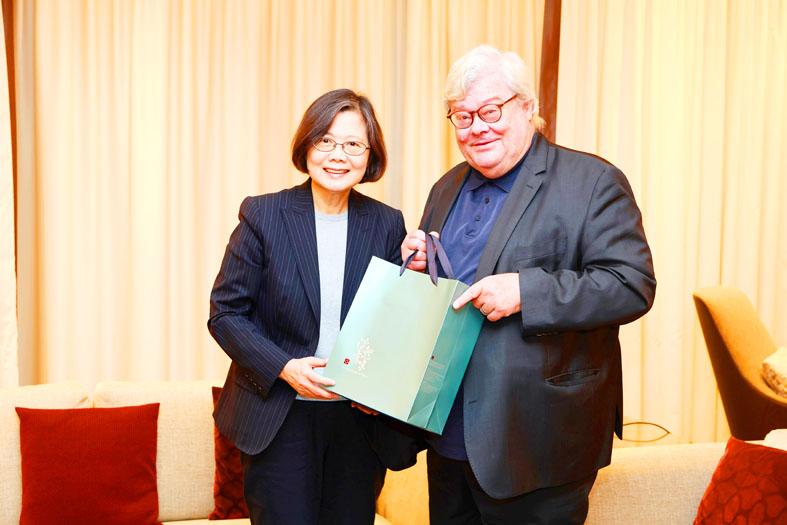
Photo courtesy of Tsai’s office via CNA
The Berlin Freedom Conference, the main event of Berlin Freedom Week, is jointly organized by the Berlin city government, the Axel Springer Freedom Foundation and the World Liberty Congress.
The forum gathers global civil society leaders, human rights advocates and experts, who deliver speeches, and engage in panel discussions on how to defend and strengthen freedom and democracy amid the resurgence of authoritarianism.
Shortly after arriving in Berlin on Sunday, Tsai met with German-Taiwan Civil Forum chair Reinhard Butikofer, formerly a chairman of the European Parliament Delegation for Relations with the People’s Republic of China.
Butikofer said they discussed economic cooperation, the development of civil society and how to jointly advocate for freedom and democracy.
They also talked about a collaboration plan involving Taiwan’s semiconductor industry investing in Dresden, Germany, he added, describing the conversation as “pleasant, open, and friendly.”
As Berlin Freedom Week is held to commemorate the fall of the Berlin Wall, Butikofer said: “It is meaningful for Taiwan’s former president to stand with us and celebrate the tradition of freedom, advocating for the continued struggle for freedom, making this commemoration even more significant.”
Speaking about Vice President Hsiao Bi-khim’s (蕭美琴) visit to Brussels to speak at the Inter-Parliamentary Alliance on China summit on Friday, he said that it was “unimaginable” just five years ago for both Tsai and Hsiao to visit Europe in the same week.
“This reflects the significant warming of Taiwan-Europe relations,” he said.
Butikofer added that he believes Taiwan is not only a key partner in the semiconductor supply chain, but also possesses valuable experience in fields such as public health, cybersecurity and combating misinformation.
European society’s perception of China is also changing, he said.
In the past, the focus was mainly on human rights issues, such as Tibet and Xinjiang, but now an increasing number of Europeans are realizing that the challenges posed by China not only involve values, but also affect Europe’s security and institutional resilience, he said.
This shift is making Europe more inclined to deepen cooperation with Taiwan and establish a “partnership based on shared values,” he said.
Since leaving office, Tsai has continued her efforts to strengthen Taiwan’s ties with Europe. In October last year, she visited the Czech Republic, France and Belgium, and in May this year, she visited Lithuania, Denmark and the UK. Germany is the latest stop in her ongoing engagement with Taiwan’s democratic partners in Europe.
Prior to her current visit, Tsai said that as a trustworthy member of the international community, Taiwan would continue to stand with Europe and other like-minded countries to demonstrate its commitment to freedom and democracy.

A signaling system malfunction disrupted high-speed rail (HSR) services beginning at 8am today, with trains temporarily reduced to three northbound and three southbound trains per hour as authorities conduct inspections. The malfunction occurred on a section of track in Miaoli County during pre-operation checks early this morning, forcing northbound and southbound trains to use a single track, the HSR operator said. The regular schedule has been replaced with three hourly trains offering only nonreserved seating in each direction, stopping at every station, it said, adding that business class cars would still have reserved seating. Departures from terminal stations are scheduled at the top
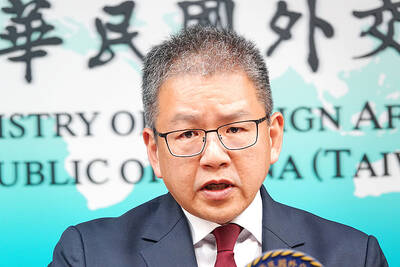
Taiwan is still in the process of assessing the possibility of recruiting workers from Eswatini, the Ministry of Foreign Affairs said yesterday, adding that its goal is to help Eswatini upgrade its vocational training centers. If there are plans to recruit workers from Eswatini, safeguarding national security, protecting public health and ensuring the employment rights of Taiwanese would be prerequisites, Department of West Asian and African Affairs Director-General Yen Chia-liang (顏嘉良) told a news conference. Key considerations would also include filling labor shortages in specific industries, and fostering bilateral professional and technical exchanges, he said. Yen was asked about the progress of labor

A US uncrewed surface vessel (USV) encountered multiple Chinese warships during an autonomous transit of the Taiwan Strait, US defense company Seasats said in a statement on Wednesday. Seasats announced that a Lightfish USV had completed the first autonomous transit of the Taiwan Strait. Over five days, the USV traversed the entire length of the Strait while constantly monitoring surface vessel traffic, the company said. The Lightfish encountered multiple Chinese warships, one of which was a Chinese People’s Liberation Army Navy (PLAN) Type 056 corvette, it said. The Chinese vessels were operating “well within Taiwan’s exclusive economic zone without transmitting their identity via the

VERBOSE VESSELS: A CGA cutter and a China Coast Guard exchanged verbal barbs for more than a day in Taiwanese-controlled waters before the Chinese vessel left The Taiwanese and Chinese coast guards had a standoff near the strategically located Pratas Islands (Dongsha Islands, 東沙群島) in the north of the South China Sea, the Coast Guard Administration (CGA) said yesterday. The two sides engaged in intense radio exchanges over sovereignty claims during the 33-hour standoff. China Coast Guard vessel 3501 eventually left the restricted waters, 26.6 nautical miles (49.2km) west of the Pratas Islands, at 5pm yesterday, the CGA said. Lying approximately between southern Taiwan and Hong Kong, the Taiwan-controlled Pratas are seen by some security experts as vulnerable to Chinese attack due to their distance — more than


 RSS
RSS