


North Korea’s defense minister on Saturday warned of more “offensive action,” after Washington and Seoul criticized Pyongyang’s latest ballistic missile launch.
North Korea’s missile launch on Friday came just over a week after US President Donald Trump — on a tour of the region — expressed interest in meeting with North Korean leader Kim Jong-un.
Pyongyang did not respond to the offer.
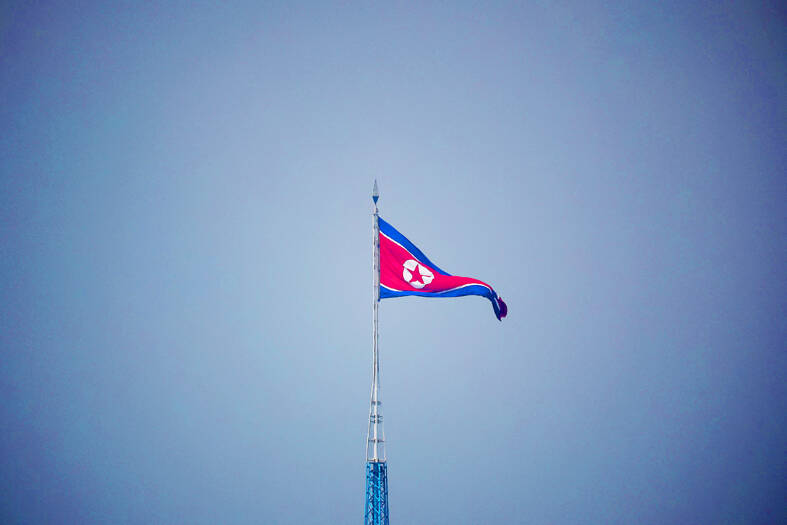
Photo: Reuters
North Korean Minister of National Defense No Kwang-chol said Washington “has become brazen in its military moves to threaten the security” of the North, and that it was “intentionally escalating the political and military tension in the region.”
“We will show more offensive action against the enemies’ threat,” he said, according to Pyongyang’s Korean Central News Agency.
Earlier in the week, before Friday’s launch, US Secretary of Defense Pete Hegseth and his South Korean counterpart visited the Demilitarized Zone (DMZ) where they “reaffirmed the strong combined defence posture and close cooperation” between their countries.
On Wednesday, the US nuclear-powered aircraft carrier USS George Washington arrived in the South Korean port city of Busan for logistics support and crew rest, according to Seoul’s navy — an act No said was “further escalating tensions on the Korean Peninsula.”
No also said Hegseth’s DMZ visit was meant to “fan up war hysterics.”
The US Indo-Pacific Command on Friday said that North Korea’s latest ballistic missile launch “highlights the destabilizing impact” of Pyongyang’s actions, adding that the US was “consulting closely with our allies and partners.”
South Korea’s military had strongly condemned Pyongyang’s missile launch.
Seoul’s military “urges North Korea to immediately cease all actions that heighten tensions between the two Koreas,” it said in a statement.
Trump last week also announced that he had approved South Korea’s plan to build a nuclear-powered submarine.

WHAT WAS ALL THAT FOR? Jaw Shaw-kong said that Cheng Li-wen had pushed for more drastic cuts and attacked him, just for the outcome to be nearly identical to his bill The legislature yesterday passed a supplementary budget bill to fund the purchase of separate packages of US military equipment, with the combined amount of spending capped at NT$780 billion (US$24.8 billion). The Chinese Nationalist Party (KMT) and Taiwan People’s Party (TPP) used their legislative majority to pass the bill, which runs until 2033 and has two main funding provisions. One was for NT$300 billion of arms sales already approved by the US for Taiwan on Dec. 17 last year, the other was for NT$480 billion for another arms package expected to be announced by Washington. The bill, which fell short of the NT$1.25

Taiwanese shares yesterday posted a record daily gain of more than 1,700 points to close above 40,000 points for the first time, led by large-cap semiconductor stocks such as Taiwan Semiconductor Manufacturing Co (TSMC, 台積電) and MediaTek Inc (聯發科) amid optimism about the artificial intelligence (AI) boom. The TAIEX ended up 1,778.51 points, or 4.57 percent, at 40,705.14 after moving between 39,228.39 and 40,755.52, while the New Taiwan dollar closed up NT$0.038 at NT$31.610 per US dollar, ending three consecutive sessions of declines. Turnover on the main board totaled NT$1.007 trillion (US$31.9 billion), with foreign institutional investors buying a net NT$66.98 billion

A former television news host and six military personnel — active and retired — have been indicted on espionage charges, Kaohsiung prosecutors said yesterday. Lin Chen-you (林宸佑), a former CTi News host and YouTuber, last year allegedly made videos at the direction of a Chinese agent criticizing the Democratic Progressive Party’s recall campaign, the Ciaotou District Prosecutors’ Office told a news conference in Kaohsiung. He allegedly received 4,325 tether coins for the videos from an unidentified person surnamed Huang (黃), believed to be an agent of a hostile foreign power, they said. Lin, also known as Ma Te (馬德), has a show named
NON-INTERFERENCE: The US called Taiwan a trusted and capable partner, while an African Union leader urged nations to reflect on respect for sovereign choices Taiwan is a “trusted and capable” partner of the US and Taipei’s global relationships, including with Eswatini, provide significant benefits, the US Department of State said of President William Lai’s (賴清德) trip to the southern African kingdom. Lai arrived in the former Swaziland on Saturday on a surprise visit after a planned trip last month was canceled when Seychelles, Mauritius and Madagascar denied overflight permission for his aircraft due to Chinese pressure. “Taiwan is a trusted and capable partner of the United States and many others, and its relationships around the world provide significant benefits to the citizens of those countries,


 RSS
RSS