

A ban on transporting and slaughtering pigs would last at least 15 days after African swine fever was detected at a Taichung hog farm, as that is the incubation period for the virus that causes the disease, Minister of Agriculture Chen Junne-jih (陳駿季) said yesterday.
The ministry would check for new cases every five days and if none are reported after the 15 days, the measures would be lifted, Chen said.
The ministry on Tuesday night confirmed a case of African swine fever on a hog farm in Taichung’s Wuci District (梧棲), after which it instituted an initial five-day ban on transporting and slaughtering pigs, and prohibited feeding pigs kitchen waste.

Photo: CNA
Chen told the legislature’s Economics Committee that deaths at the farm, which had about 300 pigs, began on Oct. 10.
Taichung City Animal Protection and Health Inspection Office personnel on Tuesday last week visited the farm due to a abnormally large number of deaths, but did not sample the pig carcasses at the time, the ministry’s report to the legislature said.
As of Monday, when the personnel returned to collect samples for inspection, 117 hogs had died at the farm, and the Veterinary Research Institute on Tuesday confirmed the presence of African swine fever, it showed.
The remaining 195 hogs at the farm were culled and buried on Wednesday to prevent the spread of the disease, while the ministry designated a 3km radius around the farm a control zone for investigation, Chen said.
The farm had on Sept. 30 acquired pigs from another facility in Taichung’s Tanzih District (潭子) and they were transported by the owner of a different pig farm, but no abnormal deaths occurred at those farms, Chen said, adding that the two farms are in the control zone.
The ministry also inspected 33 pig farms that commissioned the same vehicle as the affected farm to transport carcasses and confirmed that none of them had any abnormal deaths from Oct. 1 to Tuesday, he said.
Two hog transport vehicles that had entered the affected farm also traveled to seven pig farms, which were also listed for further inspection, Chen said.
The ministry has asked the Taiwan Frozen Meat Packers Association to release stored frozen pork to help stabilize domestic pork supply, he said.
Democratic Progressive Party Legislator Chiu Yi-ying (邱議瑩) cited the ROC Swine Association as saying that the pork industry can afford to stop slaughtering and using kitchen waste to feed pigs for up to 20 days.
Deputy Minister of Agriculture and Chief Veterinary Officer Tu Wen-jane (杜文珍) yesterday told a news conference in Taichung that all 28 slaughtered pigs from the affected farm that circulated on the market were confirmed to be safe.
The city government would inspect all pig farms in Taichung within the next three days, she said.
Leftovers stored at pig farms would be buried or processed into compost with assistance from the Ministry of Environment, Tu said.
African swine fever cannot be transmitted to humans and the ban aims to protect the health of the livestock, she said.
The ministry has no plans to permanently ban feeding pigs with kitchen waste, as there is still no confirmation as to the cause of the outbreak, Deputy Minister of Agriculture Hu Jong-i (胡中一) told reporters after a weekly Cabinet meeting.
Viruses in the kitchen waste would be killed when it is steamed at 90°C or higher for an hour before being fed to the hogs, Hu said, adding that the approach is used in many places such as the US, Japan, South Korea and the EU.
Taiwan produces about 2,115 tonnes of kitchen waste per day, 1,385 tonnes of which are from households and 731 tonnes from commercial sources, Environmental Management Administration official Wei Wen-yi (魏文宜) said.
While the processing capacity for household food waste is sufficient, leftovers from commercial sources are primarily processed into compost or energy, with excess amounts buried, she said.
Additional reporting by CNA
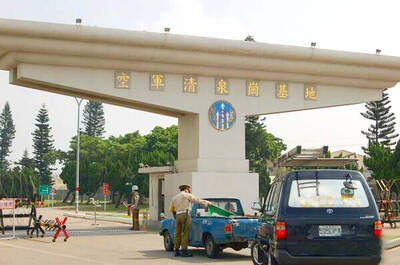
An unauthorized drone intrusion over Ching Chuan Kang Air Base (清泉崗基地) at Taichung International Airport on Tuesday night forced the temporary closure of the base, diverting eight fighter jets and delaying a commercial flight, authorities said. Air Force Command Headquarters said that clear weather had allowed for scheduled night training exercises, but after a drone was spotted entering the airspace, the control tower declared an emergency closure of the airport, forcing eight Indigenous Defense Fighter jets in the air to divert and land at Hsinchu Air Base (新竹基地). Taichung airport director Chang Jui-shu (張瑞澍) said the airspace intrusion lasted from 7:37pm to
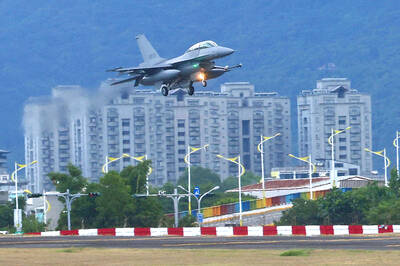
The air force plans to build 26 more hardened aircraft shelters as the number of F-16Vs stationed along Taiwan’s east coast is expected to reach 120 when the final shipment of 66 jets procured from the US arrives. The incoming jets would be stationed at Chihhang Air Base in Taitung County, augmenting the F-16V Block 20s operated by the 5th Tactical Fighter Wing in Hualien County, officials said yesterday. The air force plans to allocate more than NT$6.88 billion (US$218.1 million) from next year to 2031 to build the shelters in Hualien and Taitung as part of the implementation of a “one

Indonesian rescuers searched for eight people who went missing at sea while heading to a volcanic island to report on an eruption there, officials said yesterday. Anak Krakatau initially erupted for about 25 hours over the weekend, and it has since continued to erupt intermittently with explosions ejecting lava, ash and incandescent volcanic material from the crater, the Indonesian Geology Agency said in a statement. A speedboat carrying five photojournalists, two crew members and a route guide lost contact after leaving Carita, a coastal town in Banten Province, for the volcanic island, Banten Province Search and Rescue Office Chief Al Amrad said. He

NO LIMITS: More legislation expanding Beijing’s control over the movement of people, money and information raises risks for Taiwanese travelers and businesses, officials said China is set to implement several laws in the coming months that expand the definition of national security, creating greater risks for Taiwanese traveling to or doing business in China, Taiwanese officials said yesterday. Beijing’s Ethnic Unity and Progress Promotion Law took effect on July 1, while a draft “Internet Information Service Management Measures” finished its public consultation on Aug. 2, but has yet to be adopted. China’s Regulations of the State Council on Exit and Entry Administration are to take effect on Tuesday next week, while amendments to its National Defense Mobilization Law and the Ministry of Public Security’s Measures


 RSS
RSS