


Taipei is in close contact with Washington to make sure its interests are protected ahead of a meeting between US President Donald Trump and Chinese President Xi Jinping (習近平), who are expected to also discuss Taiwan, a Ministry of Foreign Affairs (MOFA) official said yesterday.
Taiwan always keeps close tabs on high-level exchanges between Washington and Beijing, North American Affairs Department Director-General Wang Liang-yu (王良玉) said.
Taipei also maintains “a smooth communication channel” with Washington at all times, and would keep a close eye on the latest high-level talks between the US and China, Wang told a news briefing.
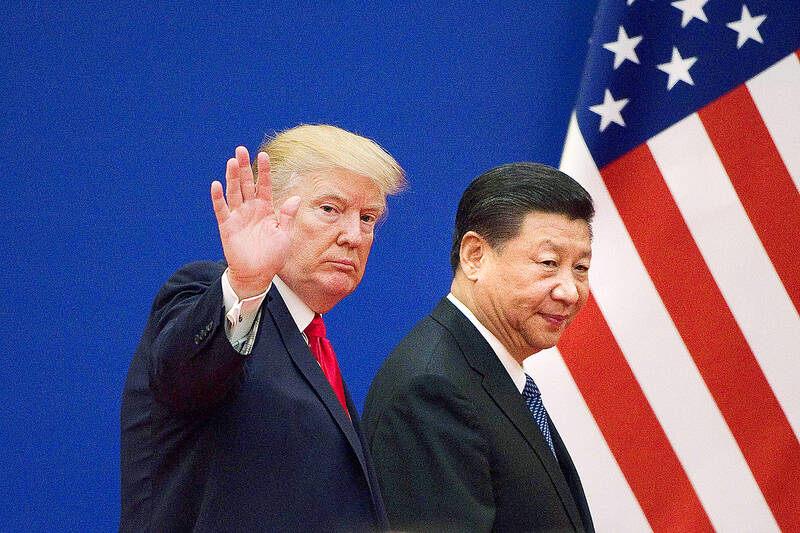
Photo: AFP
“We will make sure that the bilateral relations between Taiwan and the US continue to deepen steadily and that Taiwan’s interests are protected,” she said when asked about the US president’s earlier statement that Taiwan would be on the agenda of his upcoming meeting with Xi.
Speaking to reporters aboard Air Force One on Sunday, Trump said “rare earths, fentanyl, soybeans and Taiwan” are some of the divisive topics that are to be discussed when he meets with Xi next week at the APEC summit in South Korea, Bloomberg reported.
Before meeting with Australian Prime Minister Anthony Albanese in the White House on Monday, Trump told reporters that he expects to reach a trade deal with Xi soon, and he downplayed the risks of the two superpowers clashing over Taiwan.
Asked about an earlier Pentagon assessment that Xi could attempt to seize Taiwan in the next six years, Trump said he doubts that China would invade Taiwan.
“I think we’ll be just fine with China. China doesn’t want to do that,” Trump told reporters.
However, Taiwan is probably a key issue for Xi, he said.
“Now that doesn’t mean it’s not the apple of his eye, because probably it is, but I don’t see anything happening,” Trump said.
Without explicitly pledging to defend Taiwan in case of a Chinese invasion, Trump said China knows that the US “is the strongest military power in the world by far.”
“We have the best of everything, and nobody’s going to mess with that. And I don’t see that at all with President Xi,” Trump said. “I think we’re going to get along very well as it pertains to Taiwan and others.”
Since taking office in January, Trump has not made any clear statements on the protection of Taiwan in the event of an invasion by China.
The US’ long-standing position on the issue has been one of “strategic ambiguity,” which is aimed at deterring Beijing from an attempted invasion without committing to involvement in such a war.
However, former US president Joe Biden had said publicly on several occasions that the US would defend Taiwan if China attacked.
Each time, Biden administration officials later walked back his statements, signaling that the US policy on Taiwan had not changed.
Additional reporting by Reuters
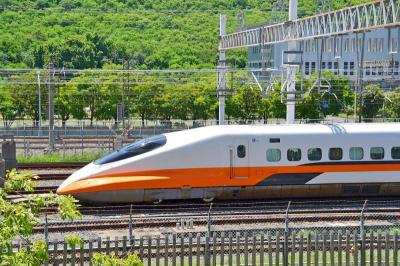
A signaling system malfunction disrupted high-speed rail (HSR) services beginning at 8am today, with trains temporarily reduced to three northbound and three southbound trains per hour as authorities conduct inspections. The malfunction occurred on a section of track in Miaoli County during pre-operation checks early this morning, forcing northbound and southbound trains to use a single track, the HSR operator said. The regular schedule has been replaced with three hourly trains offering only nonreserved seating in each direction, stopping at every station, it said, adding that business class cars would still have reserved seating. Departures from terminal stations are scheduled at the top
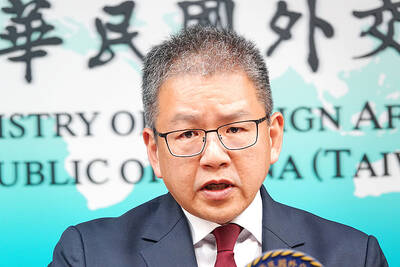
Taiwan is still in the process of assessing the possibility of recruiting workers from Eswatini, the Ministry of Foreign Affairs said yesterday, adding that its goal is to help Eswatini upgrade its vocational training centers. If there are plans to recruit workers from Eswatini, safeguarding national security, protecting public health and ensuring the employment rights of Taiwanese would be prerequisites, Department of West Asian and African Affairs Director-General Yen Chia-liang (顏嘉良) told a news conference. Key considerations would also include filling labor shortages in specific industries, and fostering bilateral professional and technical exchanges, he said. Yen was asked about the progress of labor
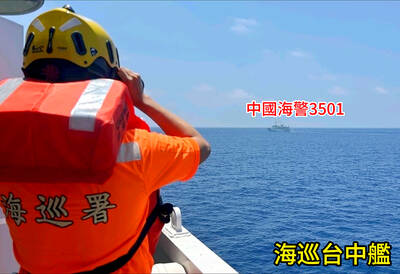
VERBOSE VESSELS: A CGA cutter and a China Coast Guard exchanged verbal barbs for more than a day in Taiwanese-controlled waters before the Chinese vessel left The Taiwanese and Chinese coast guards had a standoff near the strategically located Pratas Islands (Dongsha Islands, 東沙群島) in the north of the South China Sea, the Coast Guard Administration (CGA) said yesterday. The two sides engaged in intense radio exchanges over sovereignty claims during the 33-hour standoff. China Coast Guard vessel 3501 eventually left the restricted waters, 26.6 nautical miles (49.2km) west of the Pratas Islands, at 5pm yesterday, the CGA said. Lying approximately between southern Taiwan and Hong Kong, the Taiwan-controlled Pratas are seen by some security experts as vulnerable to Chinese attack due to their distance — more than

A US uncrewed surface vessel (USV) encountered multiple Chinese warships during an autonomous transit of the Taiwan Strait, US defense company Seasats said in a statement on Wednesday. Seasats announced that a Lightfish USV had completed the first autonomous transit of the Taiwan Strait. Over five days, the USV traversed the entire length of the Strait while constantly monitoring surface vessel traffic, the company said. The Lightfish encountered multiple Chinese warships, one of which was a Chinese People’s Liberation Army Navy (PLAN) Type 056 corvette, it said. The Chinese vessels were operating “well within Taiwan’s exclusive economic zone without transmitting their identity via the


 RSS
RSS