


US President Donald Trump on Monday hailed a “tremendous day for the Middle East,” as he and regional leaders signed a declaration meant to cement a ceasefire in Gaza, hours after Israel and Hamas exchanged hostages and prisoners.
Trump made a lightning visit to Israel, where he lauded Israeli Prime Minister Benjamin Netanyahu in an address to parliament, before flying to Egypt for a Gaza summit, where he and the leaders of Egypt, Qatar and Turkey signed the declaration as guarantors to the ceasefire deal.
“This is a tremendous day for the world, it’s a tremendous day for the Middle East,” Trump said as more than two dozen world leaders sat down to talk in the resort of Sharm el-Sheikh.
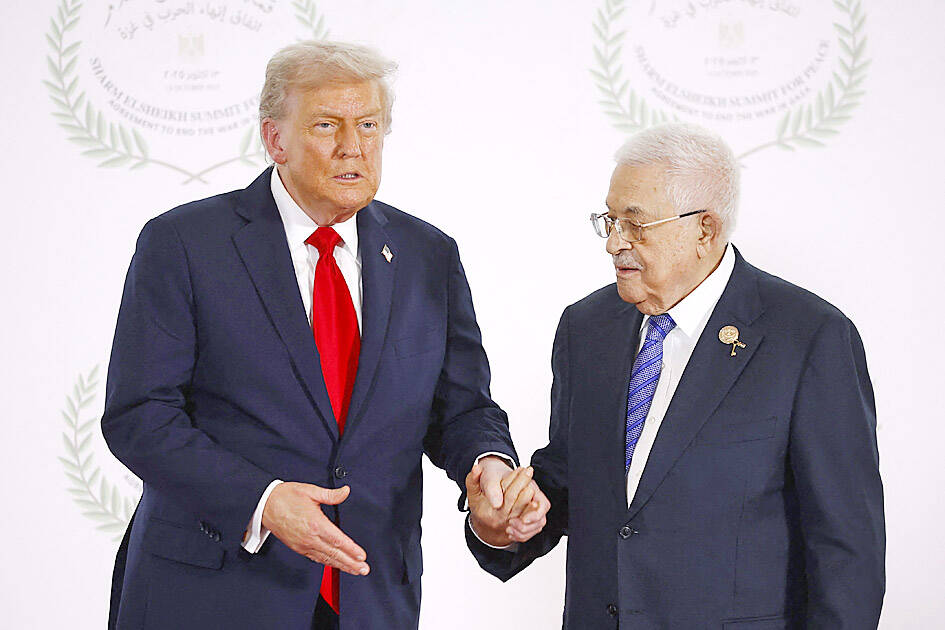
Photo: AFP
He later declared that the assembled leaders had “achieved what everybody said was impossible.”
“At long last, we have peace in the Middle East,” Trump said in a speech.
According to the declaration, the signatories pledged to “pursue a comprehensive vision of peace, security and shared prosperity in the region,” and also welcomed “the progress achieved in establishing comprehensive and durable peace arrangements in the Gaza Strip.”
However the statement, released on Monday night by the White House, was vague about the path ahead for peace between Israel and its neighbors, including the Palestinians, making no mention of a one or two-state solution.
“We’re talking about rebuilding Gaza. I’m not talking about single state or double state or two state,” Trump told reporters en route back to the White House.
Egyptian President Abdel Fattah al-Sisi said the Gaza deal “closes a painful chapter in human history” and sets the stage for a two-state solution.
As part of Trump’s plan to end the Gaza war, Hamas on Monday freed the last 20 surviving hostages it held after two years of captivity in Gaza.
In exchange, Israel released 1,968 mostly Palestinian prisoners held in its jails, its prison service said.
“For so many families across this land, it has been years since you’ve known a single day of true peace,” Trump told Israel’s parliament, where he received a standing ovation.
None of the hostages spoke directly immediately after their return, but videos filmed and released by the Israeli military captured some of the raw emotion of the reunions.
“My life, you are my life ... you are a hero,” cried Einav Zangauker as she embraced her smiling son Matan in one video.
Under the ceasefire agreement, Hamas is also due to return the bodies of 27 hostages who died or were killed in captivity, as well as the remains of a soldier killed in 2014 during a previous Gaza conflict.
In Gaza, the ceasefire has brought relief, but with the territory racked by a humanitarian crisis and much of it flattened by war, the road to recovery remains long.
“The greatest joy is seeing my whole family gathered to welcome me,” Yusef Afana, a 25-year-old released prisoner from north Gaza, said in Khan Yunis. “I spent 10 months in prison — some of the hardest days I’ve ever lived.”
In Ramallah, Palestinian prisoners released by Israel were met by a cheering crowd so dense that they struggled to get off the bus.
“It’s an indescribable feeling, a new birth,” newly released Mahdi Ramadan said flanked by his parents.

SILENCING CRITICS: In addition to blocking Taiwan, China aimed to prevent rights activists from speaking out against authoritarian states, a Cabinet department said The Ministry of Foreign Affairs (MOFA) yesterday condemned transnational repression by Beijing after RightsCon, a major digital human rights conference scheduled to be held in Zambia this week, was abruptly canceled due to Chinese pressure over Taiwanese participation. This year’s RightsCon, the world’s largest conference discussing issues “at the intersection of human rights and technology,” was scheduled to take place from tomorrow to Friday in Lusaka, and expected to draw 2,600 in-person attendees from 150 countries, along with 1,100 online participants. However, organizers were forced to cancel the event due to behind-the-scenes pressure from China, the ministry said, expressing its “strongest condemnation”
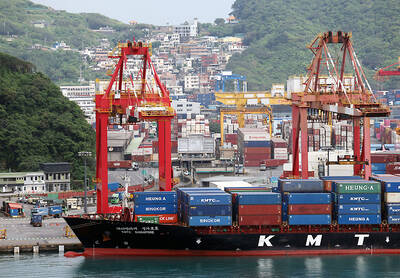
Taiwan’s economy grew far faster than expected in the first quarter, as booming demand for artificial intelligence (AI) applications drove a surge in exports, spilling over into investment and consumption, the Directorate-General of Budget, Accounting and Statistics (DGBAS) said yesterday. GDP growth was 13.69 percent year-on-year during the January-to-March period, beating the DGBAS’ February forecast by 2.23 percentage points and marking the most robust growth in nearly four decades, DGBAS senior official Chiang Hsin-yi (江心怡) told a news conference in Taipei. The result was powered by exports, which remain the backbone of Taiwan’s economy, Chiang said. Outbound shipments jumped 51.12 percent year-on-year to
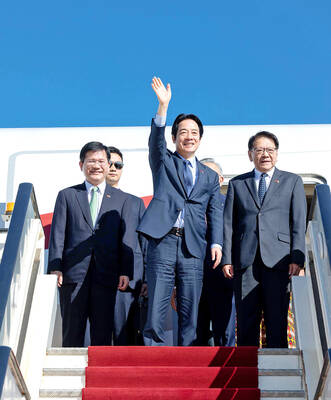
DELAYED BUT DETERMINED: The president’s visit highlights Taiwan’s right to international engagement amid regional pressure from China President Willaim Lai (賴清德) yesterday arrived in Eswatini, more than a week after his planned visit to Taiwan’s sole African ally was suspended because of revoked overflight permits. “The visit, originally scheduled for April 22, was postponed due to unforeseen external factors,” Lai wrote on social media. “After several days of careful arrangements by our diplomatic and national security teams, we successfully arrived today.” Lai said he looked forward to further deepening Taiwan-Eswatini relations through closer cooperation in the economy, agriculture, culture and education, as well as advancing the nation’s international partnerships. The president was initially scheduled to arrive in time to celebrate
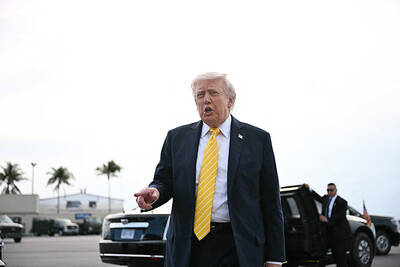
Iran’s Islamic Revolutionary Guard Corp (IRGC) yesterday said the US faced a choice between an “impossible” military operation or a “bad deal” with Tehran, after US President Donald Trump disparaged Iran’s latest peace proposal. Negotiations between the two countries have been deadlocked since a ceasefire came into effect on April 8, with only one round of direct peace talks held so far. Iran’s Tasnim and Fars news agencies reported that Tehran had submitted a 14-point proposal to mediator Pakistan, but Trump was quick to cast doubt on it. “I will soon be reviewing the plan that Iran has just sent to us, but


 RSS
RSS