


Enhancing bilateral cooperation is crucial for Taiwan and Paraguay to address the threat of authoritarian expansionism amid rapid global change, President William Lai (賴清德) said yesterday at an event welcoming a delegation of lawmakers headed by Paraguayan Chamber of Deputies President Raul Latorre.
Working together, Taiwan and Paraguay can overcome the challenges of a new era, defend freedom and democracy, and make greater contributions to global peace and prosperity, Lai told the meeting at the Presidential Office in Taipei.
He thanked the delegation for visiting Taiwan to attend tomorrow’s Double Ten National Day events, calling it an act of goodwill and friendship.
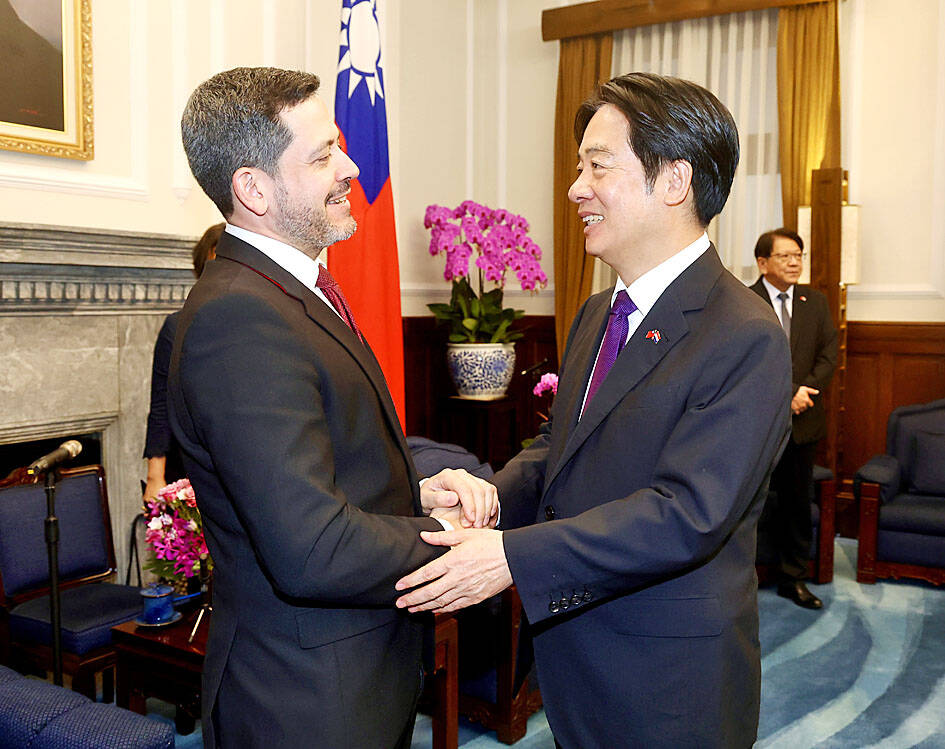
Photo: CNA
Lai in 2023 attended Paraguayan President Santiago Pena’s inauguration ceremony as the then-vice president, sharing a table with Paraguayan Chamber of Deputies Foreign Affairs Committee Chairman Juan Manuel Anazco at a state banquet, he said.
Latorre has been a good friend of Taiwan, voicing support for the nation at numerous international events, and attending Lai and Vice President Hsiao Bi-khim’s (蕭美琴) inauguration last year, he said.
Pena earlier this year supported Taiwan’s participation in the UN and other international organizations at the General Debate of the UN General Assembly, while the Paraguayan legislature on multiple occasions backed the nation’s bid to meaningfully participate in global bodies, Lai said.
Taiwan was moved by Pena’s comments at the UN, urging world leaders to admit Taiwan as a full member and calling the nation’s participation a matter of justice, he said.
Latorre said that Paraguay stands firmly beside Taiwan and that Asuncion is committed to deepening the bonds of brotherhood between the two nations.
A total of 204 foreign dignitaries are to take part in tomorrow’s National Day celebrations, including delegations from diplomatic allies Belize, led by Belizean Governor-General Dame Froyla Tzalam, and Saint Lucia, led by Saint Lucian Governor-General Sir Cyril Charles, as well as Paraguay, the Ministry of Foreign Affairs said in a statement.
The guests include 120 members of visiting foreign delegations and 74 foreign representatives currently stationed in Taiwan, along with their spouses, it said.
Fifty-five of the visiting delegates are from the Asia-Pacific region, 26 are from Latin America and the Caribbean, and 17 are from Europe. The group also includes 16 foreign journalists and six representatives from the Central American Bank for Economic Integration, of which Taiwan has been a non-regional member since 1992.
A Swedish parliamentary delegation, a delegation of local Japanese political leaders and a group of participants in the European Valued Important Partnership program are also to join the celebrations, the ministry said.

A signaling system malfunction disrupted high-speed rail (HSR) services beginning at 8am today, with trains temporarily reduced to three northbound and three southbound trains per hour as authorities conduct inspections. The malfunction occurred on a section of track in Miaoli County during pre-operation checks early this morning, forcing northbound and southbound trains to use a single track, the HSR operator said. The regular schedule has been replaced with three hourly trains offering only nonreserved seating in each direction, stopping at every station, it said, adding that business class cars would still have reserved seating. Departures from terminal stations are scheduled at the top

Taiwan is still in the process of assessing the possibility of recruiting workers from Eswatini, the Ministry of Foreign Affairs said yesterday, adding that its goal is to help Eswatini upgrade its vocational training centers. If there are plans to recruit workers from Eswatini, safeguarding national security, protecting public health and ensuring the employment rights of Taiwanese would be prerequisites, Department of West Asian and African Affairs Director-General Yen Chia-liang (顏嘉良) told a news conference. Key considerations would also include filling labor shortages in specific industries, and fostering bilateral professional and technical exchanges, he said. Yen was asked about the progress of labor

A US uncrewed surface vessel (USV) encountered multiple Chinese warships during an autonomous transit of the Taiwan Strait, US defense company Seasats said in a statement on Wednesday. Seasats announced that a Lightfish USV had completed the first autonomous transit of the Taiwan Strait. Over five days, the USV traversed the entire length of the Strait while constantly monitoring surface vessel traffic, the company said. The Lightfish encountered multiple Chinese warships, one of which was a Chinese People’s Liberation Army Navy (PLAN) Type 056 corvette, it said. The Chinese vessels were operating “well within Taiwan’s exclusive economic zone without transmitting their identity via the

VERBOSE VESSELS: A CGA cutter and a China Coast Guard exchanged verbal barbs for more than a day in Taiwanese-controlled waters before the Chinese vessel left The Taiwanese and Chinese coast guards had a standoff near the strategically located Pratas Islands (Dongsha Islands, 東沙群島) in the north of the South China Sea, the Coast Guard Administration (CGA) said yesterday. The two sides engaged in intense radio exchanges over sovereignty claims during the 33-hour standoff. China Coast Guard vessel 3501 eventually left the restricted waters, 26.6 nautical miles (49.2km) west of the Pratas Islands, at 5pm yesterday, the CGA said. Lying approximately between southern Taiwan and Hong Kong, the Taiwan-controlled Pratas are seen by some security experts as vulnerable to Chinese attack due to their distance — more than


 RSS
RSS