


Cleanup work in Hualien County’s Guangfu Township (光復) following flooding has made significant progress, the Central Emergency Operations Center (CEOC) said.
The flooding was triggered by heavy rainfall brought by Super Typhoon Ragasa that caused a barrier lake in the Mataian River (馬太鞍溪) to burst on Sept. 23.
In a briefing made during President William Lai’s (賴清德) inspection yesterday, the center said that 98 percent of roads were expected to be cleared yesterday, and four schools were preparing to reopen tomorrow.
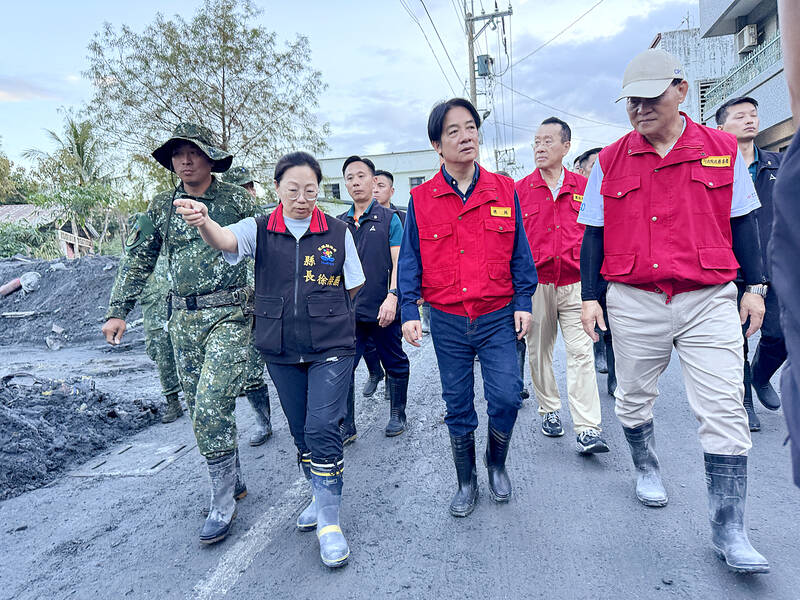
Photo: CNA
CEOC chief coordinator Chi Lien-cheng (季連成) said that of the 89 households which had been unable to remove sediment after the disaster, 49 have completed cleanup work.
Ninety-five percent of the major roads in Guangfu were cleared as of Saturday and the figure was expected to reach 98 percent yesterday, he said.
National Kuangfu Commercial and Industrial Vocational High School has been cleaned, with power and water fully restored, while remaining debris was scheduled to be removed yesterday, he added.
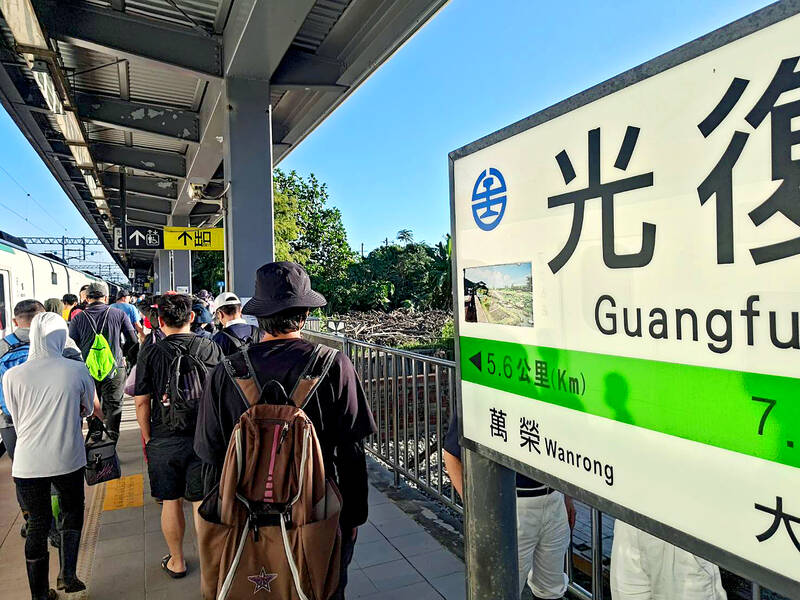
Photo: Wang Jung-hsiang,Taipei Times
The vocational high school would hold online classes beginning tomorrow and resume in-person classes on Oct. 13, Chi said.
Two elementary schools and a junior-high school in the township would also resume in-person classes tomorrow, he said.
Taiwan Water Corp (Taiwater, 台灣自來水) said that 33 water supply stations have been set up and 16 water trucks have been deployed, delivering 3,427 tonnes of water in 731 trips as of 8am yesterday to support residents in cleaning their homes.
Taiwater said 200 repair cases within its scope of responsibility have mostly been completed, with nine still under way.
The company said that 36 out of 120 additional cases involving household internal leaks have been fixed, after they were referred to volunteer electricians and plumbers.
Taiwater and Taiwan Power Co (台電) have formed a joint task force to assess residents’ water and electricity repair needs, and coordinate with the Executive Yuan’s Eastern Taiwan Joint Services Center to integrate volunteer efforts, Taiwater said.
It also said it would continue to assess the water needs of shelters, schools and homes to help people in the disaster area return to normal life as soon as possible.
During Lai’s visit to the center, he received reports on disaster relief and rescue efforts as well as follow-up plans.
During the briefing, Hualien County Commissioner Hsu Chen-wei (徐榛蔚) used large-scale aerial photos to show areas where serious accumulation of sediment still needed to be addressed.
Chinese Nationalist Party (KMT) caucus whip Fu Kun-chi (傅崐萁) said that heavy rains or a typhoon could send more sediment into Guangfu, suggesting that Lai consider relocating the township.
Lai said he is pleased that the rescue and relief efforts are proceeding according to schedule, and expressed gratitude to volunteers from across the nation for assisting in cleanup efforts.
If the barrier lake cannot be fixed in the short-term, four measures need to be taken, he said.
First, authorities should check whether the river’s surface and flow are smooth, and monitor the water level, he said.
Second, temporary embankments should be constructed, he said.
Third, the riverbed should be dredged, and fourth, an evacuation plan should be prepared, he added.
Only by implementing these four measures can the barrier lake alert level be reduced from red to orange — and even lower — so that residents no longer have to worry, he said.
Rescue agencies need to continue doing their utmost to locate those still missing, the president said.
Lai announced an additional NT$200,000 (US$6,200) per household in subsidies for home repairs in flood-hit areas of Hualien.
Lai said the new subsidy would supplement existing government assistance, which includes NT$1 million for each fatality or missing person, NT$250,000 for those seriously injured, NT$100,000 per household in condolence payments, and NT$50,000 for cleanup work.

A signaling system malfunction disrupted high-speed rail (HSR) services beginning at 8am today, with trains temporarily reduced to three northbound and three southbound trains per hour as authorities conduct inspections. The malfunction occurred on a section of track in Miaoli County during pre-operation checks early this morning, forcing northbound and southbound trains to use a single track, the HSR operator said. The regular schedule has been replaced with three hourly trains offering only nonreserved seating in each direction, stopping at every station, it said, adding that business class cars would still have reserved seating. Departures from terminal stations are scheduled at the top

Taiwan is still in the process of assessing the possibility of recruiting workers from Eswatini, the Ministry of Foreign Affairs said yesterday, adding that its goal is to help Eswatini upgrade its vocational training centers. If there are plans to recruit workers from Eswatini, safeguarding national security, protecting public health and ensuring the employment rights of Taiwanese would be prerequisites, Department of West Asian and African Affairs Director-General Yen Chia-liang (顏嘉良) told a news conference. Key considerations would also include filling labor shortages in specific industries, and fostering bilateral professional and technical exchanges, he said. Yen was asked about the progress of labor

VERBOSE VESSELS: A CGA cutter and a China Coast Guard exchanged verbal barbs for more than a day in Taiwanese-controlled waters before the Chinese vessel left The Taiwanese and Chinese coast guards had a standoff near the strategically located Pratas Islands (Dongsha Islands, 東沙群島) in the north of the South China Sea, the Coast Guard Administration (CGA) said yesterday. The two sides engaged in intense radio exchanges over sovereignty claims during the 33-hour standoff. China Coast Guard vessel 3501 eventually left the restricted waters, 26.6 nautical miles (49.2km) west of the Pratas Islands, at 5pm yesterday, the CGA said. Lying approximately between southern Taiwan and Hong Kong, the Taiwan-controlled Pratas are seen by some security experts as vulnerable to Chinese attack due to their distance — more than

A US uncrewed surface vessel (USV) encountered multiple Chinese warships during an autonomous transit of the Taiwan Strait, US defense company Seasats said in a statement on Wednesday. Seasats announced that a Lightfish USV had completed the first autonomous transit of the Taiwan Strait. Over five days, the USV traversed the entire length of the Strait while constantly monitoring surface vessel traffic, the company said. The Lightfish encountered multiple Chinese warships, one of which was a Chinese People’s Liberation Army Navy (PLAN) Type 056 corvette, it said. The Chinese vessels were operating “well within Taiwan’s exclusive economic zone without transmitting their identity via the


 RSS
RSS