


Conservative Sanae Takaichi yesterday hailed a “new era” after becoming head of Japan’s ruling party, putting her on course to become the country’s first female prime minister.
The 64-year-old, whose hero is former British prime minister Margaret Thatcher, said that a “mountain of work” lay ahead to restore the fortunes of her ailing Liberal Democratic Party (LDP).
The LDP has governed Japan almost uninterrupted for decades, but it has been hemorrhaging support as backing grows for smaller parties, including the anti-immigration Sanseito.
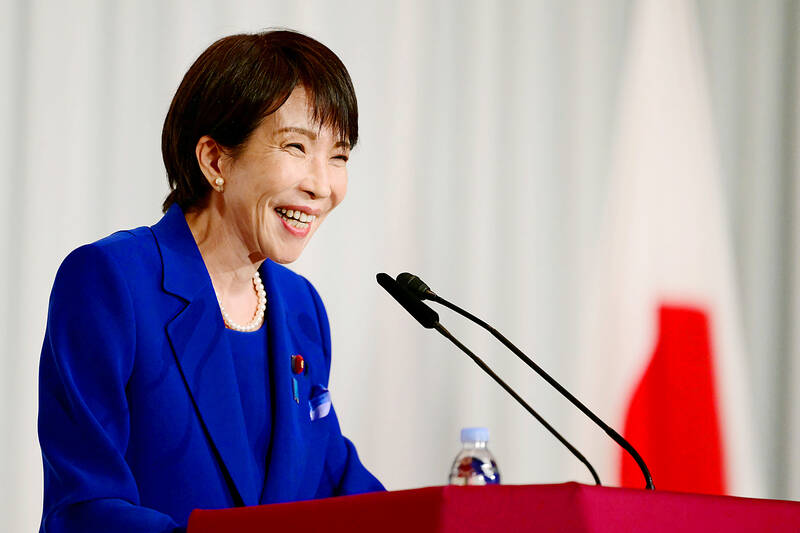
Photo: EPA
Takaichi, a heavy metal drummer as a student, would almost certainly be approved by the Japanese Diet later this month as Japan’s prime minister.
She is to face a host of complex issues including an aging population, geopolitical upheaval, a faltering economy and growing unease about immigration.
“Together with so many of you, we have carved a new era for the LDP,” Takaichi said at the party headquarters after winning a runoff vote against the telegenic and more socially progressive Japanese Minister of Agriculture, Forestry and Fisheries Shinjiro Koizumi.
“We must all pull together across all generations and work as one to rebuild [the LDP]... Everyone will have to work like a horse,” she said.
Koizumi, 44, would have been Japan’s youngest prime minister in the modern era and represented a generational change for the LDP.
One of Takaichi’s first official duties as prime minister would be receiving US President Donald Trump, who is reportedly set to make a stopover in Japan late this month.
Takaichi said yesterday that she had no plans to overturn Tokyo’s recent trade deal — over which questions remain — with Washington.
Takaichi has been a strident critic of China’s military buildup, and as a regular visitor to the Yasukuni Shrine, her appointment might irk Beijing and Seoul.
The Chinese Ministry of Foreign Affairs reacted to her win by saying that “it is hoped that Japan will abide by ... its political commitments on major issues such as history and Taiwan, [and] pursue a positive and rational policy toward China.”
However, primarily for LDP members, Takaichi’s task would be to restore the fortunes of the party, which has governed almost non-stop since 1955.
Outgoing Japanese Prime Minister Shigeru Ishiba took the reins last year, but his LDP-led coalition lost its majority in both houses of parliament, in part because of voter anger at inflation and an LDP slush fund scandal.
One party on the up is Sanseito, which echoes other populist movements in calling immigration a “silent invasion” and blames newcomers for a host of ills.
Japan should “reconsider policies that allow in people with completely different cultures and backgrounds,” Takaichi said during the LDP campaign.
People born abroad make up just 3 percent of the population, and Japan, with an aging population, is in dire need of foreign workers.
On the economy, Takaichi has in the past backed aggressive monetary easing and big fiscal spending, echoing her mentor, late Japanese prime minister Shinzo Abe.
Coming from the traditionalist wing of the LDP, celebrations that finally a woman is leading Japan might soon turn to disappointment.
Takaichi “has no interest in women’s rights or gender equality policies,” Tokai University academic Yuki Tsuji said.

The Legislative Yuan’s Finance Committee yesterday approved proposed amendments to the Amusement Tax Act (娛樂稅法) that would abolish taxes on films, cultural activities and competitive sporting events, retaining the fee only for dance halls and golf courses. The proposed changes would set the maximum tax rate for dance halls and golf courses at 50 and 20 percent respectively, with local governments authorized to suspend the levies. Article 2 of the act says that “amusement tax shall be levied on tickets sold or fees charged by amusement places, facilities or activities” in six categories: “Cinema; professional singing, story-telling, dancing, circus, magic show, acrobatics

Tainan, Taipei and New Taipei City recorded the highest fines nationwide for illegal accommodations in the first quarter of this year, with fines issued in the three cities each exceeding NT$7 million (US$220,639), Tourism Administration data showed. Among them, Taipei had the highest number of illegal short-term rental units, with 410. There were 3,280 legally registered hotels nationwide in the first quarter, down by 14 properties, or 0.43 percent, from a year earlier, likely indicating operators exiting the market, the agency said. However, the number of unregistered properties rose to 1,174, including 314 illegal hotels and 860 illegal short-term rental

INFLATION UP? The IMF said CPI would increase to 1.5 percent this year, while the DGBAS projected it would rise to 1.68 percent, with GDP per capita of US$44,181 The IMF projected Taiwan’s real GDP would grow 5.2 percent this year, up from its 2.1 percent outlook in January, despite fears of global economic disruptions sparked by the US-Iran conflict. Taiwan’s consumer price index (CPI) is projected to increase to 1.5 percent, while unemployment would be 3.4 percent, roughly in line with estimates for Asia as a whole, the international body wrote in its Global Economic Outlook Report published in the US on Monday. The figures are comparatively better than the IMF outlook for the rest of the world, which pegged real GDP growth at 3.1 percent, down from 3.3 percent
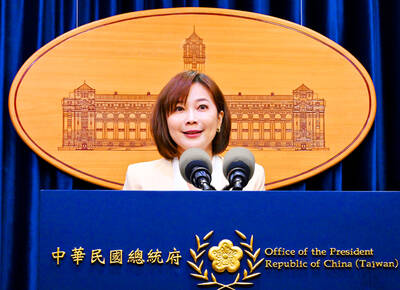
ECONOMIC COERCION: Such actions are often inconsistently applied, sometimes resumed, and sometimes just halted, the Presidential Office spokeswoman said The government backs healthy and orderly cross-strait exchanges, but such arrangements should not be made with political conditions attached and never be used as leverage for political maneuvering or partisan agendas, Presidential Office spokeswoman Karen Kuo (郭雅慧) said yesterday. Kuo made the remarks after China earlier in the day announced 10 new “incentive measures” for Taiwan, following a landmark meeting between Chinese President Xi Jinping (習近平) and Chinese Nationalist Party (KMT) Chairwoman Cheng Li-wun (鄭麗文) in Beijing on Friday. The measures, unveiled by China’s Xinhua news agency, include plans to resume individual travel by residents of Shanghai and China’s Fujian


 RSS
RSS